
I’ve seen this pattern enough times that it doesn’t even feel surprising anymore. A game launches with a “new economy,” things ramp up fast, rewards flow, activity looks strong… and then slowly it fades. Not a crash, just a steady erosion. Rewards shrink, players drift away, tokens start feeling like pressure instead of upside.
It’s not really about one game. It’s about how incentives are built.
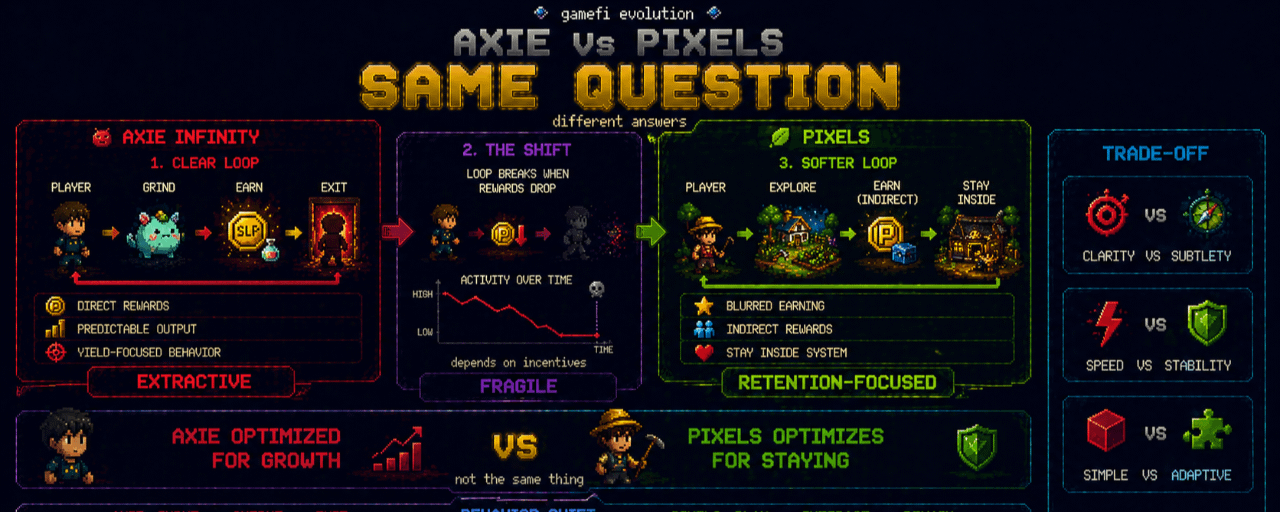
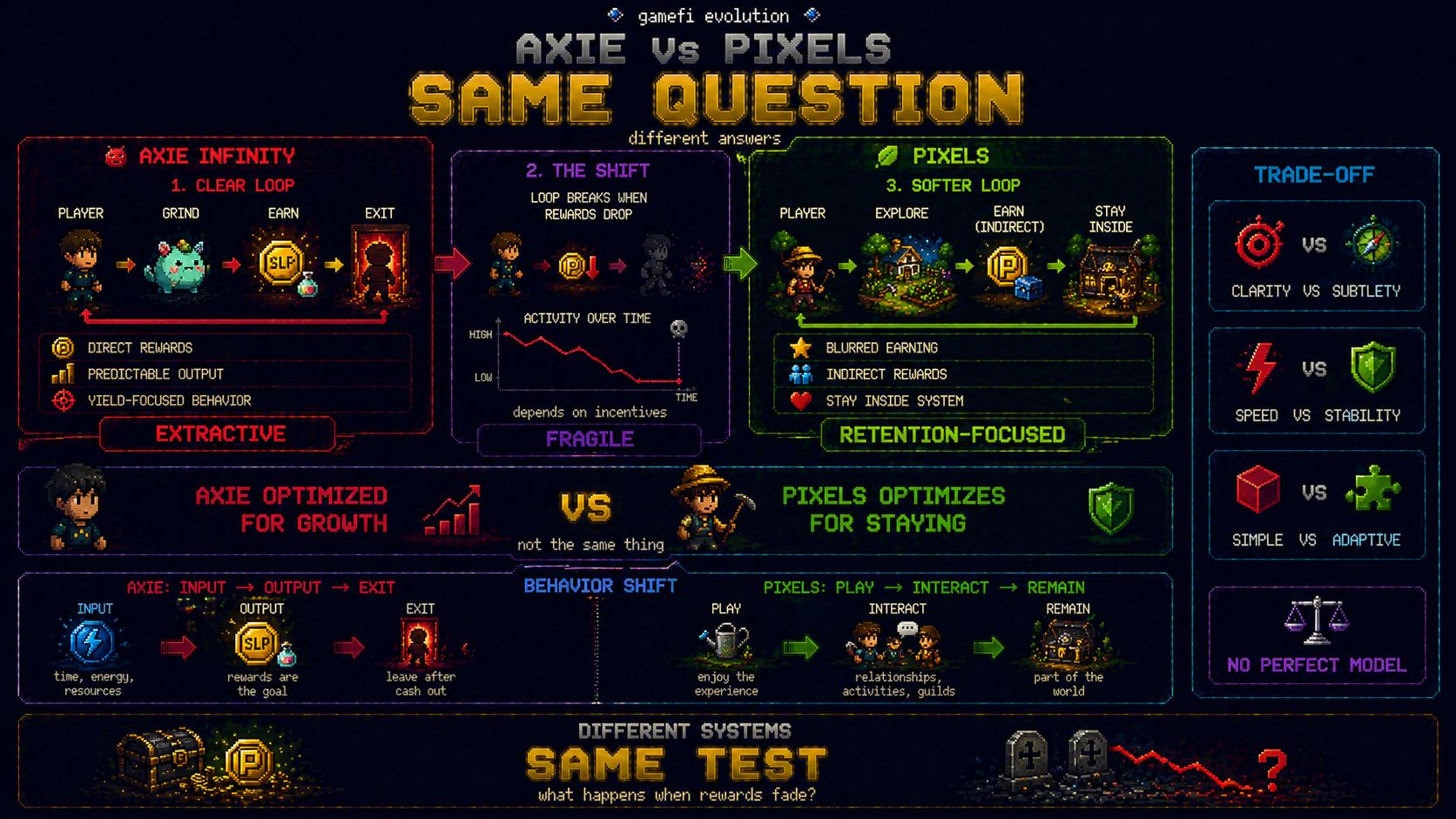
If I look back at Axie Infinity, it wasn’t “wrong.” In fact, it was almost too correct in how it executed the old logic. Pay people, get activity. Scale that loop, and you get growth. For a while, it worked incredibly well. But the moment new money slowed down, the system exposed itself. Players weren’t there for the game, they were there for the yield. When yield dropped, so did everything else.
That loop has repeated more times than people like to admit.
What makes Pixels feel different, at least on the surface, is that it doesn’t lean as hard into that same framing. It still has rewards, still has PIXEL, still has incentives… but it feels less direct. Less like “do this, get paid” and more like something softer, where the line between playing and earning is a bit blurred.
And that changes behavior, even slightly.
In Axie, the loop became industrial. Clear input, clear output. You grind, you earn, you exit. In Pixels, the loop feels less rigid. You can still optimize, of course people will, but it doesn’t present itself as purely extractive in the same way. It leans more toward keeping you inside the world rather than pushing value outward immediately.
At least that’s how it feels to me right now.
But I don’t think that means the problem is solved.
Because the same underlying question is still there, just quieter. If you remove or reduce the incentive, what’s left? Is the gameplay enough? Is the loop interesting enough? Do people stay because they want to, or because they haven’t found a reason to leave yet?
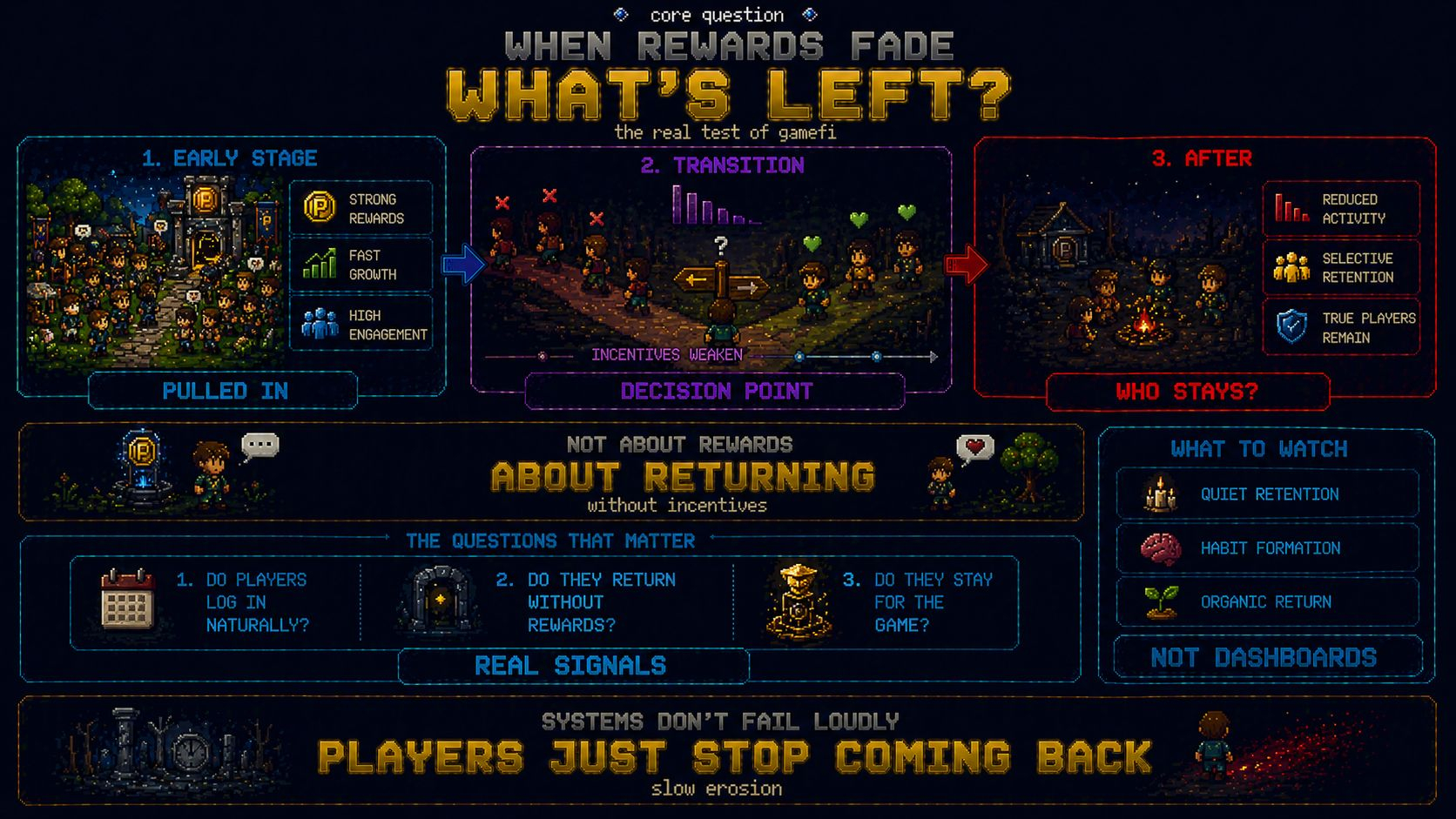
That’s the real test.
Pixels seems to be experimenting with something closer to a “living” economy, less fixed, more adaptive. Players aren’t just extracting, they’re interacting with a system that shifts over time. That’s interesting, but it also makes things harder. The more flexible the system becomes, the more complex it is to balance. And complexity has its own risks.
Axie chose clarity and speed. Pixels seems to be choosing subtlety and retention. Neither is automatically better, they just carry different trade-offs.
What I keep coming back to is that both are circling the same unresolved problem.
How do you keep players when you’re no longer paying them to stay?
That answer doesn’t come from tokenomics or whitepapers. It shows up in behavior. Do people log in without thinking about rewards? Do they come back after incentives fade? Do they bring others in without needing a referral link?
Axie gave the space a very clear lesson.
I’m not sure Pixels is the answer yet. It might be progress, or it might just be a more refined version of the same loop. Hard to tell this early.
So I’m not really watching the dashboards.
I’m watching the small behaviors. The ones that repeat quietly and are hard to fake.
That’s usually where the real answer shows up, just slower than most people expect.