
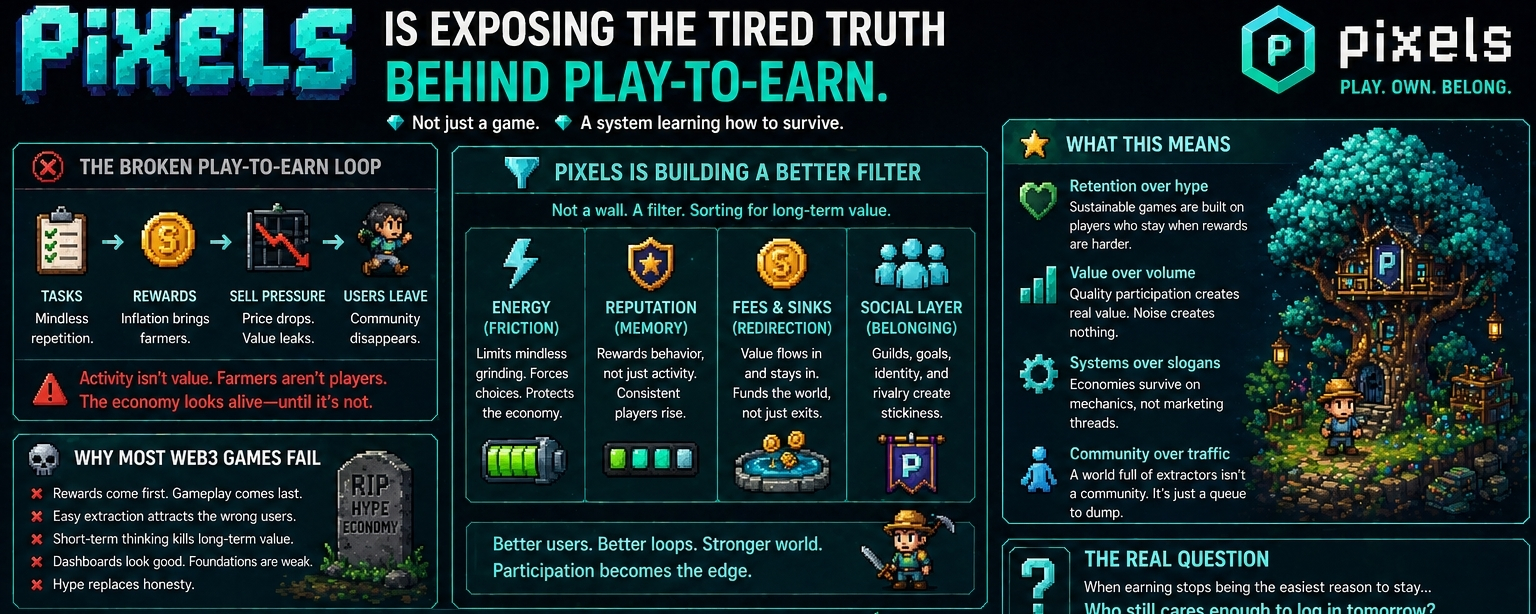
You can feel it when a game stops being a world and starts being a worksheet.
Log in. Click tasks. Calculate yield. Ask if the upgrade pays back. Check token price. Repeat until boredom wins.
I’ve seen that loop too many times.
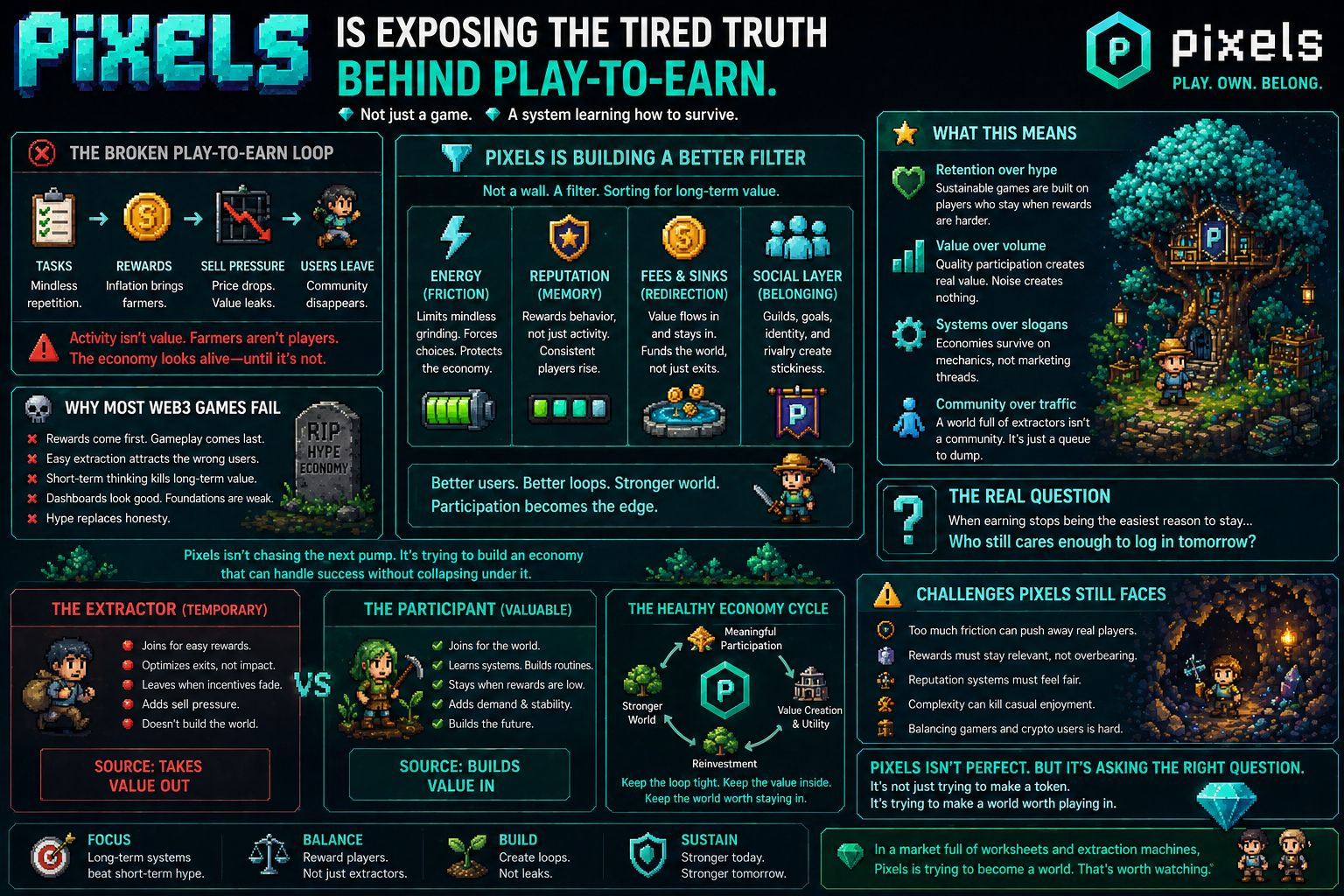
That’s why Pixels keeps pulling my attention. Not because it’s perfect. Not because I think it solved Web3 gaming overnight. Because it’s operating in the most uncomfortable zone possible: trying to keep rewards relevant without letting rewards become the whole reason anyone stays.
That tension is the real story.
Play-to-earn always sounded clean on paper. Play. Earn. Own. Grow. Beautiful pitch deck material. Then reality arrived. Once players start seeing every action through payout math, the magic drains fast. A quest becomes labor. Progress becomes ROI. Fun becomes admin work wearing cartoon clothes.
That’s where earn-first models crack.
And they usually crack suddenly.
I remember watching projects with booming dashboards and loud communities that looked unstoppable... until rewards weakened by a small amount. Then users vanished with shocking speed. Turns out many weren’t players at all. Just temporary accountants with avatars.
Pixels seems aware of that trap.
I’m careful saying “different” in this market because crypto punishes early conviction. But Pixels at least appears to understand that paying people to click isn’t the same as building a place people want to return to.
Huge difference.
Yes, Pixels still has the standard Web3 ingredients: assets, land, resources, token utility, ownership. Fine. Everyone has those now. The real question isn’t whether those ingredients exist.
It’s whether they create meaningful behavior... or just more noise.
That’s why I keep circling back here.
Pixels doesn’t only seem to reward users. It seems to be sorting them. Quietly. Through progression. Through friction.
Through access. Through systems where rewards increasingly favor people inside the loop rather than anyone passing through with a harvest bag.
That sounds harsh.
Necessary too.
A wallet logging in is not automatically a player. A bot finishing tasks is not community. A farmer extracting value is not the same as someone who learns systems, builds routines, invests time, and gives the world some emotional weight.
Many GameFi models refused to admit this because fake activity looked great in screenshots. More users. More volume. More charts to flex during someone’s weekly ego trip.
But fake demand always sends a bill later.
Pixels now seems to be fighting the real enemy of Web3 gaming: empty activity.
Not competitors.
Not headlines.
Not attention itself.
Empty activity is what hollows these economies out. Users who stay only while extraction is easy. Communities that disappear when incentives cool. Systems that mistake motion for health.
That’s why I care more about retention than hype.
Hype is cheap. Crypto manufactures it daily. A few candles, a few threads, a few loud voices, and everyone behaves like destiny has arrived.
It hasn’t.
The real test is slower and more boring: do people still return when earning gets harder? When the grind has friction? When the game asks them to be participants instead of claimers?
That’s where Pixels is still on trial.
And to be fair, friction can backfire.
Too much friction annoys real users. Too little invites parasites. Some players will complain that rewards feel tighter. Some will leave. Some may be right. Tightening a system can accidentally punish the good users along with the bad ones.
This is hard work.
But here’s the truth many teams never say during hype season: an economy that rewards everyone forever usually rewards the wrong people first.
The easiest user to satisfy is often the least loyal one.
If the best strategy is extract-and-exit, then the economy is already leaning toward failure—even if charts look fine today. Under the surface, pressure builds. Rewards become sell pressure. Sell pressure becomes doubt. Doubt becomes silence. Then the world feels empty before the metrics admit it.
Pixels seems to be trying another route: make participation matter more than raw activity.
That’s smarter.
Not easier.
Because Web3 gaming serves two suspicious audiences. Crypto users want upside. Gamers want a reason to care. One side leaves when rewards weaken. The other side leaves when everything feels like a token dashboard in costume.
Pixels has to live between them.
Brutal balancing act.
So I’m watching the fundamentals no dashboard captures well. Do players care about progress without checking price first? Does land feel useful instead of speculative? Do resources create loops or just chores? Does ownership deepen attachment or simply create another asset to dump later?
That’s where truth hides.
I’m also watching what happens when users leave. Sometimes losing low-quality traffic is healthy. Sometimes it’s a warning siren. Telling the difference early is where real analysis begins.
The market is tired now. People have heard every version of the pitch: earn, inflate, dump, patch, rebrand, repeat.
Pixels might be trying to break that cycle.
Might.
Good intentions won’t save weak gameplay. Better tokenomics won’t rescue boredom. Community spirit won’t survive endless extraction either.
So the question isn’t whether Pixels lets people earn.
That part is easy.
The real question is uglier... when earning stops being the easiest reason to stay, who still cares enough to log in tomorrow?