I didn’t open @Pixels expecting to think this deeply about it.
At first, it’s exactly what it looks like. You log in, farm a bit, craft some items, maybe explore around. It’s simple, and honestly that’s what makes it work. No pressure, no overload, just a clean loop you can get into without thinking too much.
But the longer you stay, the more something starts to feel different.
It’s not obvious at first. Nothing suddenly changes. You’re still doing the same actions. But the results don’t always match the effort the way you expect. That’s usually where most games lose people. Here, it actually makes you pause and rethink what you’re doing.
That’s when it starts to click.
Pixels isn’t really rewarding everything you do. It’s filtering it.
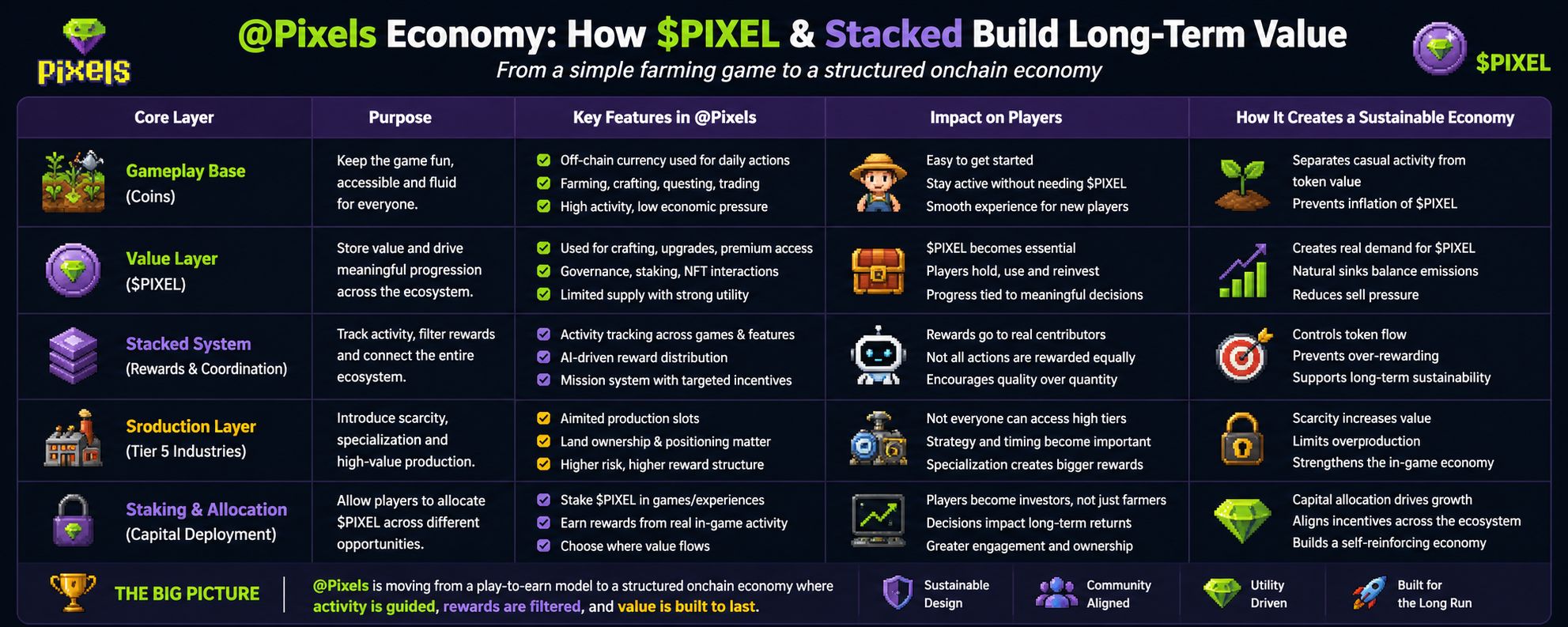
A lot of your daily activity runs on simple systems like Coins. They keep you moving, keep the game alive, but they don’t really push you forward in a meaningful way. The real progression almost always leads back to $PIXEL.
And $PIXEL doesn’t feel like something you just farm anymore.
You need it.
Whether it’s upgrading, crafting higher-tier items, or unlocking deeper parts of the game, the token is slowly becoming the thing that decides how far you can actually go. That changes your mindset completely. You stop playing just to stay active, and start thinking about where your effort actually matters.
Then you start noticing the Stacked system.
At first, it just feels like another rewards layer. But it’s not. It’s more like the system watching how players behave and deciding what actually deserves value. Not everything gets rewarded the same way, and that feels intentional.
It’s a very different approach from what we’ve seen before.
Most Web3 games tried to reward everything. More activity, more tokens. It worked for a while, then everything got diluted. Prices dropped, players left, and the system couldn’t hold itself together.
Pixels is doing almost the opposite.
It’s not trying to give you more. It’s trying to make what you get actually matter.
And you really start to feel that shift when you look at things like Tier 5.
Now it’s not just about playing more. It’s about where you are, what you have access to, and how you use it. Not everyone can just jump into the highest-level production. Land, slots, timing… all of it starts to matter.
It stops feeling like an open grind.
It starts feeling like positioning.
That’s probably the biggest change for me.
In most games, if you put in enough time, you get similar results as everyone else. Here, it doesn’t feel like that anymore. Two players can be equally active but end up in completely different positions depending on how they approach the system.
And then there’s how $PIXEL moves through everything.
You don’t just earn it. You spend it, lock it, use it to grow, and sometimes you have to decide whether to hold it or deploy it somewhere else. It doesn’t just sit in your wallet. It flows through the game.
That flow is what makes the whole thing feel more like an economy than a game.
You’re producing, consuming, allocating, and reinvesting, even if you don’t think about it in those terms.
And I think that’s what Pixels is really building here.
Not a fast play-to-earn loop.
But a system where value is controlled, progression is intentional, and not everything is handed out just for showing up.
It’s still early, but the direction is clear.
Pixel is slowly moving away from the idea that everyone should earn the same way, and toward a system where decisions actually matter.
And if that keeps developing with Pixel and the Stacked ecosystem…
this might end up feeling less like a game, and more like something people actually have to learn how to play properly.