
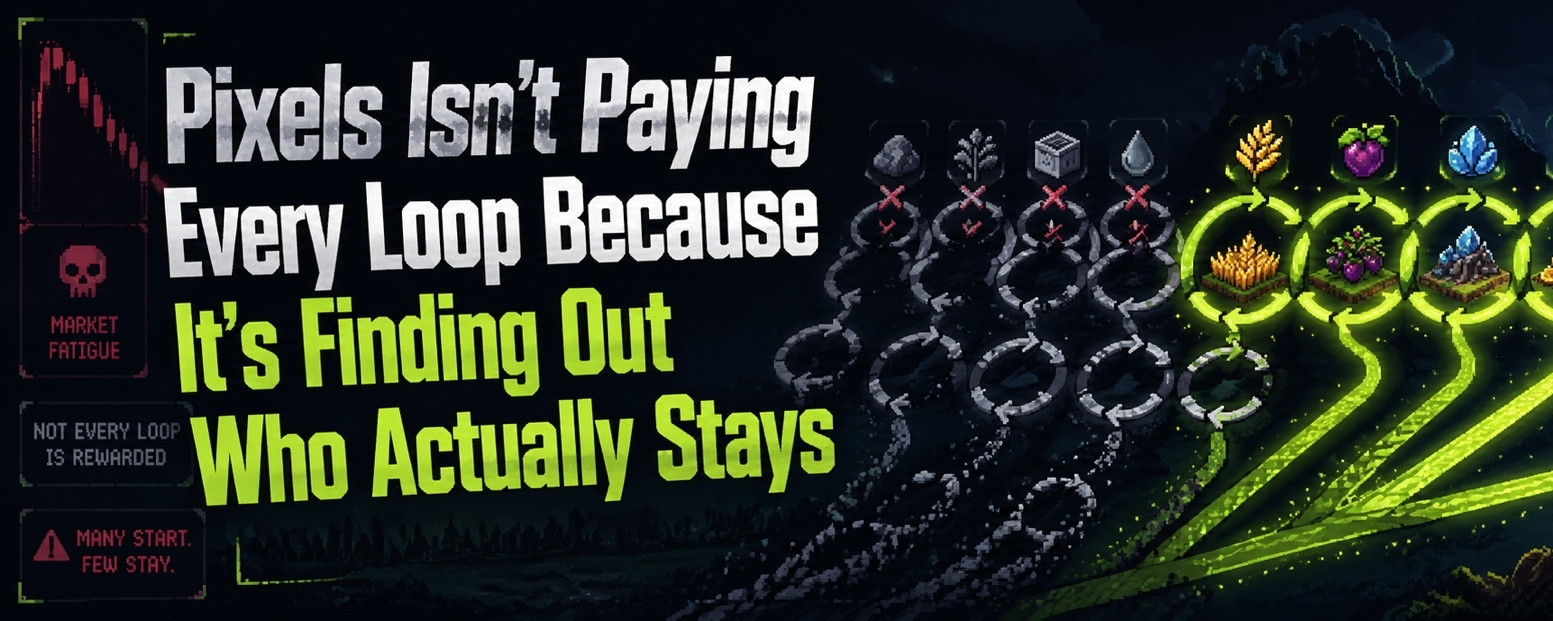
Pixels begins with a loop, and I’ve seen enough crypto loops to know most of them don’t survive contact with boredom.
That sounds harsh, but it’s usually true. The first few days always feel alive. People test the land, chase the rewards, talk about strategy, watch the token, compare routes, guess what the next update means. Then the noise starts thinning out. The easy excitement fades. The loop is still there, but now it has to carry real weight. That is where most projects begin to show cracks.
Pixels is interesting because it does not seem to pay every loop just to keep people moving. And honestly, that matters. Too many crypto games have tried the lazy version. Reward everything. Call every click “engagement.” Let users grind until the token gets tired. Then act surprised when the economy turns into recycled farming, sell pressure, and empty activity.
I’m not looking at Pixels like a perfect project. I don’t look at any project that way anymore. I’m looking for the moment this actually breaks. Every token economy has one. Sometimes it breaks when rewards get too thin. Sometimes it breaks when rewards are too generous. Sometimes the game is fine, but the players realize the payout was the only reason they were showing up. That one is the ugliest break, because no patch can easily fix it.
The thing with Pixels is that the loop has to be more than a payout. Farming, crafting, collecting, upgrading, waiting, trading — all of that can feel good if the world has texture. If there is ownership. If there is routine. If there are people worth seeing again. But if the player opens the game only to ask, “What can I extract today?” then the world is already weaker than it looks.
I’ve watched this pattern too many times. A project builds a beautiful surface, then lets the reward system teach users the worst possible habit. Come in. Farm. Dump. Leave. Return only when incentives improve. That is not a community. That is a queue at a leaking machine.
Pixels has to fight that.
Not with louder marketing. Not with some dramatic promise. With better friction.
Friction gets treated like a bad word in crypto, but it is often the only thing stopping an economy from becoming trash. If everything is easy, nothing has weight. If every action pays, no action feels special. If every player can extract without caring about the world, the world becomes background decoration for yield hunting.
That is why I don’t mind the idea that Pixels is not paying every loop. It should not. A digital economy has to disappoint the weakest behavior sometimes. It has to make people choose. It has to let some routes feel slower, some choices feel heavier, some rewards feel earned rather than sprayed around to keep the dashboard looking busy.
Still, this is dangerous ground.
Players are not patient forever. Especially crypto players. They have been trained badly. Years of reward farming, airdrop hunting, point systems, vague roadmaps, and recycled token models have made people allergic to waiting unless they can smell a payout nearby. So when Pixels slows a loop down, some users will call it strategy. Others will call it dead. Both may be wrong. Both may be right for different reasons.
That is the tension.
The project needs people to stay without bribing them every minute. But it also cannot pretend financial motivation is not part of the room. It is. The token is there. The market is there. The exit button is there. Players know it. The team knows it. Everyone is watching the same economy from different angles, trying not to say the quiet part too loudly.
Pixels also sits inside a bigger shift that crypto people sometimes over-polish. Digital currencies are changing how people behave with money, especially in unstable economies, but not in the clean brochure way. People are not waking up one morning and deciding to become part of some grand monetary movement. Most are tired. They are reacting. They are trying to keep value from leaking out of their hands.
That is the part I care about.
When money gets weak, people become sharp. Not because they want to. Because they have to. They start checking rates before buying basic things. They stop holding balances longer than needed. They move savings into whatever feels less fragile. They become suspicious of delays. They become suspicious of promises. They become suspicious of anything that asks them to wait.
That same mindset enters crypto games too.
A Pixels player may be playing, yes, but once there is value involved, they also start protecting their time. They ask whether the grind is worth it. They ask whether the resource has demand. They ask whether the next upgrade actually matters. They ask whether they are building something or just feeding a loop that will get nerfed later.
And that question is brutal.
Because if enough users decide the loop is not worth it, the economy does not collapse loudly at first. It just gets quieter. Fewer people care. Fewer people return. The chat slows. The market gets thinner. The tasks feel heavier. The same loyal names keep showing up, but even they start sounding tired.
I’ve seen that stage. It has a smell.
Pixels needs to avoid becoming another reward treadmill with nicer art. The world has to create attachment. Not fake attachment. Not forced “community” language. Real attachment. The kind where a player remembers what they built, recognizes other players, understands the rhythm, and feels some small reason to come back even when the token is not doing anything exciting.
That is hard.
It is much harder than launching incentives. Incentives are easy. You can always pay attention into existence for a while. Keeping attention after the reward glow fades is the real test. That is where design matters. That is where land matters. That is where social habits matter. That is where the economy either becomes a place or just another temporary extraction route.
I do think Pixels has a better setup than many projects that came before it. The game loop is understandable. The world has a softer entry point. It does not require every user to act like a trader from the first minute. That helps. People need something to do besides stare at price movement.
But I’m still cautious.
Crypto has a habit of turning every soft thing hard. A game becomes a market. A player becomes liquidity. A community becomes distribution. A reward becomes sell pressure. A roadmap becomes a delay management document. The fun gets buried under spreadsheets, screenshots, and arguments about emissions.
Pixels cannot fully escape that. No token project can. It can only manage it better.
The project has to decide what kind of behavior it wants to reward. That sounds obvious, but most teams avoid the hard version of that question. Rewarding activity is easy. Rewarding healthy activity is harder. Rewarding patience without boring people is harder still. Rewarding contribution without inviting abuse is where things get messy.
This is why “not paying every loop” may be the most honest thing about Pixels.
It suggests the project knows endless reward recycling is not a real economy. It suggests the team understands that some loops need to be filtered, not fed. It suggests value should come from stronger participation, not just repeated motion.
Maybe.
I say maybe because crypto has taught me not to clap too early.
The next stage is where Pixels has to prove the loop can carry tired users. Not excited users. Not new users. Not people farming because everyone else is farming. Tired users. The ones who have seen tokens bleed, roadmaps slip, reward systems change, and communities slowly become customer support rooms with memes.
Those users are harder to impress. They do not want a perfect promise. They want to see whether the world still works when the market is dull.
That is the real test, though. Can Pixels make the grind feel like progress instead of punishment? Can it make friction feel meaningful instead of cheap? Can it keep the economy from becoming another machine where the earliest and loudest extract the most while everyone else gets a lesson?
I don’t know yet.
And maybe that is the only honest place to leave it: Pixels has a loop, the loop has pressure, and sooner or later the project will find out whether players are staying because the world matters — or because they are still waiting for it to pay them back.