
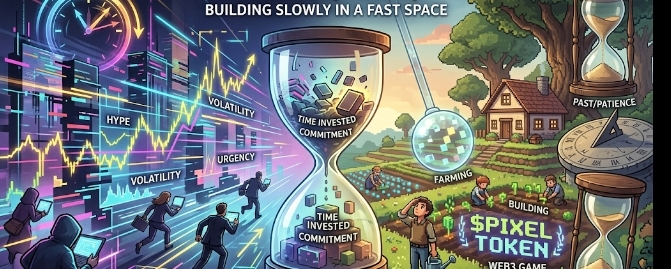
I have been thinking about Pixels again, not because anything dramatic happened, but because nothing dramatic did. That in itself feels unusual right now. The market keeps shifting in these uneven bursts. One day there is excitement, coins moving quickly, people talking like momentum is back. Then it fades just as fast, almost like the energy wasn’t strong enough to hold.
In between those moments, there is this quiet space. And Pixels seems to exist inside that space.
I keep noticing how different it feels compared to most things in crypto. Not better, not worse. Just… slower. More grounded, maybe. It doesn’t demand attention the same way. It doesn’t create urgency. And I find myself wondering if that is intentional, or if it is simply a byproduct of the kind of game it is trying to be.
Farming, collecting, building. These are not fast activities. They require repetition. Time. A certain willingness to come back again and again, even when nothing significant happens in a single session. That kind of loop feels almost out of place in a market where people are used to quick reactions and immediate feedback.
I might be wrong, but it feels like Pixels is asking people to move at a different pace than the market around it.
And that creates a kind of tension.
Because outside the game, everything is speeding up. Even now, I see traders jumping between setups, looking for small edges, reacting to news that barely lasts a few hours. Liquidity feels thinner in some places, more aggressive in others. It’s like a crowded road where everyone is trying to overtake at once, even when there isn’t enough space.
Inside Pixels, the pace doesn’t match that.
It feels more like a slow lane. You don’t rush. You don’t expect immediate results. You plant something, you wait, you come back later. And I keep asking myself whether people can really stay in that rhythm when everything around them is pulling in the opposite direction.
There’s also the token layer, PIXEL, which connects the game to the broader market. And this is where things start to feel more complicated. Because once a token is involved, expectations change. People start watching price, volume, movement. Even if they say they are there for the game, the market still influences how they feel.
I keep seeing this subtle disconnect.
The game rewards time and consistency. The market rewards timing and reaction. These are not the same thing. And when both exist together, they don’t always align smoothly. It’s like two clocks ticking at different speeds. Eventually, you start to notice the difference.
I don’t think this is a flaw exactly. It’s more like a structural challenge. Something that every Web3 game has to deal with in one way or another. But in Pixels, it feels more visible because the gameplay itself is so deliberately slow.
The more I look at it, the more I feel like this is really a question about patience.
And patience is a strange thing in crypto.
People talk about long-term thinking, but behavior often says something else. There is always another opportunity, another trend, another place to move capital. That constant movement creates pressure. Not loud pressure, but steady, persistent pressure. Like water building behind a wall. It doesn’t break immediately, but you can feel it pushing.
I am trying to understand how Pixels holds up under that kind of pressure.
So far, it seems to rely on routine. Giving players small reasons to return, small tasks to complete, small progress to track. And there is something quietly powerful about that. Routine creates habit. Habit creates attachment. But at the same time, routine can also become repetitive in a way that pushes people away if it stops feeling meaningful.
That balance feels fragile.
I also think about trust, not just in the system, but in the outcome. People need to believe that their time matters. That what they are building inside the game has some form of lasting value, even if that value is not immediate. And that belief is not easy to maintain, especially in a space where things change quickly.
Even small uncertainties can affect it.
A delay in updates. A change in rewards. A shift in how the economy works. None of these things are unusual in game development, but in Web3 they carry extra weight. Because they don’t just affect gameplay, they affect perceived value.
And perception, more than anything, drives behavior here.
I keep noticing how quickly sentiment can change. One moment people are engaged, optimistic, talking about potential. The next moment, something small happens and the tone shifts. Not completely, but enough to create hesitation. And hesitation spreads quietly.
It reminds me of standing in a line where no one is sure if it’s moving anymore. At first, people wait patiently. Then someone steps out. Then another. And slowly, the line starts to break, even if the system itself hasn’t changed much.
I don’t think Pixels is anywhere near that kind of situation, but the possibility exists. It always does.
At the same time, I don’t want to ignore what it might be doing right.
There is something steady about it. Something that doesn’t chase every new narrative. And in a market that often feels reactive, that kind of steadiness can matter more than it seems at first. It creates a base. A place that doesn’t shift every time sentiment changes.
Buy even that has limits.
Because no project exists in isolation. External conditions always play a role. If the broader market becomes more uncertain, if liquidity tightens, if attention moves elsewhere, Pixels will feel that impact too. Not directly at first, but gradually.
That is something it cannot control.
And maybe that is where my uncertainty comes from.
Not in the idea of the game, but in the environment it has to survive in. Building something slow and stable in a fast and unstable space is not easy. It requires constant adjustment, even if those adjustments are subtle.
I find myself watching more than judging.
Trying to see how players behave over time. Whether they stay, whether they leave, whether they come back. Those patterns probably matter more than short-term price movements or temporary spikes in activity.
Because in the end, this feels like a long experiment.
Not just for Pixels, but for the idea that value can be built slowly in a space that usually rewards speed. That time itself can be part of the system, not just something people try to minimize.
I don’tknow if that idea fully works yet.
But I do think it is worth observing.
And as I keep watching, I keep coming back to the same quiet thought.
