
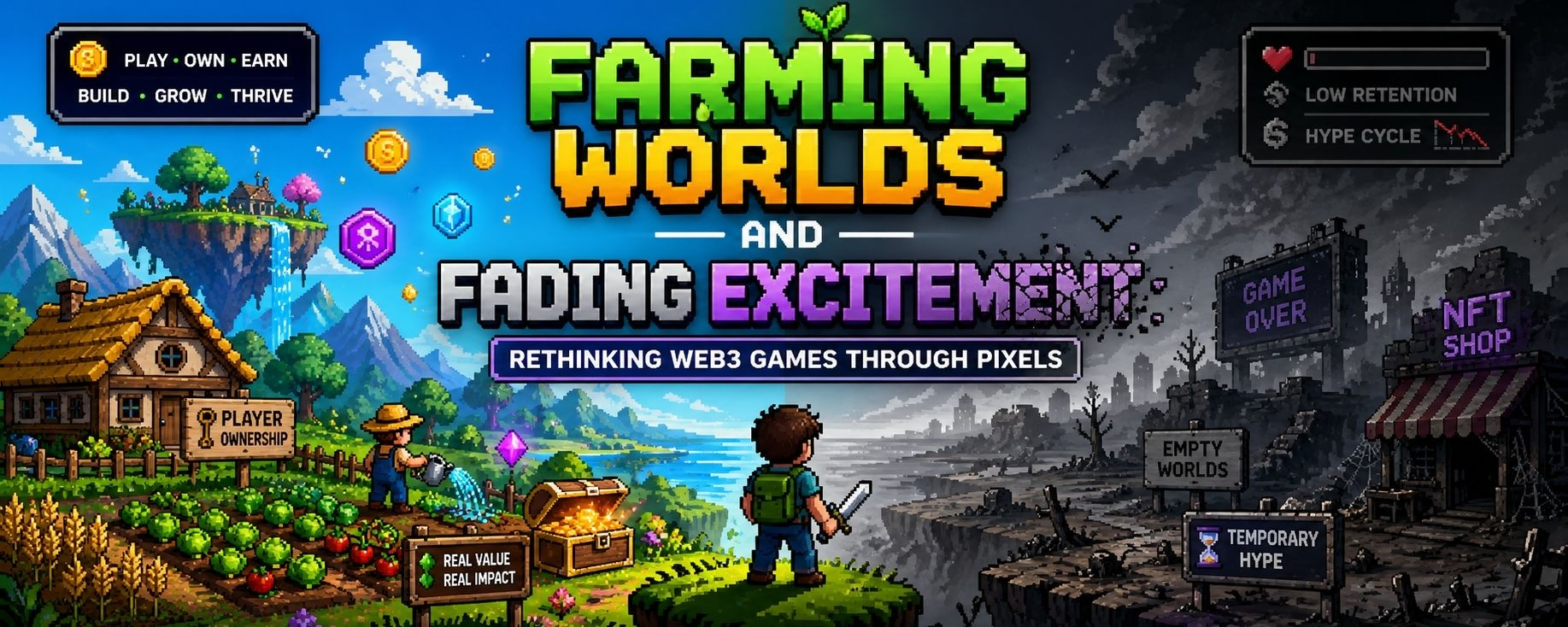
I don’t really get excited about crypto projects the way I used to.
There was a time when every new whitepaper felt like a doorway. Every token launch carried this quiet promise that something fundamental was about to change, finance, ownership, coordination, the internet itself. But after enough cycles, you start recognizing the rhythm. The same ideas come back wearing different names. DeFi, NFTs, GameFi, SocialFi, AI agents, RWAs. Each wave arrives with its own vocabulary, but the emotional arc feels familiar. Early curiosity. Loud conviction. Then gradual dilution into speculation, incentives, and eventually fatigue.
It is not cynicism exactly. It is more like pattern recognition that no longer lets you feel surprised.
So when something like Pixels (PIXEL) shows up again, another Web3 game, another economy, another attempt at “on chain life”, I do not feel the old spark. But I do pause. Not because I expect it to succeed, but because I have seen enough versions of this idea to know there is always a real problem hiding underneath the hype.
Pixels, as it exists on the Ronin Network, is a social farming and exploration game. You grow things, gather resources, move through an open world, and participate in a player driven economy. It borrows heavily from familiar comfort games, Stardew Valley is the obvious reference point, and layers on blockchain ownership and a token economy around it.
At a glance, it feels almost disarmingly simple compared to the weighty narratives crypto usually carries. There is no grand claim of reinventing global finance here. Just farming, crafting, guilds, land ownership, and a token called PIXEL sitting somewhere underneath it all.
And maybe that simplicity is the most interesting part.
Because if you strip away the crypto layer for a moment, what Pixels is trying to solve is not new at all, how do you create a persistent online world where players actually care about what they build, where effort accumulates into something that feels like ownership rather than just progress bars resetting every season.
Games have been wrestling with that question long before blockchains entered the conversation.
The blockchain angle tries to answer it in a very specific way, by making parts of that world economically real. Items become tradable. Land becomes ownable. Effort becomes tokenized. And in theory, that transforms participation from “playing” into “participating in an economy”.
But theory is where crypto always feels strongest.
In practice, I keep coming back to the same tension, does adding a token actually deepen the experience, or does it slowly pull attention away from the experience into the market surrounding it.
Pixels leans into the idea that players can earn PIXEL through gameplay, quests, and in game activity, forming the backbone of its economy. On paper, that creates alignment, players contribute, players earn, players sustain the world.
But I have seen enough of these systems to know alignment rarely stays clean.
At some point, players stop asking what do I want to build here and start asking what is efficient. That shift is subtle at first. Then it becomes dominant. The game becomes a job, or worse, a competition to extract value before the system changes. And when enough people feel that shift, the social world quietly turns into a marketplace with prettier graphics.
That is one side of the story.
The other side is harder to dismiss.
Because there is something compelling about Pixels’ direction. Not in a revolutionary sense, but in a practical one. It does not try to reinvent gaming from scratch. It uses familiar mechanics, farming loops, resource gathering, social guilds, and adds ownership structures on top. The Ronin Network, built specifically for games, also suggests the team understands that general purpose blockchains often struggle with gaming latency and cost constraints.
And I cannot ignore the fact that people do actually play it. Not just speculate on it. There is a persistent audience engaging with it as a game first, token second. That matters more than most token charts.
Still, I keep circling back to uncertainty.
Because “people are playing it” is not the same as “people will stay when incentives change”.
Adoption in Web3 gaming has always been fragile. It depends not just on gameplay quality, but on token prices, reward schedules, and external market conditions that the game itself does not control. When markets turn, these worlds tend to empty faster than they were filled. It is a strange kind of dependency, where the health of the game economy is tied to forces completely outside the game.
Then there is trust.
Not just trust in the team, but trust in the permanence of the system. In traditional games, players trust that the rules of the world will stay consistent enough for their effort to matter. In crypto games, that stability is always slightly negotiable. Economies can be rebalanced. Token emissions adjusted. Incentives redesigned. Sometimes that is necessary. Sometimes it is fatal to belief.
And belief is the only real currency these worlds have.
The token itself, PIXEL, sits in an uncomfortable middle position. It is meant to be both utility and incentive layer, used for in game actions like crafting, guild participation, VIP systems, and various economic interactions. In theory, it is the connective tissue of the ecosystem.
But tokens in games often become something else entirely, a scoreboard for speculation layered over gameplay.
The uncomfortable question is whether PIXEL is strong enough to stay in the background.
If the token becomes too important, the game risks becoming finance first. If it becomes too irrelevant, it risks losing the entire crypto narrative that attracted capital and users in the first place. That balancing act is not unique to Pixels, it is basically the central problem of almost every Web3 game I have seen.
And I do not know if that balance is actually stable or just temporarily aligned with favorable conditions.
There is also a quieter concern that does not get talked about as much, saturation of meaning.
When everything is tokenized, land, crops, guilds, pets, energy systems, you eventually reach a point where ownership stops feeling meaningful and starts feeling procedural. You own things, but ownership does not necessarily translate into attachment. It becomes data rather than experience.
That is a hard problem to solve with economics alone.
Still, I find myself not fully dismissing Pixels either.
Maybe because it does not pretend to be more than it is. Or maybe because after enough failed attempts at over engineered “revolutions”, something modest and iterative feels more honest. A farming game with a token layer is not trying to rewrite civilization. It is trying to merge play and economy in a way that holds attention.
Whether that is enough is another question entirely.
I keep thinking about what “success” even means here.
Is it a high token price, a large active user base, a stable in game economy that survives multiple cycles, or is it something softer, like a digital space where people return not because they are incentivized, but because it still feels worth being in.
Crypto tends to measure success in numbers that move fast. Games measure success in habits that move slowly. Pixels sits awkwardly between those two time scales.
And maybe that mismatch is the real story.
Not whether Pixels will succeed or fail, but whether anything built on this hybrid of play and finance can ever fully escape the tension between enjoyment and extraction.
I do not have a conclusion for it.
Only the same feeling I keep returning to in this space, that most of these systems are not as new as they claim to be, but also not as meaningless as they sometimes appear once the excitement fades.
Somewhere between those two truths, projects like Pixels exist, still running, still being played, still being traded, waiting to see whether persistence counts for anything in an industry that tends to forget quickly.
