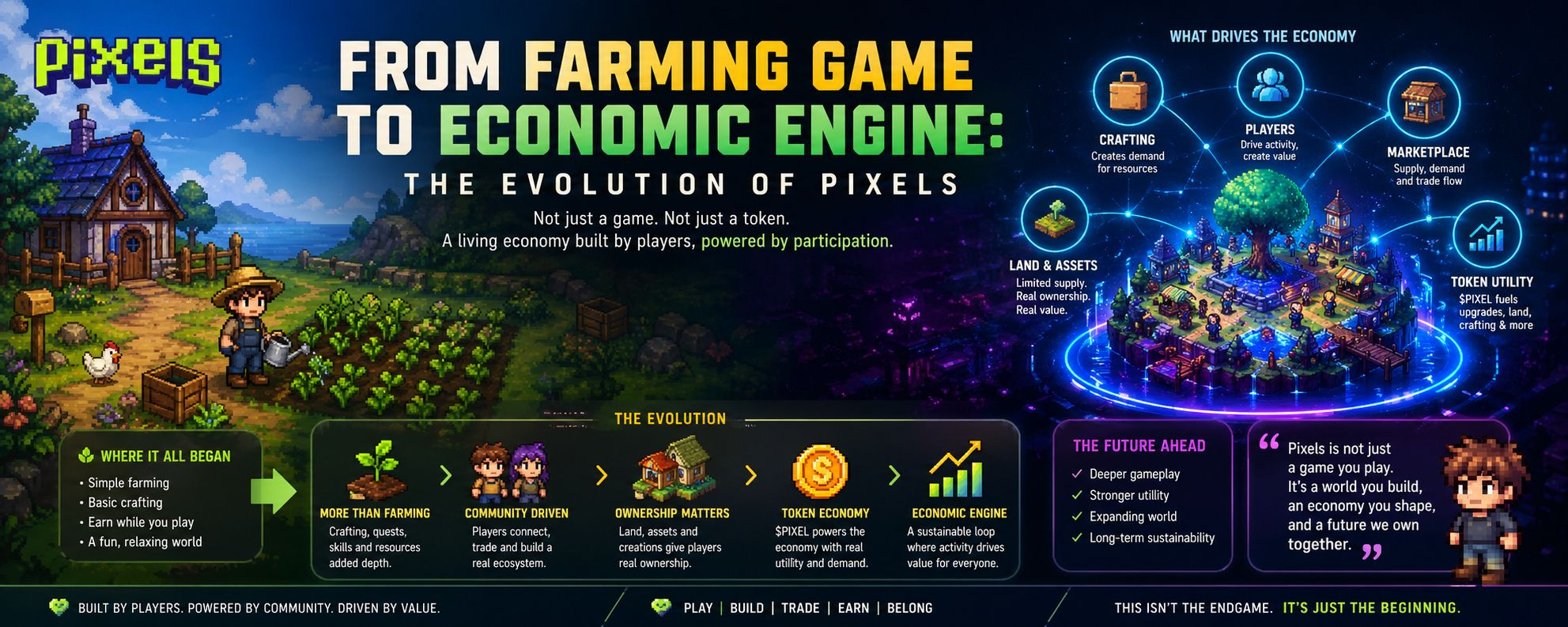

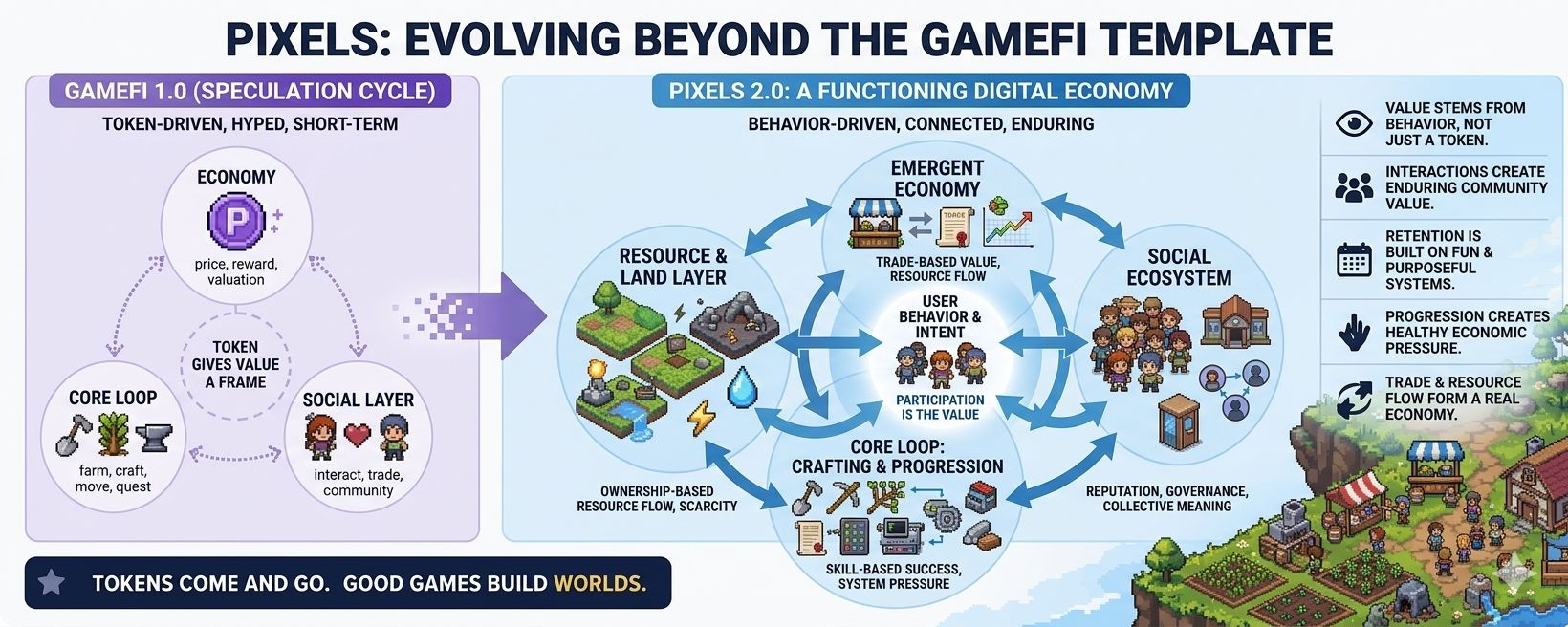
Pixels is entering a phase where it can no longer be judged by the old GameFi template. This is not just a farming game with a token attached anymore, and it is not simply another crypto project trying to keep attention alive through rewards. What is forming now looks more like a functioning digital economy one where player behavior, resource flow, progression pressure, and retention all interact at the same time. That shift is important because it separates Pixels from projects built only for short-term speculation.
In the first generation of Web3 gaming, success was usually simple.
Launch token, offer rewards, attract users, watch activity spike, then struggle once emissions slowed. Pixels appears to be moving beyond that cycle.
The platform has gradually built a system where participation itself carries value. Farming, crafting, land usage, upgrades, and social interaction are no longer isolated features. They are becoming connected economic layers. That creates a stronger foundation because value is not dependent on hype alone—it is supported by repeated user behavior.
One of the clearest signs of maturity is how progression feels inside the ecosystem. Many players have noticed that the same effort does not always produce the same outcome. Some sessions feel smooth and rewarding, while others feel slower despite identical routines. On the surface, that can feel frustrating. From a systems perspective however, it often signals balancing logic.
Strong economies cannot remain perfectly linear forever. If rewards become too predictable, farming becomes mechanical. If extraction becomes too efficient, inflation grows. If every player follows one optimal route, depth disappears. Pixels increasingly feels like a game trying to manage those pressures in real time.
That is where the real advantage begins. Pixels is not only trying to attract users—it is trying to keep them. In crypto, acquisition is easy during hype cycles. Retention is where most projects fail. People return consistently when they feel momentum, ownership, routine, and identity.
Pixels has quietly created these emotional anchors. A player logs in to maintain progress, improve land, complete systems, and remain part of a world that continues moving even when they are offline. That creates a deeper relationship than simple reward farming ever could.
The PIXEL token still plays an important role, but its real significance is evolving. Earlier markets often valued GameFi tokens only through speculation. Today, traders and users are beginning to look for utility, sinks, and ecosystem relevance.
PIXEL maintaining active volume and community attention suggests the market still sees future potential. In crypto, price can move fast, but relevance lasts longer. A token tied to an active world always has more upside than one tied only to nostalgia.

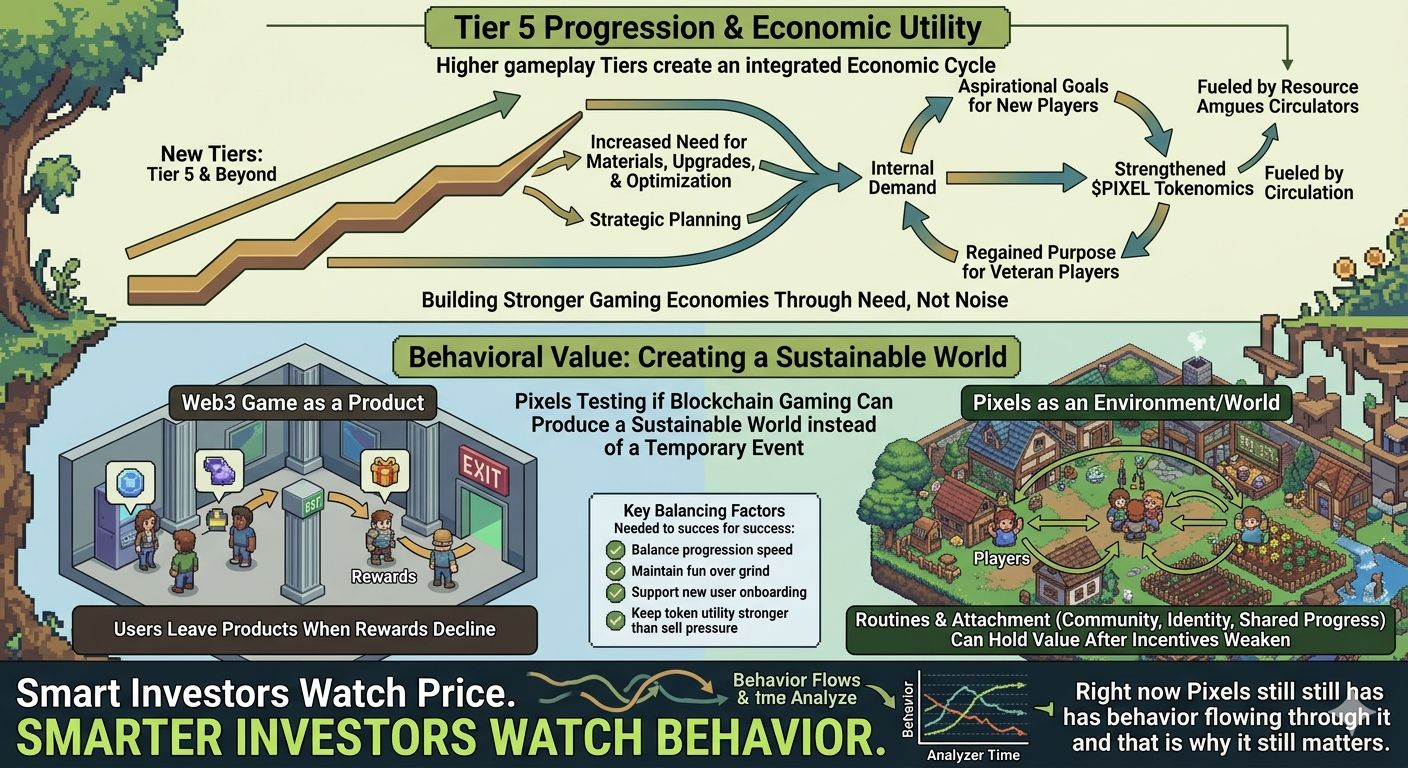
Tier 5 progression may become the next major test. Expansion systems matter because they create internal demand. New tiers increase the need for materials, upgrades, optimization, and strategic planning. Veteran players regain purpose, newer players gain aspirational goals, and the economy gains new reasons for resources to circulate.
If tied correctly to $PIXEL utility, this kind of progression can strengthen tokenomics naturally instead of forcing artificial demand. That is how stronger gaming economies are built through need, not noise.
Perhaps the most underrated strength of #pixel is something many analysts miss: it feels like a place. Most Web3 games feel like products. Pixels often feels like an environment. That difference changes user behavior completely. People leave products when rewards decline. They stay in worlds where they feel connected. Community presence, routines, identity, and shared progress can hold value long after incentives weaken. This is why some ecosystems survive bear markets while others disappear after one cycle.
Of course, none of this guarantees success. Pixels still needs to balance progression speed, maintain fun over grind, support new user onboarding, and keep token utility stronger than sell pressure. As systems become more advanced, clarity becomes just as important as complexity. Players accept depth, but they reject confusion. The challenge now is scaling the economy without losing the simplicity that made Pixels accessible in the first place.
My honest view is this Pixels is no longer fighting for a spot among GameFi trends. It is testing whether blockchain gaming can produce a sustainable world instead of a temporary event. That is a far more valuable mission. Most projects taught users how to extract rewards and move on.
Pixels appears to be exploring how to create routines, attachment, and long-term participation. If that model continues improving, it may become one of the strongest examples of what Web3 gaming was always supposed to become.
Smart investors watch price.
Smarter investors watch behavior.
Right now Pixels still has behavior flowing through it and that is why it still matters.