
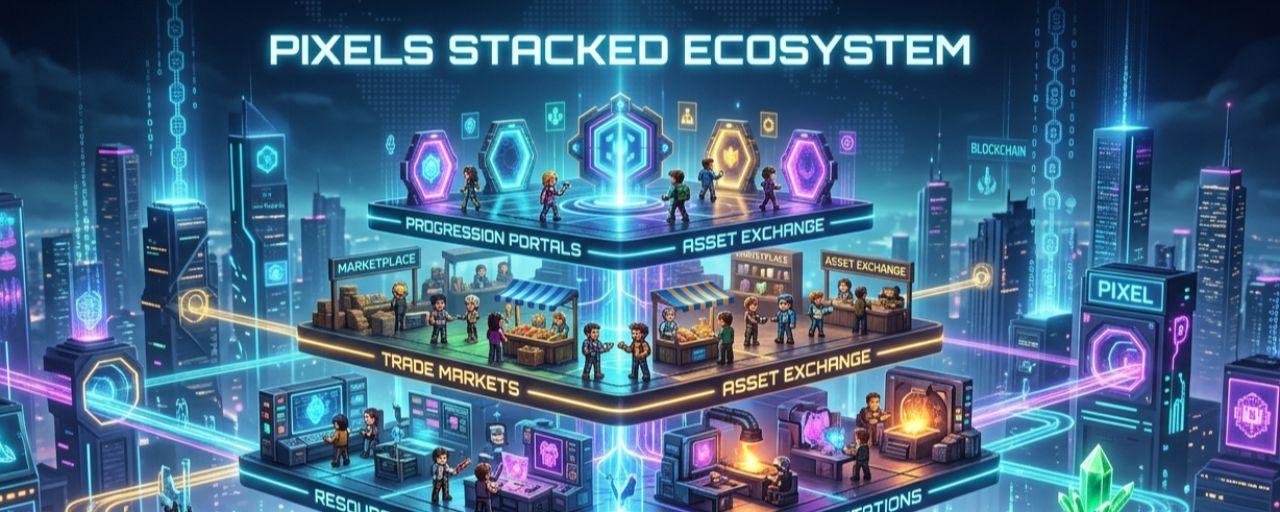
When most people hear “Web3 gaming,” they immediately think of short-lived hype cycles, unsustainable token emissions, and gameplay that exists only to farm rewards. But @Pixels is positioning itself differently through what it calls the Stacked ecosystem model — and if you actually break it down, it’s closer to a self-reinforcing in-game economy than a traditional play-to-earn system.
At the core of this model is a simple but powerful idea: every player action must feed into another layer of the ecosystem. Nothing is isolated. Nothing is “just for fun” or “just for farming.” Everything connects.
For example, resource gathering isn’t an endpoint. It feeds into crafting systems. Crafting isn’t an endpoint either — it supports progression, trade, and deeper gameplay loops. Progression then unlocks additional systems that feed back into resource demand. This creates a continuous cycle where players are not just playing a game, but actively participating in an evolving economy.
This is where the “Stacked” concept becomes important. Instead of a flat reward structure (do X → earn Y), Pixels builds a layered interaction model where each system depends on the others. The result is interdependency between players, which is something most GameFi projects fail to achieve.
And interdependency matters because it changes behavior.
In weak GameFi economies, players act individually: farm, sell, exit.
In stacked economies like this one, players are incentivized to:
• stay longer
• reinvest resources
• collaborate indirectly through markets
• and think in cycles instead of one-time gains
That shift is critical because it transforms the ecosystem from extraction-based to participation-based.
Now let’s talk about $PIXEL .
$PIXEL is not just a “reward token” in the traditional sense. In a properly functioning stacked system, the token becomes a flow mechanism — meaning it moves through players as a medium of value exchange tied to in-game activity. The more integrated the gameplay loops become, the more natural the demand for the token becomes within the system itself.
This is where the long-term thesis of @Pixels starts to matter:
If the ecosystem successfully maintains player engagement across multiple layers (resource → crafting → progression → trade), then value is no longer driven purely by speculation. It becomes tied to actual in-game economic activity.
That is fundamentally different from most GameFi models that rely heavily on external hype cycles.
Another important aspect is sustainability through reinvestment. In weak systems, players extract rewards and leave. In stacked systems, players are encouraged to reinvest because progression is tied to continuous participation. That means experienced players tend to accumulate advantages over time instead of resetting constantly.
In simple terms:
👉 Short-term farming weakens the system
👉 Long-term participation strengthens it
And systems that reward long-term participation usually outlast systems that reward extraction.
Of course, no GameFi model is guaranteed success. Execution, adoption, and player retention will determine everything. But structurally, the Stacked ecosystem design is attempting to solve a real problem that has existed in Web3 gaming since day one: how to make in-game economies actually sustainable instead of temporary reward loops.
Whether @Pixels fully succeeds or not, the design direction is clear — and it’s one of the more serious attempts to align gameplay, economy, and token utility into a single system rather than separate pieces.
💬 Final thought:
The real test isn’t hype — it’s whether players still exist in the economy after the hype fades.