

At the surface level, @Pixels still looks like a familiar farming game.
You plant.
You harvest.
You upgrade.
You repeat.
But when you carefully observe the system especially after the recent updates and discussions it becomes clear that something deeper is happening.
This is no longer just about gameplay.
It’s about how a system is being designed to control value, influence behavior, and sustain itself over time.
🔍 Understanding the Shift: Features vs Structure
One of the strongest common points across all four perspectives is this:
Most players see updates as features.
But in reality, they are structural changes.
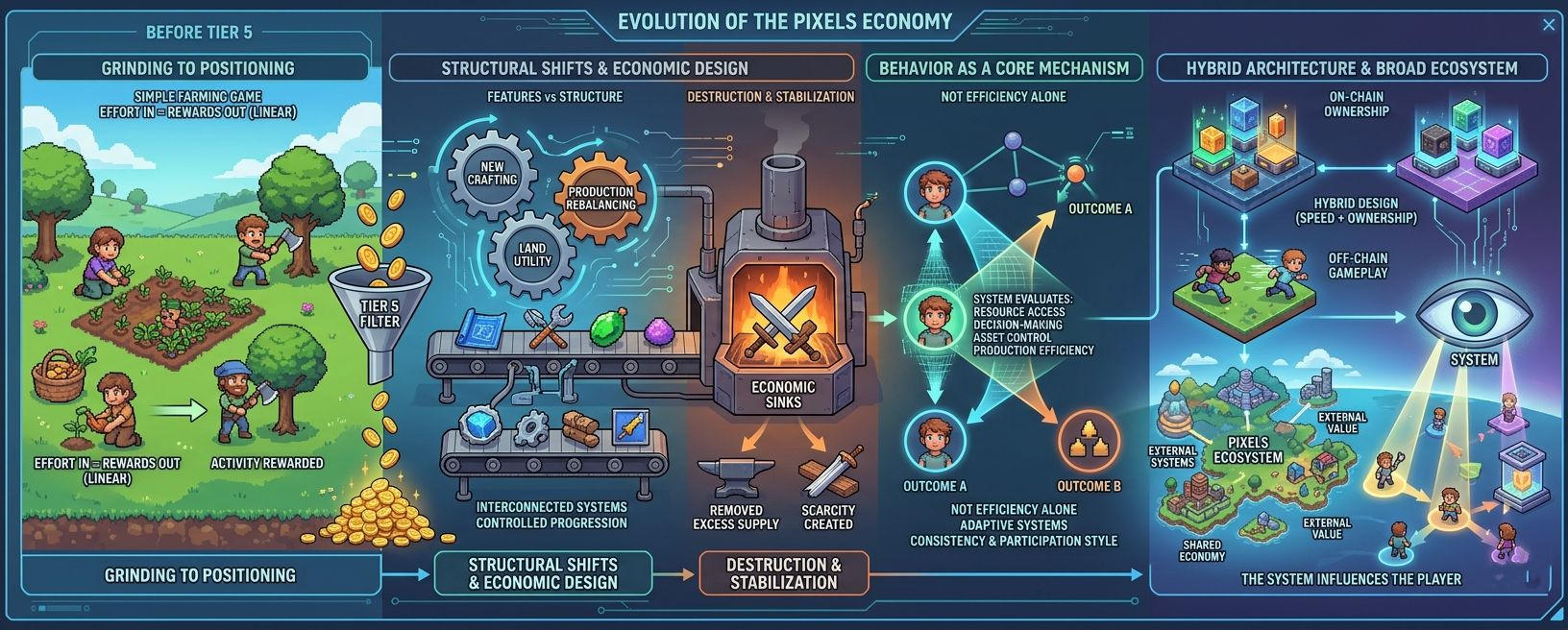
The introduction of Tier 5, new crafting recipes, XP adjustments, land utility changes, and production rebalancing — none of these exist in isolation.
They are interconnected.
They all serve one purpose:
👉 To move the system away from uncontrolled growth
👉 And toward controlled progression
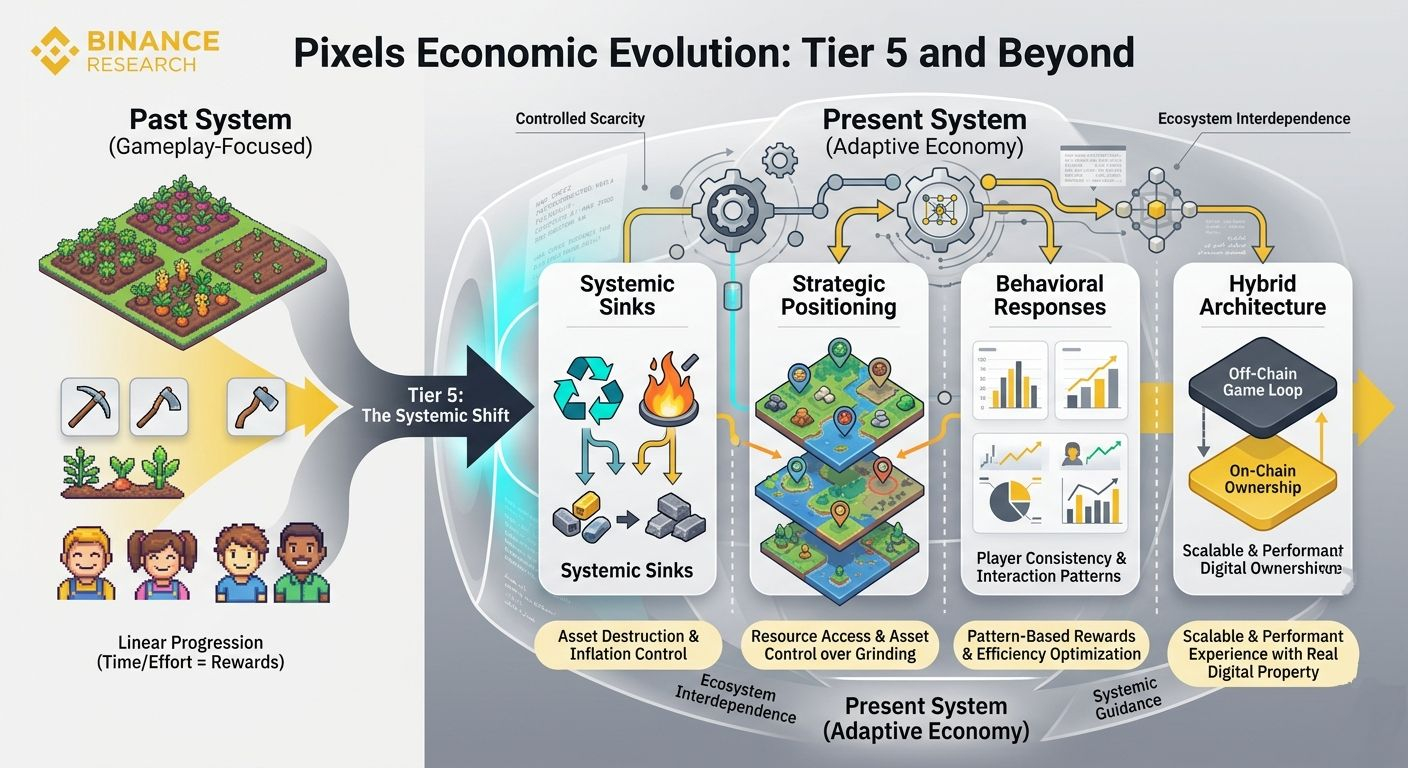
Earlier, progression was simple: Effort in = rewards out.
Now, that equation no longer holds in a linear way.
⚖️ From Grinding to Positioning
Before Tier 5, the system rewards activity.
After Tier 5, the system rewards positioning.
This is where the second article’s idea becomes critical.
Two players can reach the same level…
but experience completely different outcomes.
Why?
Because the system now evaluates:
resource access
production efficiency
asset control
decision-making
This creates a separation between:
players who play more
and players who understand more
And that separation is intentional.
Tier 5 acts less like an achievement…
and more like a filter.
---
🔄 The Role of Destruction in a Growing Economy
A major concept discussed is the introduction of mechanics that require players to break down their own assets.
At first glance, this feels counterintuitive.
Why would progress require destruction?
But this is where economic design comes in.
In any system where:
resources are constantly produced
and nothing is removed
👉 inflation becomes inevitable
And when inflation rises:
value drops
rewards feel weaker
and engagement declines
To counter this, the system introduces economic sinks.
By forcing players to:
deconstruct items
sacrifice production
and rebuild strategically
the system: ✔ removes excess supply
✔ creates scarcity
✔ and stabilizes value over time
This is not slowing players down.
It is protecting the economy from collapsing under its own growth.
---
🧩 Behavior as a Core Mechanism
Another subtle but powerful insight from the fourth article is this:
The system doesn’t just respond to actions —
it responds to patterns of behavior.
This is where things become more complex.
Because now:
efficiency alone is not enough
activity alone is not enough
The system begins to “read”:
consistency
participation style
and interaction patterns
This is why:
two efficient players can get different results
predictable strategies sometimes stop working
and outcomes don’t always scale linearly
It doesn’t feel random.
It feels adaptive.
🌐 Beyond a Single Game Loop
Another key point is expansion.
Pixels is no longer operating as a closed environment.
With integrations and external systems, it is moving toward a broader ecosystem.
This means:
value is not confined to one loop
rewards can extend beyond a single activity
and participation becomes multi-layered
This transition is important.
Because systems that exist in isolation often struggle to sustain long-term value.
But ecosystems can redistribute pressure and maintain balance more effectively.
---
⚙️ The Hybrid Architecture Advantage
The third article highlights something technical — but very important.
The system is not fully on-chain.
And that is a strength, not a weakness.
By splitting:
gameplay (off-chain)
and ownership (on-chain)
the system achieves: ✔ real-time performance
✔ scalability
✔ and usable gameplay
If every action was on-chain:
latency would increase
costs would rise
and user experience would break
This hybrid design allows the system to: 👉 remain fast
👉 while still preserving digital ownership
It’s a practical solution to a major Web3 limitation.
🎯 Economic Pressure and Player Responsibility
Another shared theme is the introduction of pressure.
After Tier 5:
resources feel tighter
mistakes feel costly
inefficiency becomes visible
This changes player psychology.
Before: 👉 you could play casually and still progress
Now: 👉 you need planning
👉 structure
👉 and sometimes coordination with others
This transforms the experience from: 🎮 a solo game
➡️ into
🏗️ a shared economy
🔄 The System vs The Player
Perhaps the most important realization across all four articles is this:
The relationship between player and system is changing.
It’s no longer: 👉 player controls the game
It’s becoming: 👉 system influences the player
Through:
reward structures
scarcity
behavioral responses
and economic balancing
The system subtly guides how players act.
Not through instructions
but through outcomes.
🧠 Final Perspective
When you connect all these insights together, a clear picture emerges:
Pixels is evolving into:
a system that balances creation and destruction
an economy that controls inflation and rewards efficiency
an environment that responds to behavior, not just activity
At that point, the experience changes completely.
You are no longer just: 👉 playing for rewards
You are: 👉 operating inside a system that decides how rewards are distributed
Closing Thought
If progression is no longer linear…
If rewards depend on positioning…
If behavior itself becomes part of the system…
Then the real question is:
Are you still playing the game the same way…
Or are you learning how the system actually works
and adapting before it forces you to?