
I’ve seen enough cycles now to know how this usually goes.
A new project shows up with a clean aesthetic, a tight loop, and just enough narrative to feel like it matters. People gather around it, not because they fully understand it, but because it feels alive. That’s usually enough in this space. Feeling is currency.
Pixels sits somewhere in that familiar pattern, but not entirely inside it.
At first glance, it looks almost disarmingly simple. Farming, gathering, wandering around a pixelated world. Nothing about that pitch should work anymore. We’ve seen it too many times. Play-to-earn burned that genre into the ground. It trained people to optimize instead of play. It turned games into spreadsheets with avatars.
And yet Pixels doesn’t feel like it’s trying to sell you a yield strategy. At least not directly.
There’s a quietness to its design. A sense that someone, somewhere in the process, actually cared about the loop being enjoyable before it was profitable. That alone sets it apart, which says more about the state of Web3 than it does about Pixels.
Still, I can’t shake the feeling that we’ve been here before.
The idea of a “social, open-world, player-driven economy” has been recycled so many times it barely registers anymore. Every cycle, it comes back with slightly better graphics, slightly smoother onboarding, slightly more convincing tokenomics. But underneath, the same question lingers. Who is this really for?
Not the early users. They’re transient. They arrive fast, extract what they can, and leave just as quickly when incentives dry up. That pattern hasn’t changed.
So then it has to be for the players. Real players. The ones who stay when there’s nothing left to farm except the experience itself.
That’s where things get murky.
Pixels is built on Ronin, which at least gives it some structural advantage. Lower friction, better throughput, a network that already understands gaming to some extent. That matters more than people admit. Infrastructure fatigue is real. Nobody wants to bridge assets five times just to plant virtual carrots.
But infrastructure alone doesn’t create attachment.
The world has to feel necessary. Not just interesting. Not just well-designed. Necessary.
That’s a much higher bar than most teams realize.
Because necessity isn’t something you can design directly. It emerges. Slowly. Usually from constraints, not features. From moments where users realize they would miss something if it disappeared. That kind of connection can’t be forced with quests or rewards.
Pixels feels like it understands this, at least partially. The pacing isn’t aggressive. The mechanics don’t scream for attention. There’s space in it. Room to just exist without immediately thinking about extraction.
But space can also turn into emptiness if there’s nothing anchoring it.
I’ve wandered through a lot of these worlds over the years. Early metaverses, tokenized economies, social layers that promised persistence and identity. Most of them looked meaningful at first. Some even felt meaningful for a while. Then the activity tapered off, the economy stalled, and what was left behind felt more like a stage set than a living place.
That’s the risk here too.
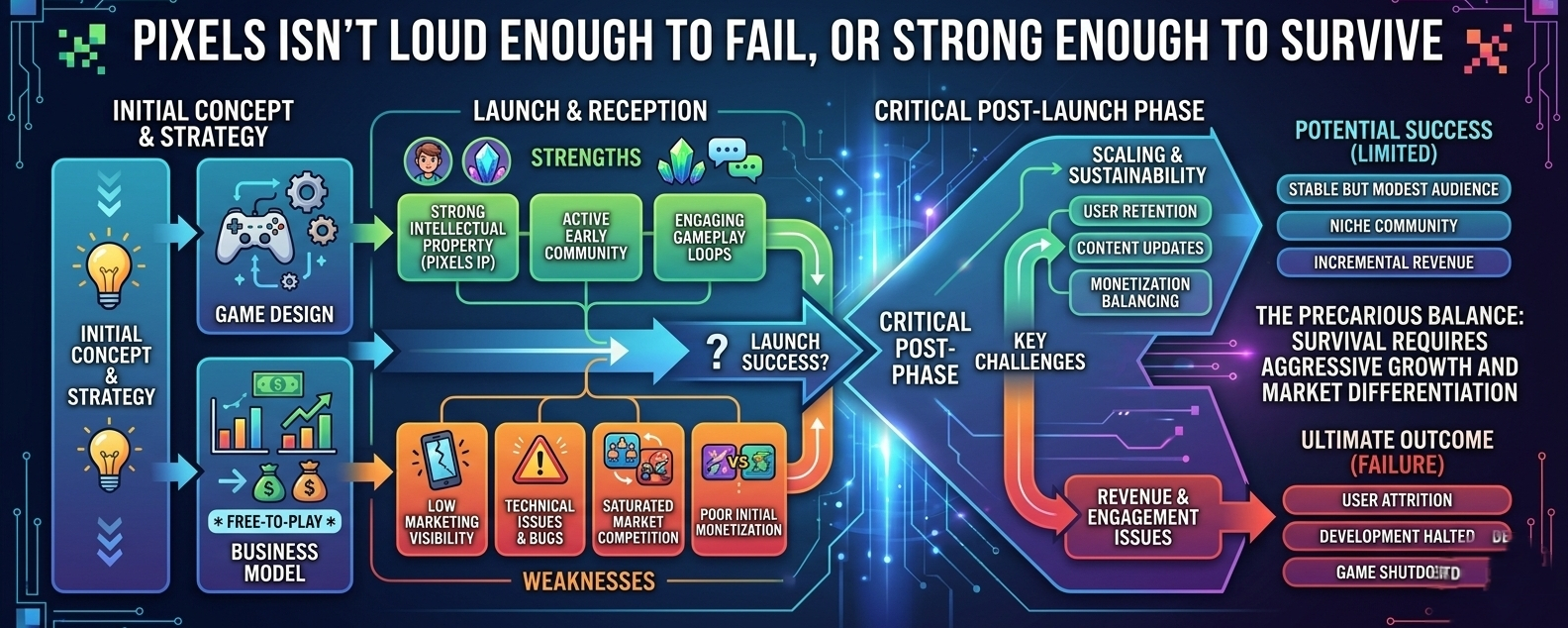
Not that Pixels is poorly designed. It isn’t. If anything, it might be too thoughtful for its own good. It resists the usual tricks. It doesn’t overwhelm you with noise or urgency. It invites you in instead of pulling you in.
But invitation alone doesn’t guarantee people will stay.
There’s also the question of complexity. Not technical complexity, but conceptual friction. Web3 still carries a cognitive cost. Wallets, tokens, ownership semantics. Even when abstracted, they’re still there, sitting just beneath the surface. Most players don’t want to think about any of that. They want frictionless immersion.
Every extra layer, no matter how well designed, is another opportunity for someone to quietly disengage.
And then there’s the token.
PIXEL exists, of course. It has to. That’s part of the structure. But its role feels… unresolved. Not in a broken way. More like it hasn’t fully justified itself yet. It’s present, it functions, but it doesn’t feel indispensable.
That’s a dangerous place to be.
Because if the token isn’t necessary, it becomes speculative. And once speculation takes over, the entire dynamic shifts. Players become traders. Systems get optimized. The world starts bending around price action instead of experience.
I’ve watched that transition happen more times than I can count. It’s subtle at first. Then it’s all you see.
Maybe Pixels can avoid that. Maybe its slower pacing and softer design will resist the usual financialization spiral. Or maybe that’s just wishful thinking from someone who’s tired of seeing the same pattern repeat.
There’s also a broader fatigue in the market now. Not just with games, but with narratives in general. People have heard it all. Ownership, interoperability, digital identity. The words don’t carry weight anymore. They’ve been stretched too thin.
So projects like Pixels are operating in a different environment. Less hype, more skepticism. Which is probably healthier, but also harder.
Good ideas don’t get a free pass anymore. They have to prove themselves in quieter ways. Over longer periods of time.
That’s not easy to do when attention itself has become so fragmented.
I keep coming back to a simple question. If you removed the token entirely, would this still be a place people want to spend time in?
I don’t have a clear answer.
Some days, it feels like yes. There’s something there. A kind of understated charm, a rhythm that doesn’t feel forced. Other days, it feels like it’s still leaning on the same scaffolding as everything else, just with better taste.
And maybe that’s enough. Or maybe it isn’t.
It’s hard to tell from inside the cycle. It always is.
