
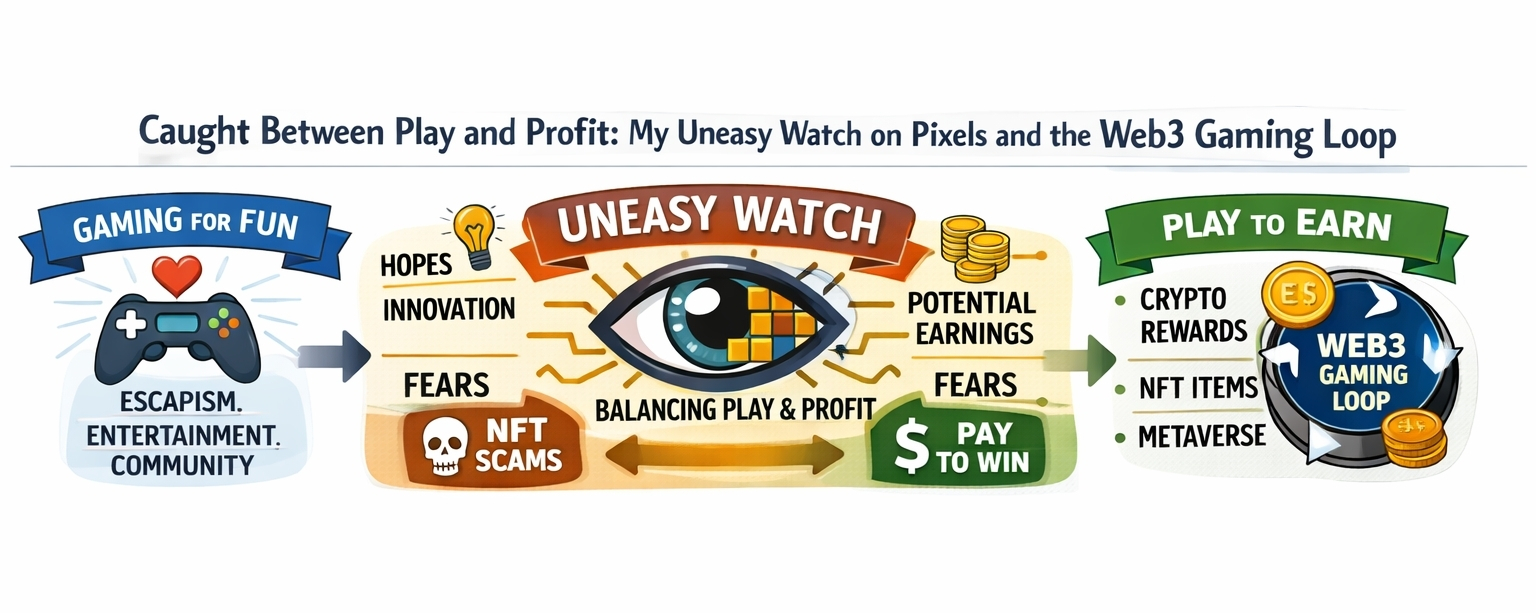

Pixels ($PIXEL) is a social casual Web3 game running on Ronin. Farming, wandering around, building things — simple loops, nothing flashy. And somehow, I keep coming back to it when I’m trying to make sense of what’s actually real in this space.
I was looking at a chart again tonight — not even intentionally — and saw PIXEL catch a random bid out of nowhere. No major announcement, no obvious catalyst. Just volume appearing like it always does, as if the market itself gets bored and starts poking random corners to see what moves. And I had that same dull realization I get more often these days: I’m not surprised anymore. Not impressed either. Just… familiar with it.
We’ve been telling ourselves for years that gaming would be the gateway. Not yield farms, not JPEGs, not whatever the latest AI-token mashup is pretending to be — but actual games. Something normal people could touch without needing a thesis on liquidity cycles. Something that didn’t feel like work disguised as opportunity.
Pixels kind of fits that idea, but only halfway. It’s not trying to be something it’s not. You log in, plant crops, move around, interact, repeat. It’s almost intentionally basic. And weirdly, that’s probably why it worked at all. No grand promises, no cinematic trailers trying to mimic AAA studios. Just a loop that people can understand in five minutes.
And for a while, it actually looked like it clicked. User numbers climbed fast — wallets, daily activity, all the metrics people like to screenshot when they’re trying to prove something is “working.” Ronin itself started waking up again, like someone flipped a switch after a long period of irrelevance.
But then you zoom in a little closer, and the edges start to blur.
Because activity doesn’t always mean engagement. And engagement doesn’t always mean value.
I’ve seen enough cycles now to know that when user numbers spike but revenue or fees don’t follow in a meaningful way, something’s off. Either the system is incredibly efficient… or it’s being gamed. And let’s be honest with ourselves — most of the time, it’s the second one.
Bots aren’t some fringe issue anymore. They’re baked into the structure. Same with airdrop farmers, multi-account grinders, people optimizing behavior not for fun but for extraction. Pixels didn’t invent that dynamic, but it definitely lives inside it.
And that’s where things get uncomfortable. Because on one side, I can’t ignore that Pixels brought real activity back to Ronin. That matters. Chains don’t survive on theory — they need usage, even if it’s messy. But on the other side, I can’t fully convince myself that this usage is… clean, or sustainable in the way people want it to be.
The token reflects that confusion better than any metric. I remember when PIXEL was trading above a dollar and people were talking about it like it had cracked the code. Now it’s sitting at a level that forces you to rethink everything you thought you knew back then. That kind of drawdown doesn’t just happen randomly. It usually means expectations ran too far ahead of reality — again.
And yet, it still moves. Violently sometimes. Sudden bursts of volume, price spikes that don’t quite line up with anything fundamental. I’ve stopped trying to explain those moments. They’re not about the game. They’re about attention — and attention in crypto is its own currency, completely detached from logic most of the time.
One thing I do respect, though, is that Pixels didn’t try to force everything on-chain. That’s a mistake I’ve watched too many projects make. They treat the blockchain like it needs to be involved in every tiny interaction, and then they act surprised when the system slows to a crawl.
Pixels took a different route. Keep gameplay mostly off-chain, let the token handle value where it actually matters. It’s not elegant, but it’s practical. And honestly, practicality feels underrated in a space that keeps chasing purity over usability.
Because the truth is, infrastructure only looks good until people start using it heavily. That’s when the cracks show. Fees spike, confirmations lag, UX turns into friction. I’ve seen “high-performance” chains fall apart the moment real demand shows up. It’s almost predictable at this point.
Ronin already went through that pain once with Axie. You could argue Pixels is a response to that — a quieter, more controlled experiment. Less strain, fewer moving parts, more focus on keeping things stable rather than pushing limits.
But even if the infrastructure holds up this time, the bigger question doesn’t go away.
Why are people here?
I don’t mean that in a philosophical way. I mean it literally. Are they playing because they enjoy it, or because there’s something to extract? Because those two motivations lead to very different outcomes, even if they look the same on the surface.
I’ve watched players in Pixels approach it like a job. Optimizing routes, calculating returns, figuring out the most efficient way to convert time into tokens. It’s impressive in a way, but also a little bleak. The game becomes secondary. The system becomes the focus.
And maybe that’s unavoidable. Once you attach financial incentives to behavior, behavior changes. That’s not a flaw in Pixels specifically — that’s just human nature interacting with design.
Still, I keep thinking about how fragile these systems are. They rely on a constant flow of new participants, not just for growth but for balance. Once that flow slows down, things start to feel different. Rewards shrink, engagement drops, and suddenly the same mechanics that felt exciting start to feel repetitive.
Zooming out, it doesn’t help that the broader market keeps shifting narratives every few months. One minute it’s gaming, then it’s AI, then modular everything, then something else entirely. Capital rotates fast, attention rotates even faster. Projects like Pixels get caught in that rotation whether they deserve it or not.
And maybe that’s why I can’t land on a clean opinion about it.
It’s not a scam. It’s not some revolutionary breakthrough either. It’s something in between — a working product inside a broken context. Or maybe the context isn’t broken, just… misunderstood.
I keep coming back to that idea that we’re trying to force financial layers onto experiences that were never meant to carry that weight. Sometimes it works for a while. Sometimes it even looks sustainable. But eventually, the tension shows up.
Pixels is still here. People are still playing. The token still trades. Ronin still benefits from the activity. All of that is real.
But whether it adds up to something lasting, something that survives beyond cycles and narratives… I honestly don’t know.
And that uncertainty is probably the most honest thing I can say about it.
Because every time I think I’m starting to understand where this space is heading, something like this pulls me back into that same late-night loop — staring at charts, second-guessing assumptions, wondering if I’m watching the early stages of something meaningful… or just another version of the same pattern, repeating itself with slightly different colors.
