

I’ve been thinking a lot about how @Pixels actually works under the hood, and it’s kind of funny how many people assume it’s fully on-chain.
And if it was, it probably wouldn’t even be playable.
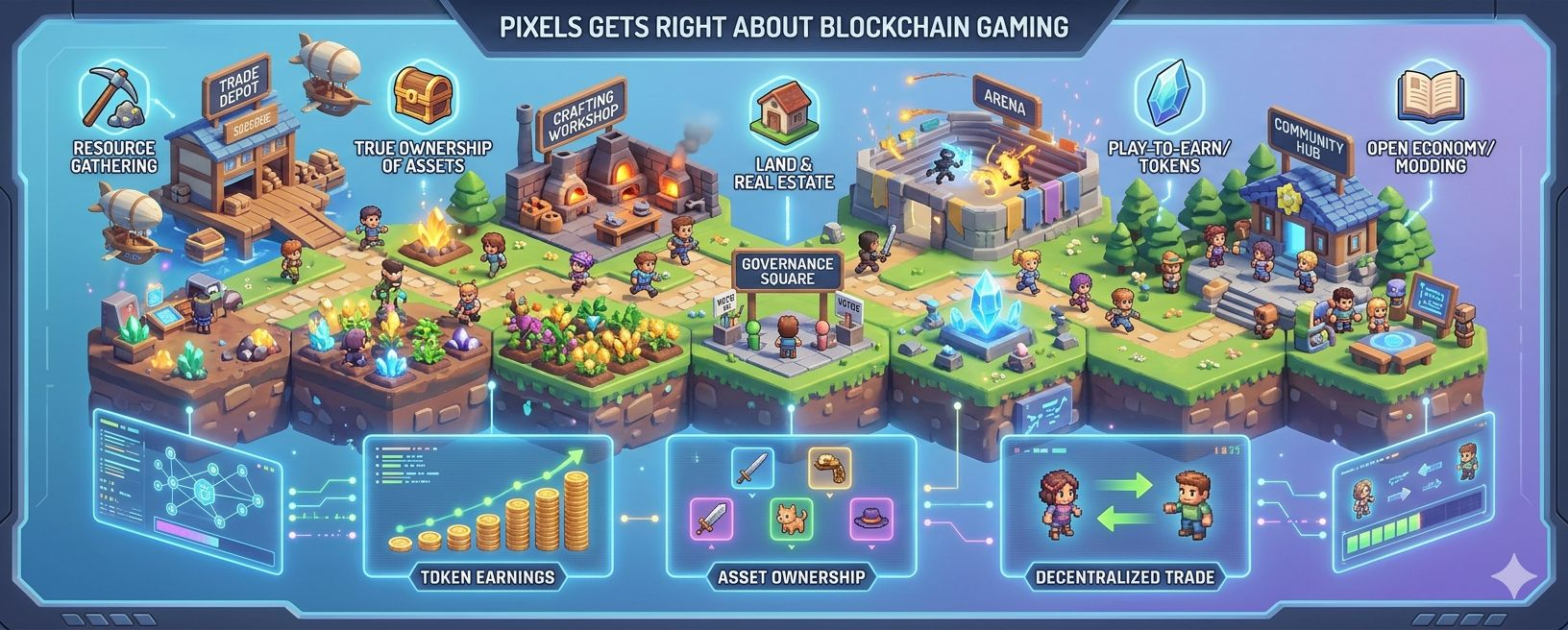
What Pixels does is actually pretty smart. The game itself—like moving around, farming, crafting—all of that runs off-chain. It’s handled the same way most normal online games are. Fast, responsive, real-time. Then the important stuff—ownership, assets, things that actually hold value—that’s what goes on-chain.
At first, I thought, “wait… isn’t that kind of defeating the purpose?” But the more I sat with it, the more it made sense.
If every single action had to go through the blockchain, the game would feel slow and clunky. Nobody wants to wait for a transaction just to plant a crop or move their character. So instead, Pixels keeps gameplay fast by using regular backend systems, and only touches the blockchain when it actually matters.
It’s basically choosing usability over purity.
And under the surface, it’s probably using the same kind of setup most online games use—servers handling player actions in real time, some kind of caching to keep things smooth, maybe in-memory systems for live data. Nothing flashy, just stuff that works.
What’s interesting is that players don’t even notice any of this. You’re just playing the game. You’re not thinking about whether something is on-chain or off-chain, and that’s kind of the point.
But it does make me wonder…
If most of the actual experience is happening off-chain, are we really building “decentralized games”? Or are we just taking traditional games and adding blockchain where it fits?
I don’t think that’s necessarily a bad thing though.
Maybe fully on-chain isn’t the goal. Maybe the real goal is using blockchain only where it actually improves things—like ownership, trading, and trust—while keeping everything else fast and playable.
Because at the end of the day, if the game isn’t fun, none of the tech really matters