
At first glance, everything looks simple. You play, you repeat actions, and over time you expect progress to follow effort. That’s the pattern most players assume. I thought the same.
But after spending more time inside the system, something starts to feel slightly off.
Not in an obvious way.
You can follow the same routine, put in similar effort, and still end up with different outcomes. Not drastically different, but enough to notice a gap. That gap doesn’t feel random. It feels selective.
This is where the idea shifts.
What if Pixels isn’t just tracking how much you do, but how your behavior evolves over time?
Repetition creates efficiency. But it also creates predictability. And once behavior becomes predictable, it becomes easy to replicate. In many systems, replication reduces value.
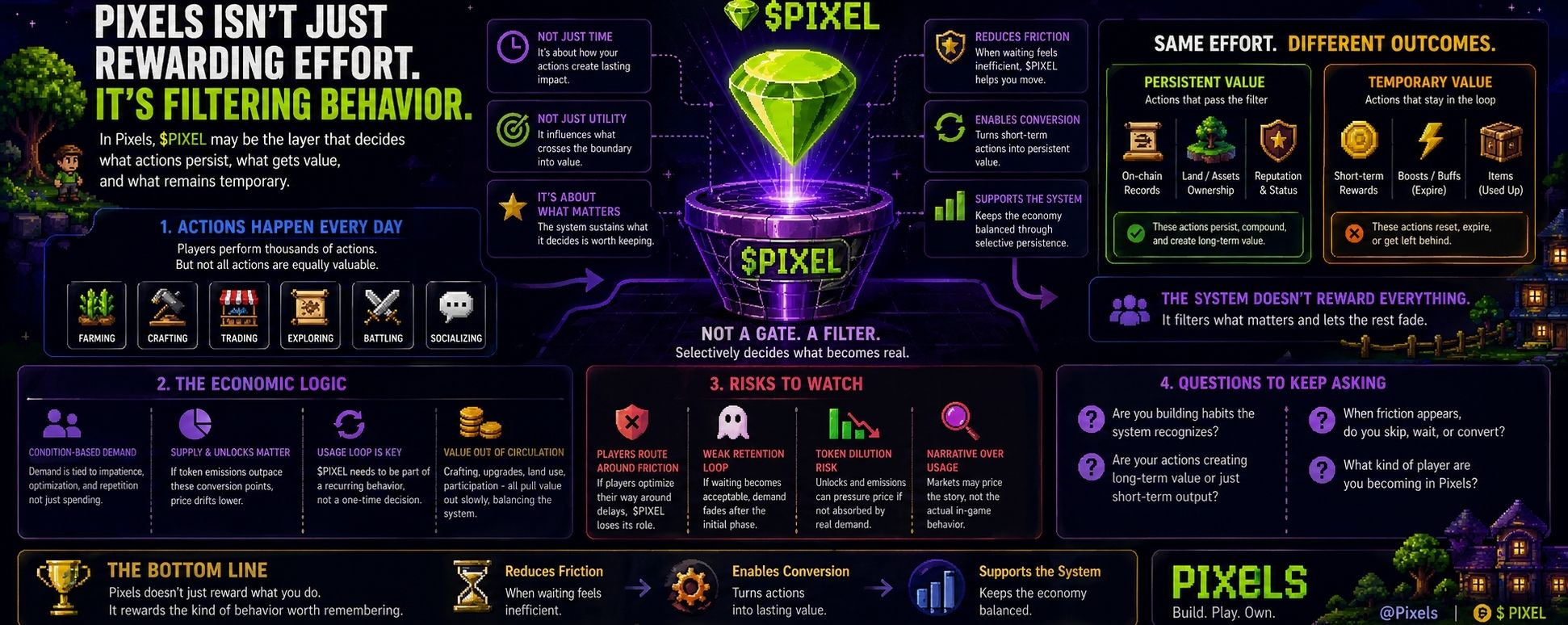
So instead of simply rewarding effort, the system may be filtering behavior.
Some actions pass through and persist. Others remain temporary, even if they look productive in the moment.
And this is where $PIXEL starts to matter.
Not just as a utility token or a speed-up mechanism, but as a layer that influences what crosses from temporary activity into something that holds value.
You can still progress without it.
But when players reach points where waiting feels inefficient or repetition feels less rewarding, $PIXEL quietly becomes part of the decision-making process.
From a broader perspective, this creates a different kind of demand.
Not demand driven purely by spending or player count, but by how often players encounter friction and choose to act on it.
If that behavior repeats, demand sustains.
If players adapt and avoid that friction, the role of the token weakens.
So the real question may not be:
“How much are players doing?”
But rather:
“What kind of behavior is the system actually recognizing over time?”
Because in Pixels, it increasingly feels like rewards are not just given.
They are filtered.