

Bitcoin Realized Dominance tracks where realized capital is concentrated between Short-Term Holders (STH, <6M) and Long-Term Holders (LTH, >6M), showing whether speculation or conviction controls the market.
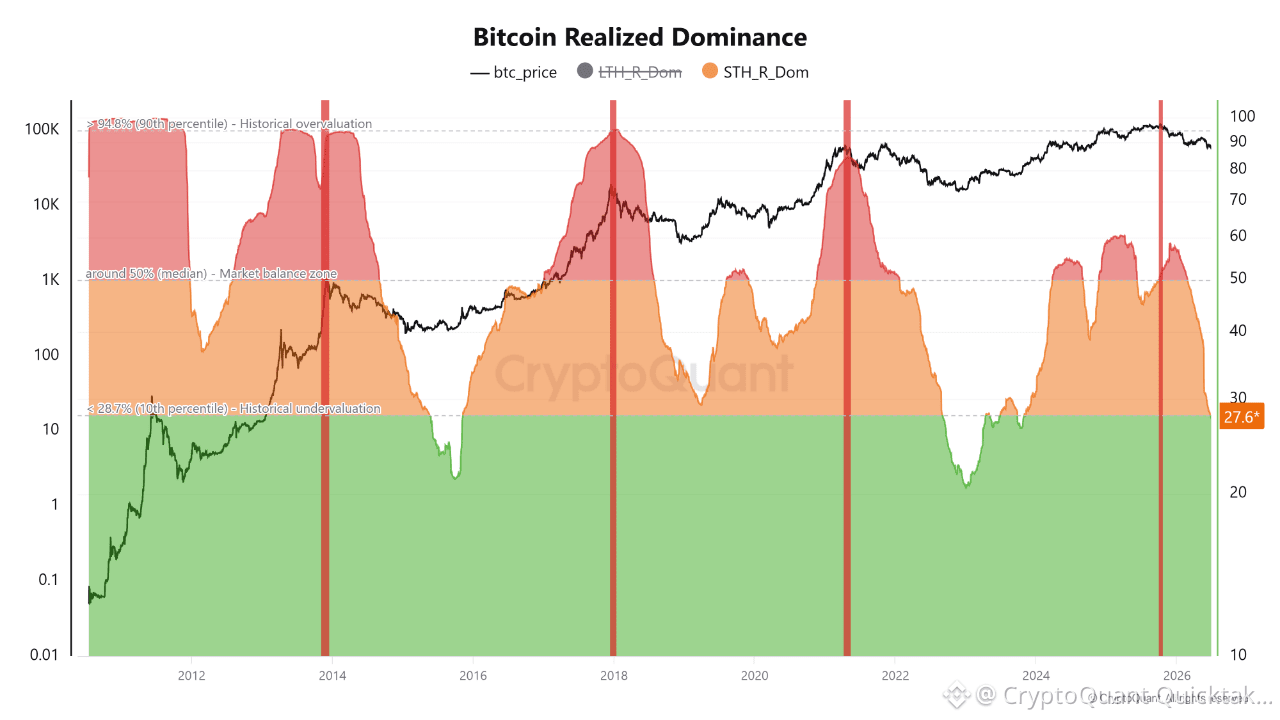
Historically, Bitcoin tops form when STHs dominate realized capital. During euphoric phases, aggressive buyers enter, older coins are redistributed at higher prices, and speculative capital reaches extreme levels. This structure appeared during previous cycle tops in 2013, 2017, and 2021.
Bear markets create the opposite transition. Short-term holders realize losses, their dominance declines, and capital shifts toward long-term holders with stronger conviction and lower realized prices.
Using the full historical distribution of STH Realized Dominance, three statistical zones stand out:
Above 94.8% = extreme speculative dominance (top 10% of historical observations).
Around 50% = historical equilibrium between STH and LTH control.
Below 28.7% = undervaluation zone (bottom 10% of historical observations), where LTHs historically control the majority of realized capital.
Currently, STH Realized Dominance is 27.6%, placing Bitcoin inside this historical undervaluation zone. This structure is closer to previous accumulation phases than cycle tops.
However, historical bottoms are formed through a process. In previous cycles, STH dominance continued declining as more weak hands capitulated before recovery.
The data suggests speculation has already been heavily flushed out, long-term holders are regaining control, and Bitcoin is approaching a structure historically associated with major cycle bottoms. The remaining risk is whether another capitulation phase is needed before the next accumulation cycle begins.
Written by Crazzyblockk