
I did not expect wallet permissions to be the part that stayed with me.
Like most people who have been in crypto for a while I usually end up looking at liquidity, developer activity, network growth or ecosystem adoption first. But while going through @NewtonProtocol I kept circling back to one question. We are moving toward a future where AI agents can trade, pay, bridge assets and interact with applications across multiple blockchains. Who is actually deciding what they’re allowed to do?
That question feels much bigger than AI itself. It feels like one of the next infrastructure problems crypto has to solve.
A lot of the discussion around AI agents is about capability. People talk about agents managing portfolios, executing trades in seconds, paying for services automatically or interacting with decentralized applications without constant human input. Those ideas are exciting but capability is not the same as authorization. Giving an AI agent direct access to a wallet means giving software the ability to move real assets and that changes the conversation completely.
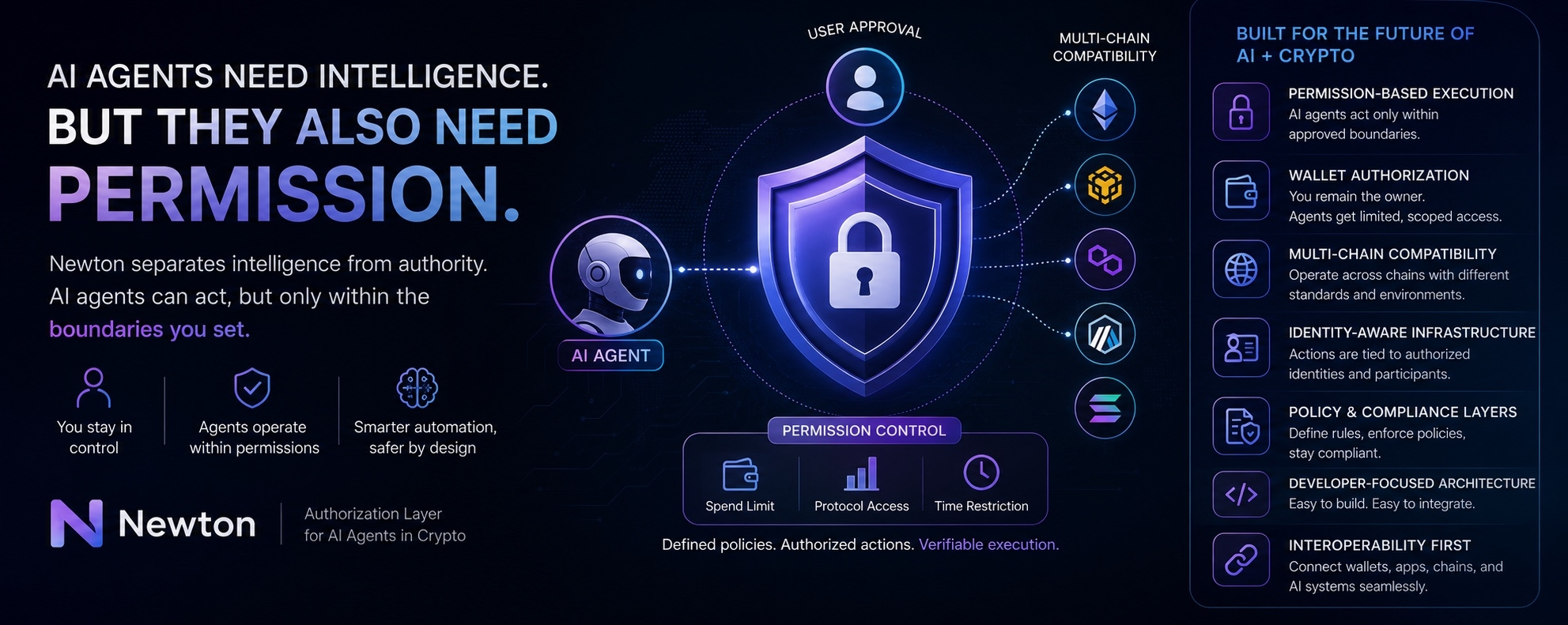
What stood out to me about Newton is that it does not assume an AI should simply take control of a wallet. Instead, it separates intelligence from authority. The user remains in control while the AI operates within permissions that have already been defined. That feels like a much more realistic approach if autonomous agents are ever going to handle meaningful financial activity.
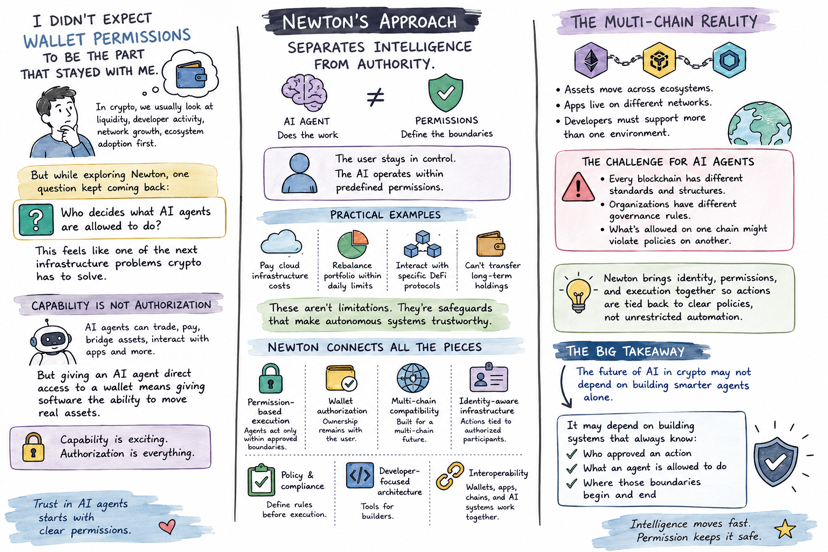
I can imagine practical situations where this matters. Maybe an AI is allowed to pay cloud infrastructure costs but cannot transfer long term holdings. Maybe it can rebalance a portfolio only within a daily spending limit or interact with a specific DeFi protocol without touching the rest of a treasury. Those aren’t limitations. They are safeguards that make autonomous systems far easier to trust.
The other thing that kept coming back to me is how quickly crypto has become a multi chain world. Most users don’t stay on a single blockchain anymore. Assets move between ecosystems constantly applications live on different networks and developers are expected to support more than one environment from day one.
That creates a problem AI agents will eventually have to deal with. Every blockchain has different transaction standards, wallet structures, execution environments, and operational requirements. On top of that organizations may have different internal policies about what an agent is allowed to do depending on where it’s operating. An action that’s perfectly acceptable on one network might violate governance rules on another.
Newton seems to recognize that this is not just a technical challenge. It’s also an authorization challenge. Rather than treating identity, permissions and execution as separate pieces the protocol brings them together so actions can be tied back to predefined policies instead of relying on unrestricted automation. As AI agents become more involved in financial systems that kind of structure feels increasingly necessary.
I also liked that @NewtonProtocol is not focused on a single feature. The design connects several pieces that work together. Permission based execution lets AI agents perform tasks only within approved boundaries instead of giving them unrestricted wallet access. Wallet authorization keeps ownership with the user while allowing automation where it’s appropriate. Multi chain compatibility acknowledges that future applications won’t live on one blockchain alone. Identity aware infrastructure helps associate actions with authorized participants while policy and compliance layers allow developers or organizations to define operational rules before an agent can execute transactions. The developer focused architecture makes those capabilities available for builders and the emphasis on interoperability helps different wallets, applications, blockchains and AI systems work together without every integration having to start from scratch.
The more I read the less I thought $NEWT was trying to build another AI narrative around crypto. It feels like it’s addressing a question the industry can’t avoid forever. AI agents are becoming more capable every year but capability alone doesn’t create trust. If these systems are going to manage assets across multiple chains interact with financial applications and make decisions on behalf of users or organizations then authorisation identity, compliance and clearly defined permissions become just as important as intelligence itself.
That’s probably the biggest takeaway I had. The future of AI in crypto may not depend on building smarter agents alone. It may depend on building systems that always know who approved an action what an agent is allowed to do and where those boundaries begin and end.