
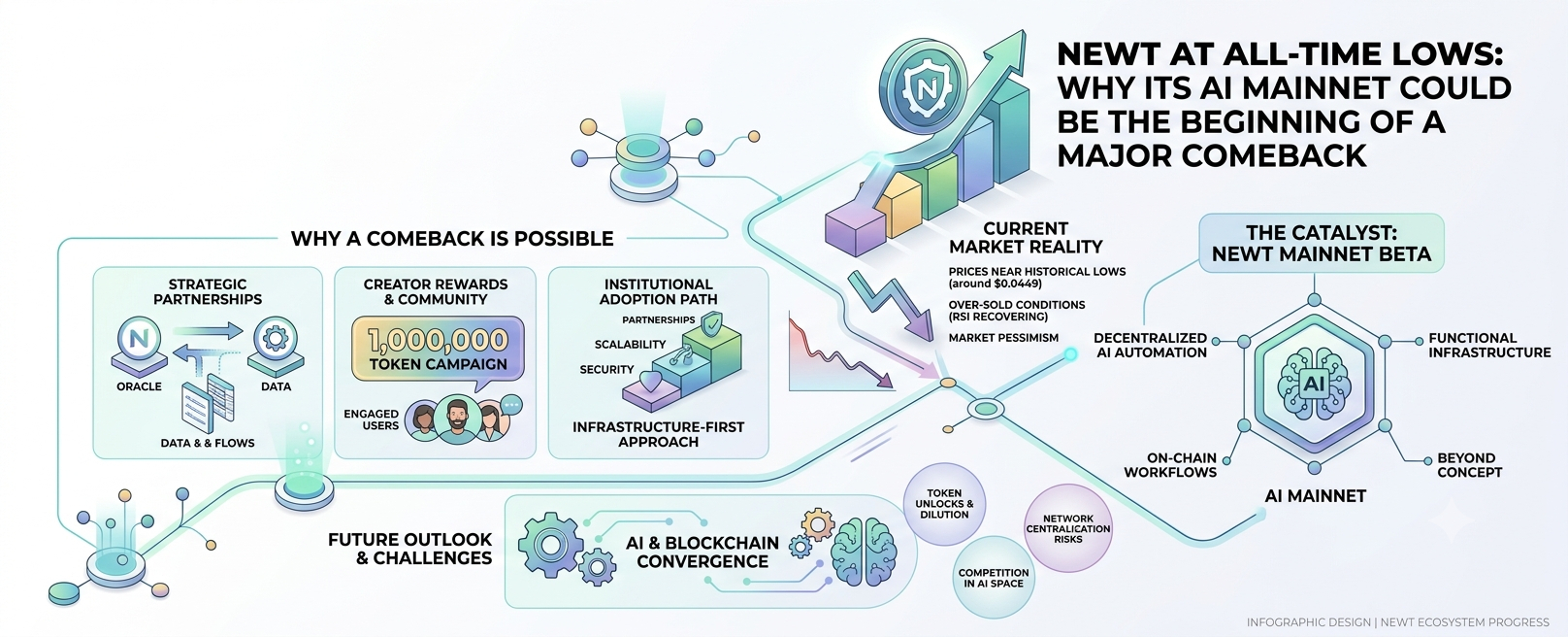
The cryptocurrency market often rewards patience, but it also tests conviction. Few examples illustrate this better than NEWT, a project that currently trades close to its all-time low while simultaneously introducing one of its most significant technological milestones. At first glance, this combination appears contradictory. Investors usually expect a major product launch to drive prices higher, yet the market has kept NEWT under pressure. This disconnect raises an important question: is the current weakness simply another phase of market pessimism, or is it creating an opportunity that long-term participants may eventually appreciate?
NEWT has entered a defining stage of its development. The launch of its Mainnet Beta marks a transition from concept to functional infrastructure, allowing decentralized AI automation to operate in a live blockchain environment. While many blockchain projects spend years discussing ambitious roadmaps, reaching the mainnet stage demonstrates tangible progress. However, financial markets rarely react to technology alone. Sentiment, liquidity, macroeconomic conditions, and investor expectations often play equally important roles in determining short-term price movements.
The recent market performance reflects that reality. Despite achieving an important technological milestone, NEWT continues to trade around the $0.0449 region, placing it near its historical low. Such price action naturally creates uncertainty among traders. Some interpret the decline as evidence of weakening confidence, while others see it as a classic example of markets undervaluing long-term fundamentals during periods of broader risk aversion.
One of the strongest developments supporting NEWT is the successful rollout of its Mainnet Beta. This launch represents more than a software update; it establishes the operational foundation for decentralized AI automation. As artificial intelligence becomes increasingly integrated into business processes, organizations require secure, transparent, and verifiable systems capable of executing automated tasks without relying entirely on centralized platforms. Blockchain technology provides an environment where automation can operate with enhanced transparency, auditability, and trust.
Rather than focusing solely on speculative token demand, the project aims to create practical infrastructure capable of supporting AI-powered workflows. This approach aligns with one of the largest technological trends currently shaping digital innovation. Businesses worldwide continue searching for methods to automate repetitive operations, improve efficiency, and reduce operational costs while maintaining accountability. A decentralized framework offers potential advantages by reducing reliance on single service providers and improving resilience across distributed networks.
Strategic partnerships further strengthen this narrative. Integrations with established oracle providers and risk management infrastructure enhance the project's credibility while expanding potential real-world applications. Reliable data feeds remain essential for decentralized automation because AI systems require accurate external information before making decisions or executing transactions. By incorporating trusted infrastructure partners, NEWT increases the reliability of its automation ecosystem while improving confidence among developers and institutional participants.
Institutional adoption rarely occurs overnight. Large organizations prioritize security, operational stability, regulatory awareness, and proven reliability before integrating emerging technologies. Infrastructure projects that demonstrate careful development, strong partnerships, and scalable architecture generally have a better chance of attracting enterprise interest over time. Although widespread adoption remains a future objective rather than an immediate reality, the Mainnet Beta provides an important first step toward achieving that vision.
Beyond institutional development, NEWT has also introduced initiatives designed to encourage community participation. The launch of a one-million-token creator reward campaign reflects an understanding that successful blockchain ecosystems depend on active users as much as technological innovation. Developers, educators, influencers, and content creators play critical roles in expanding awareness and encouraging adoption across crypto communities.
Community incentive programs often generate increased engagement during important ecosystem milestones. Participants become motivated to produce educational content, tutorials, demonstrations, and discussions that introduce new users to the platform. While incentive campaigns do not guarantee sustainable adoption, they frequently create valuable momentum during the early stages of ecosystem growth. Increased visibility may encourage developers to experiment with decentralized applications while attracting users interested in exploring practical AI automation solutions.
Retail engagement remains another important factor. Cryptocurrency adoption has historically accelerated when communities become actively involved in promoting projects they believe possess long-term potential. Reward campaigns encourage experimentation by lowering participation barriers and creating incentives for individuals to contribute rather than simply speculate on token prices.
Despite these positive developments, market sentiment has remained cautious. Technical indicators recently painted an exceptionally bearish picture, with the Relative Strength Index falling to an extremely oversold level before recovering toward more neutral territory. Such conditions often suggest that selling pressure reached unsustainable levels, allowing buyers to gradually return as valuations became increasingly attractive.
Oversold conditions do not automatically guarantee long-term recoveries, but they frequently signal that market participants may have reacted excessively during periods of panic. The subsequent rebound in trading volume indicates that buyers recognized potential value near historical support levels. Increased activity around these price zones suggests investors continue monitoring the project closely rather than abandoning it entirely.
Technical analysis provides useful insights into market psychology, although it should never be viewed in isolation. Indicators measure investor behavior rather than business fundamentals. A project can remain fundamentally strong while experiencing extended periods of weak price performance if broader market conditions discourage risk-taking. Likewise, technically strong charts cannot compensate for weak long-term utility. Successful investment decisions typically require balancing both perspectives rather than relying exclusively on one analytical framework.
Current price action demonstrates this balance. While momentum indicators continue reflecting caution, they also reveal that selling pressure may be stabilizing after an extended decline. Whether this stabilization evolves into a sustained recovery depends largely on future adoption, ecosystem growth, and overall cryptocurrency market sentiment.
Like every emerging blockchain project, NEWT faces meaningful challenges that deserve careful consideration. One of the most frequently discussed concerns involves network centralization during the project's early operational phase. Initial permissioned operator networks often provide greater stability and security while infrastructure matures, yet they naturally generate questions regarding decentralization principles.
Many blockchain communities place significant importance on distributed governance and open participation. Investors generally prefer systems where validation responsibilities become progressively decentralized over time. If NEWT successfully transitions toward broader network participation as development continues, current concerns may gradually diminish. However, maintaining transparency regarding decentralization milestones will remain essential for preserving community trust.
Market readiness represents another important challenge. Artificial intelligence continues evolving rapidly, but enterprise adoption often progresses more slowly than technological innovation itself. Organizations evaluating decentralized automation solutions typically conduct extensive testing before deploying mission-critical applications. As a result, meaningful adoption may require considerable patience from investors expecting rapid ecosystem expansion.
Competition also deserves attention. The intersection of blockchain and artificial intelligence has become increasingly crowded, with numerous projects attempting to establish leadership across decentralized computing, AI infrastructure, automation platforms, and intelligent agents. Standing out within this competitive landscape requires continuous innovation, developer engagement, reliable execution, and strong partnerships. Technological progress alone rarely guarantees market leadership without consistent ecosystem development.
Tokenomics add another layer to the long-term investment discussion. Approximately fifty-five percent of the project's total one-billion-token supply remains locked across contributor allocations and ecosystem funds. Although no immediate unlock events threaten short-term market stability, future circulating supply expansion naturally introduces dilution considerations for investors evaluating long-term valuation models.
Token unlocks are common across blockchain ecosystems because development teams require funding for ongoing research, ecosystem incentives, partnerships, and operational expenses. The critical factor lies not merely in the existence of locked tokens but in how responsibly those allocations support sustainable network growth. Transparent communication regarding future distribution schedules can significantly reduce uncertainty while improving investor confidence.
The broader cryptocurrency environment also influences NEWT's trajectory. Digital assets rarely operate independently from macroeconomic conditions. Interest rate expectations, institutional capital flows, regulatory developments, and overall market risk appetite frequently shape investor behavior across the entire sector. Even fundamentally strong projects may struggle to gain momentum during periods when capital exits higher-risk assets.
This broader context explains why technological achievements sometimes produce limited immediate price appreciation. Investors often prioritize liquidity preservation during uncertain market conditions, delaying renewed interest until broader confidence returns. Consequently, NEWT's future performance will likely depend not only on internal execution but also on external financial conditions affecting cryptocurrency markets as a whole.
One encouraging aspect of the current situation is that development appears to be continuing despite market weakness. Historically, several successful blockchain ecosystems spent extended periods building infrastructure while token prices remained relatively subdued. Once broader adoption eventually accelerated, earlier development efforts became increasingly recognized by the market. Although history never guarantees future outcomes, infrastructure-first approaches have demonstrated value across multiple technology sectors.
The convergence of blockchain and artificial intelligence remains one of the most closely watched innovation themes within digital assets. AI applications continue expanding into finance, logistics, healthcare, manufacturing, cybersecurity, and enterprise software. As automation becomes increasingly sophisticated, demand for transparent execution environments may continue growing. Decentralized verification, immutable recordkeeping, and programmable smart contracts create possibilities that complement rather than compete directly with traditional AI services.
For NEWT, success will ultimately depend on execution rather than narrative alone. Delivering reliable infrastructure, attracting developers, expanding ecosystem activity, supporting enterprise experimentation, and maintaining transparent governance will determine whether current optimism transforms into measurable adoption. Cryptocurrency markets eventually reward projects that consistently convert technological ambition into practical utility.
Investor psychology will likely remain volatile in the near term. Prices near all-time lows naturally generate emotional responses ranging from fear to cautious optimism. Some participants interpret such levels as warning signs, while others view them as opportunities to accumulate positions before broader recognition emerges. Neither perspective guarantees success because markets continuously reassess information as new developments unfold.
Risk management therefore becomes especially important. Long-term investors often focus on gradual ecosystem progress rather than short-term price fluctuations, while active traders monitor technical signals and liquidity conditions more closely. Each strategy carries advantages and limitations depending on individual objectives, time horizons, and tolerance for volatility.
Ultimately, NEWT stands at an intriguing crossroads. The project possesses meaningful technological progress through its Mainnet Beta, strengthened infrastructure partnerships, expanding community initiatives, and a vision centered on decentralized AI automation. At the same time, it continues navigating significant challenges including market skepticism, early-stage centralization concerns, competitive pressures, and long-term token supply considerations.
These contrasting forces create one of the more interesting narratives currently unfolding within the digital asset landscape. On one side stands an ambitious infrastructure project seeking to establish itself in one of technology's fastest-growing sectors. On the other stands a market that remains cautious, pricing the token near historical lows despite ongoing development. Whether this divergence ultimately narrows through stronger adoption or persists because of execution challenges will become clearer over the coming months.
For observers, developers, and investors alike, the most valuable approach may be focusing less on short-term volatility and more on measurable ecosystem progress. Product development, partnership expansion, user activity, developer participation, and real-world implementation will provide stronger indicators of long-term potential than daily price movements alone. Markets can remain emotional for extended periods, but sustainable value is generally built through consistent execution and genuine utility. As NEWT continues advancing its decentralized AI automation ecosystem, the coming chapters may determine whether today's difficult market conditions become remembered as a temporary setback or the foundation for a much larger growth story.
