
Most conversations around AI and crypto start from the same assumption: smarter models will naturally create better financial products. I'm not convinced that's where the real bottleneck is.
AI has become surprisingly capable at analyzing markets, spotting patterns, and even building trading strategies. None of that is particularly rare anymore. The difficult part begins the moment an AI has permission to move actual assets. Intelligence isn't the scarce resource anymore. Trust is.
That's the problem Newton Protocol is trying to solve.
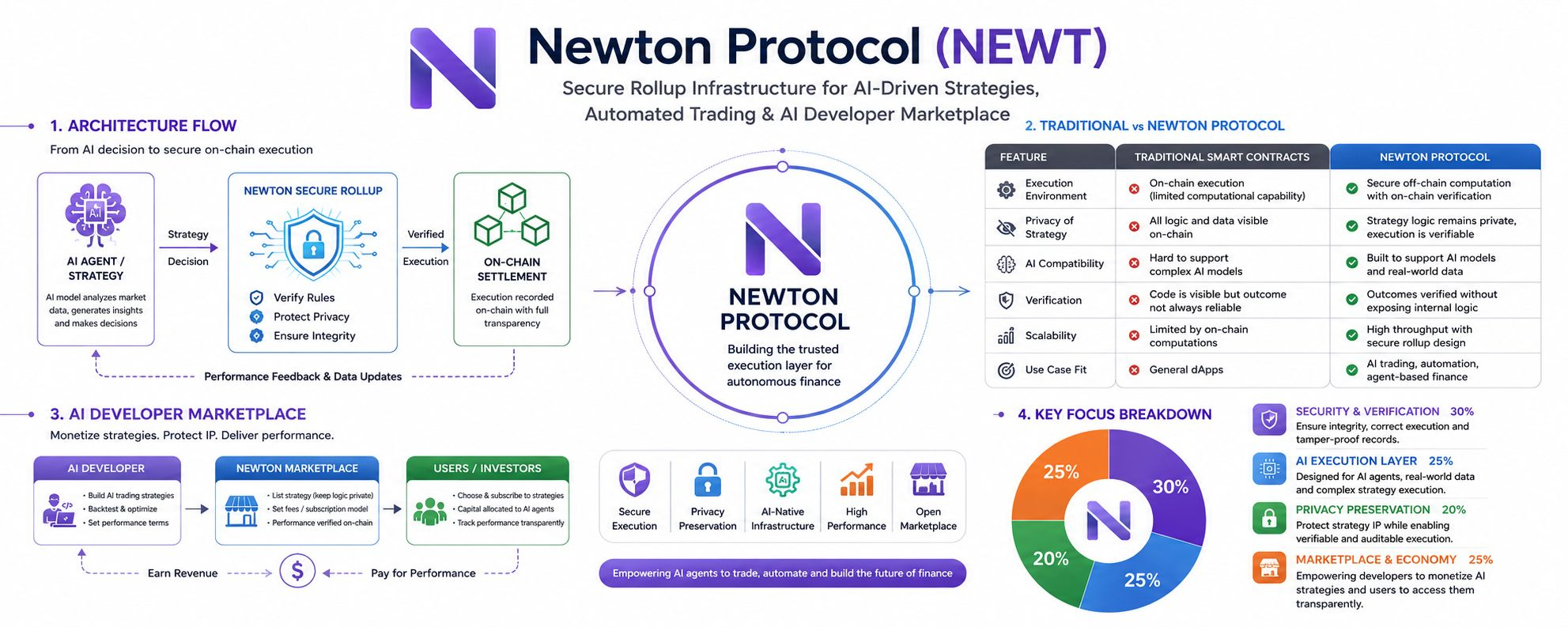
Rather than building another blockchain that happens to mention AI, Newton is designing infrastructure where autonomous agents can execute financial strategies inside a secure rollup. At first glance that sounds like another Layer-2 pitch, but the focus feels different. The goal isn't simply to process more transactions or shave a few cents off gas fees. It's about creating an environment where AI can act without asking users to blindly trust every decision it makes.
That distinction matters more than people realize.
Traditional algorithmic trading has always protected its strategies behind closed doors. The edge wasn't the server or the exchange—it was the logic. Crypto, meanwhile, grew up with an almost ideological belief that everything should be visible on-chain. That works well for simple smart contracts. It becomes much harder once AI enters the picture.
A successful AI strategy is valuable precisely because it isn't obvious.
Newton seems to recognize that transparency doesn't always mean revealing every line of reasoning. Sometimes the more important question is whether a result can be verified without exposing the process that created it. That's a subtle but meaningful shift in thinking.
It's also one of the reasons the protocol's architecture stands out.
Instead of trying to force AI models to run entirely on-chain—a direction that sounds exciting but quickly becomes expensive and impractical—Newton focuses on securing execution. Let AI handle the complex reasoning off-chain while the blockchain verifies that execution follows agreed rules. It feels like a more realistic balance between what AI is good at and what blockchains are good at.
That balance is easy to overlook because the industry often treats AI as something that should live completely on-chain. In practice, most useful AI systems depend on changing data, heavy computation, and models that evolve constantly. Trying to squeeze all of that into blockchain logic usually creates more problems than it solves.
The developer marketplace is another piece that deserves attention.
People often describe it as a marketplace for AI agents, but that description feels incomplete. What's actually interesting is the possibility that developers could license expertise instead of selling code. A profitable trading model doesn't lose its value simply because someone uses it—it loses value when everyone can copy it.
If Newton gets that incentive structure right, developers may have a reason to publish sophisticated AI systems without giving away the ideas that make them profitable.
That could create a healthier relationship between builders and users. Instead of downloading open-source strategies and hoping they're maintained, users interact with specialized AI services while the protocol handles verification behind the scenes.
There's another angle that doesn't get discussed often.
As AI begins making financial decisions, accountability becomes surprisingly complicated. If an autonomous strategy performs poorly, was the issue the model, the market, the execution layer, or the developer? Secure execution records won't eliminate those questions, but they'll make them easier to answer. That's the sort of infrastructure institutions quietly care about long before retail users notice it.
Of course, good architecture alone doesn't build an ecosystem.
Crypto history is full of technically impressive projects that never attracted meaningful adoption. Developers usually follow liquidity, users, and opportunity before they follow elegant engineering. Newton's biggest challenge may not be proving that its technology works—it may be convincing developers that AI-native finance deserves its own execution layer instead of remaining another application on existing chains.
Still, the broader idea feels timely.
For years we've imagined AI replacing human traders entirely. Reality will probably be less dramatic. Most people won't hand complete control of their finances to an AI overnight. What seems far more likely is gradual delegation: letting specialized agents handle narrow decisions while humans stay responsible for the bigger picture.
If that's where financial technology is heading, then trustworthy execution becomes more valuable than ever.
And maybe that's Newton Protocol's most interesting contribution. It isn't trying to build the smartest AI. It assumes smarter AI will keep arriving anyway. The harder challenge is creating an environment where those systems can participate in markets without forcing everyone else to trust a black box.
That's a much less glamorous problem than building another model.
It may also turn out to be the more important one.