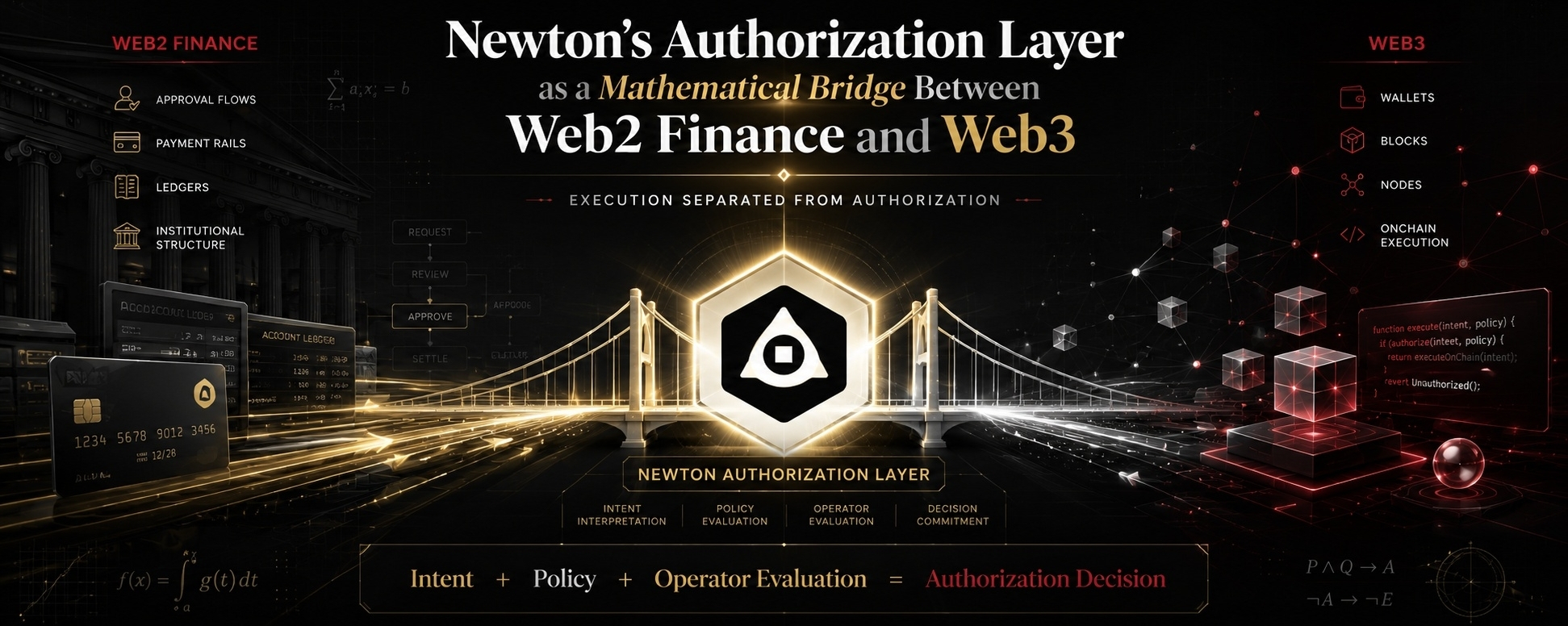
I used to think the bridge between Web2 finance and Web3 was mostly about moving assets from one side to the other
Now I see it differently.
The real bridge is not only technical. It is mental. Web2 finance is built around permission before movement. Web3 is built around execution after a signature. One side asks, “Should this action be allowed?” The other often asks, “Was this action signed correctly?”
That difference looks small, but it changes everything.
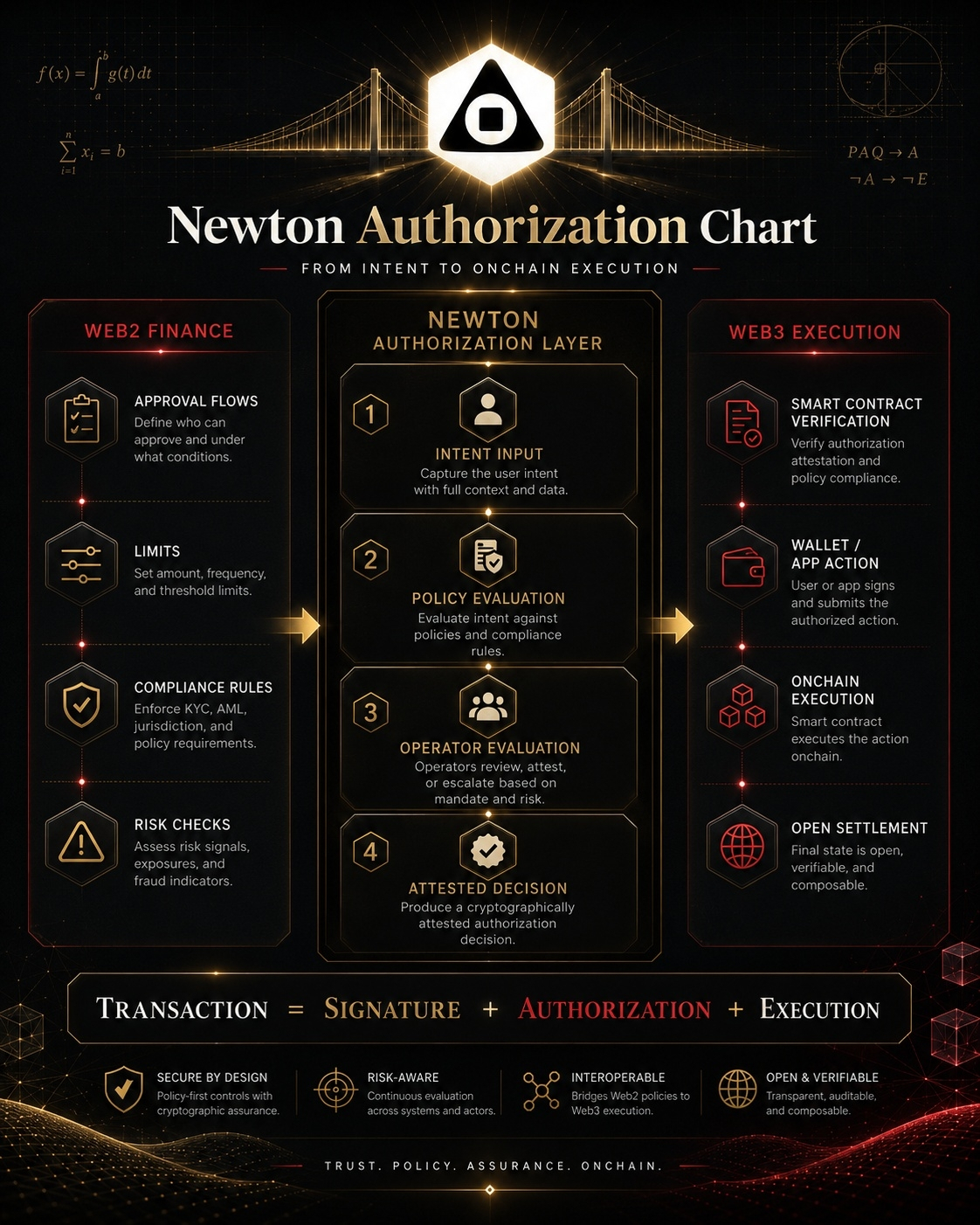
A wallet signature proves control. It does not always prove that the action fits the rule, the limit, the approval, the risk boundary, or the real intention behind the transfer. And for serious finance, that missing step matters a lot.
This is where Newton feels important to me.
Not because it tries to make Web3 look like old finance. That would be boring, and honestly, it would miss the whole point. The stronger idea is that authorization can become clear enough for both worlds to understand.
A transaction intent can be checked before execution. A rule can be written like logic, not like a vague opinion. A policy can say what is allowed, what is not allowed, and under which condition something should move. That sounds simple, but it is a big shift.
Because finance does not only care that value moves.
It cares why it moved.
Who had authority?
Was the amount inside the limit?
Was the destination acceptable?
Was the user still allowed?
Was the action valid at that exact moment?
In Web2, these questions usually sit behind banks, teams, forms, approvals, and internal systems. In Web3, those same questions need a cleaner shape. They need to become something code can evaluate without turning the whole system into a closed gate.
That is why I like the mathematical bridge idea.
Not math as something cold or complicated. More like a clear equation between trust and execution.
Intent goes in.
Policy checks it.
Authorization comes out.
Then execution can happen.
That middle step is what makes the bridge feel real.
Newt Token also fits into this bigger picture for me because the value of a network like this is not only about speculation. It is about whether authorization can become a useful layer in real financial behavior. If institutions, wallets, agents, and onchain systems need rules before movement, then the authorization layer becomes more than background infrastructure.
It becomes the place where trust gets tested before capital moves.
I think people sometimes underestimate that.
They look for the loudest part of Web3. The fastest chain. The biggest liquidity. The sharpest narrative. But in finance, the quiet layer often matters most. The yes or no before the transaction. The rule before the transfer. The boundary before the mistake.
Newton is interesting because it does not frame the bridge as surrendering Web3 to Web2 control. It frames the bridge as making permission programmable, visible, and checkable.
Of course, there is risk here too.
Too much authorization can become friction. Too little authorization can become chaos. The hard part is not just adding rules. The hard part is adding the right rules, at the right point, without killing the open nature that made Web3 powerful in the first place.
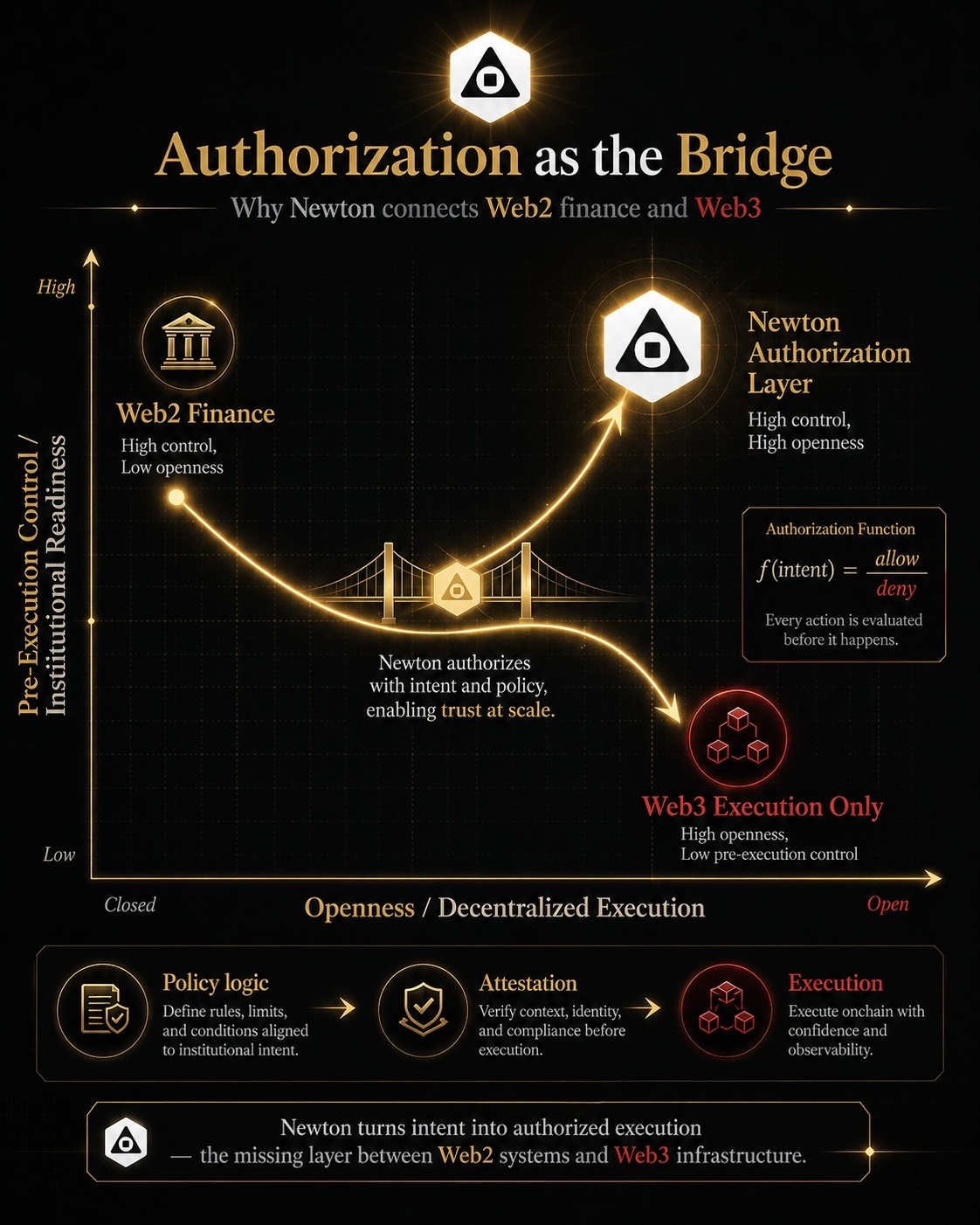
That is the tension I keep thinking about.
Maybe the future of finance is not just faster settlement.
Maybe it is better permission before settlement.
And for me, that is where the bridge really begins.