Newton Protocol: Where AI Narratives Meet Market Reality
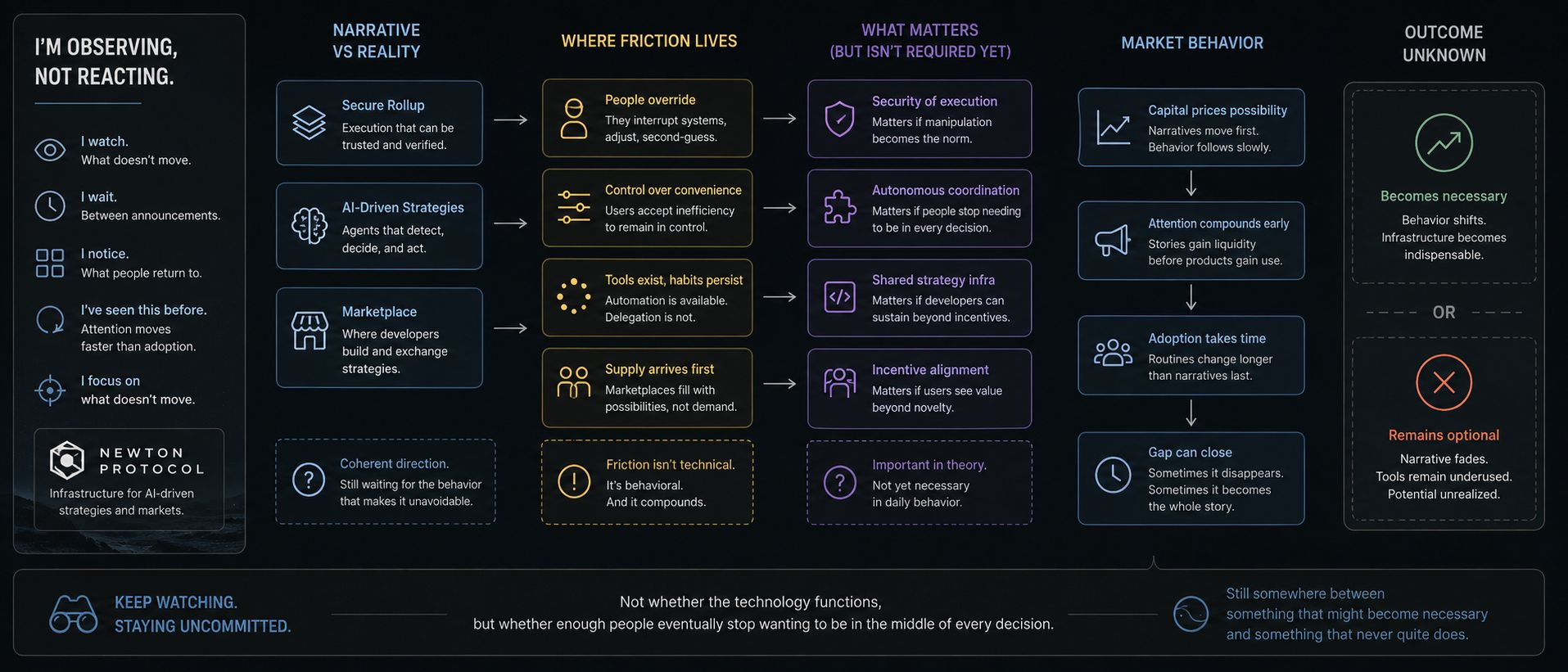
I keep watching what refuses to change. The quiet spaces after announcements. The routines people return to once the conversation fades. I've seen enough cycles to know that attention is rarely the difficult part. Persistence usually is. I find myself looking less at what is introduced and more at what remains untouched.
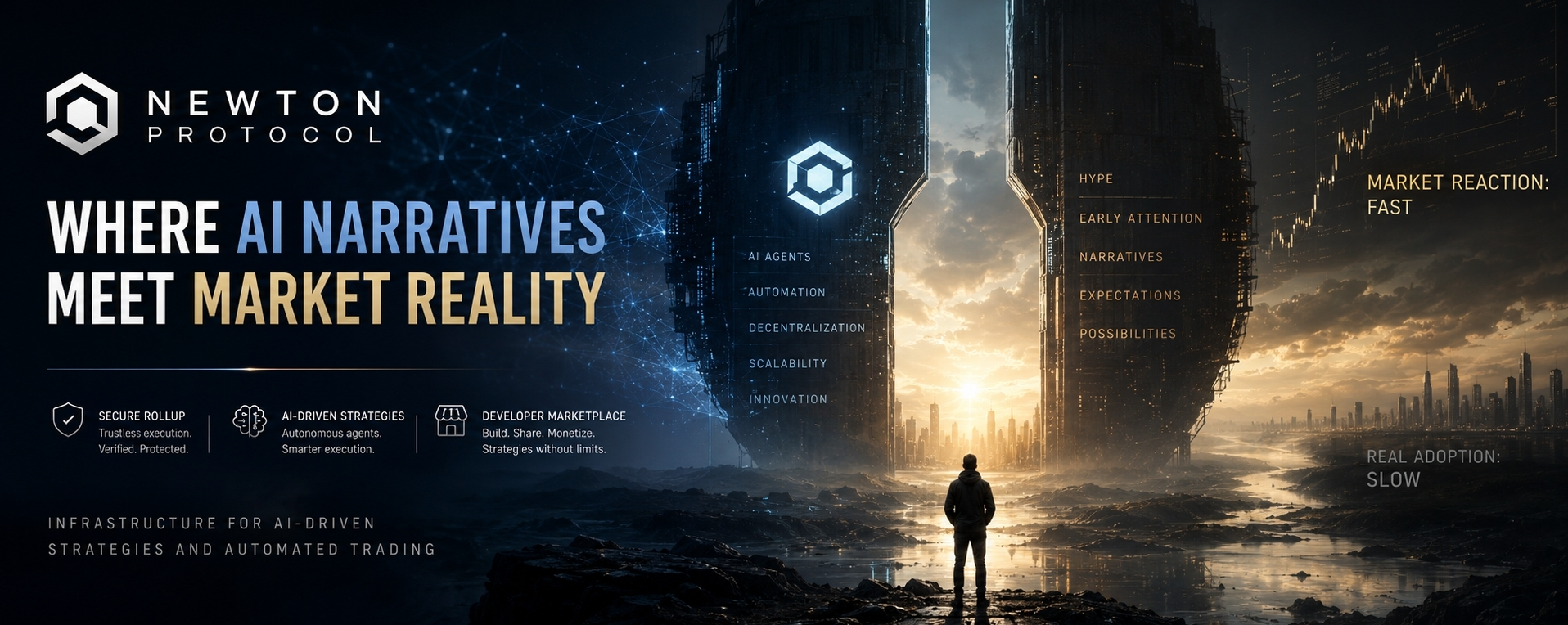
Newton Protocol appears in a familiar place. AI-driven strategies. Secure execution. Automated trading. A marketplace where developers can build and exchange intelligent systems. None of those ideas arrive quietly anymore. The market already knows how to react before it knows how to use them.
That has become its own pattern.
The protocol seems to assume a future where decisions increasingly belong to software, where execution demands stronger guarantees than trust alone can provide. It feels like infrastructure designed for behavior that hasn't fully arrived. The architecture points forward. Daily habits continue looking sideways.
People still hesitate at the moment they claim to automate.
Strategies become manual after losses. Rules become flexible after volatility. AI may generate decisions, but many users still want the final interruption to belong to themselves. That instinct survives every new cycle. Technology advances. Control remains difficult to surrender.
I don't think this is a technical limitation.
It feels more like timing.
Markets have always been willing to finance possibilities before they experience necessity. Narratives spread with remarkable efficiency. Infrastructure often waits much longer for the conditions that justify its existence. Capital learns new language almost immediately. Behavior rarely does.
Newton Protocol sits inside that distance.
A secure rollup for autonomous execution sounds increasingly relevant if AI agents become trusted participants rather than experimental tools. Yet relevance is not the same as routine. Most infrastructure projects are built around futures that exist more clearly in expectation than in everyday practice.
The marketplace tells a similar story.
Developers can build. Strategies can circulate. Systems can become composable. The framework exists. But marketplaces rarely struggle to attract ideas. They struggle to produce repeated use. Supply often appears first because possibility is easier to create than dependence.
That gap deserves more attention than the architecture itself.
The market seems comfortable assigning value to coordination before coordination becomes ordinary. It prices narratives while people continue relying on familiar workflows. There is nothing irrational about that. Markets speculate. Users adapt slowly. Those two speeds rarely move together.
Sometimes they eventually meet.
Sometimes they never do.
None of this makes Newton Protocol less interesting. If anything, it makes the project more difficult to evaluate honestly. Its direction feels coherent. Its assumptions feel reasonable. Its timing remains uncertain. Those are different observations, even if they often become confused.
I find myself returning to the same question without expecting an immediate answer.
Not whether secure infrastructure for AI agents can exist.
Whether enough people eventually reach the point where they no longer want to remain inside every decision they automate.
Until that changes, I keep watching the distance between what attracts conviction and what quietly becomes indispensable. Newton Protocol still seems suspended somewhere inside that space. I can't tell whether it is waiting for the future to arrive—or whether the future simply enjoys talking about itself before it learns to use its own tools.