
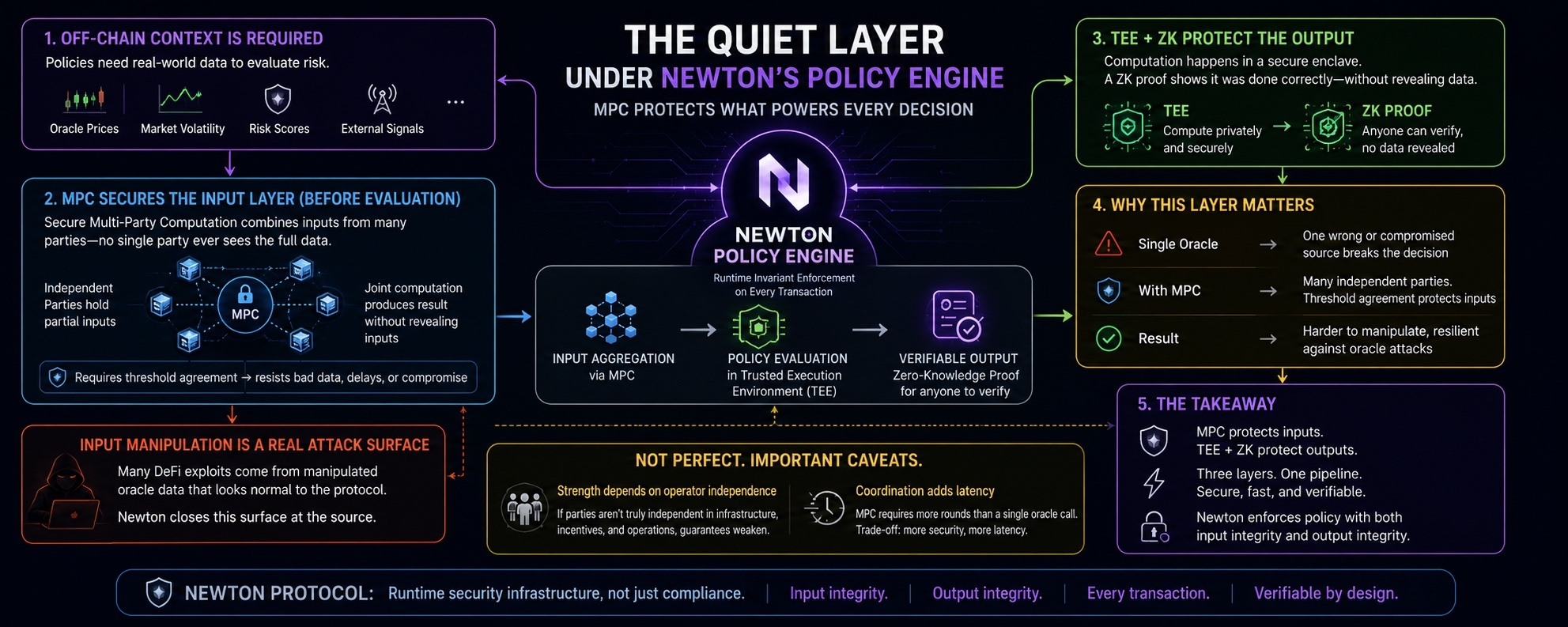
Most people who look into Newton Protocol's security architecture stop at the headline pairing: Trusted Execution Environments for fast policy evaluation, zero-knowledge proofs so anyone can verify the result without trusting the hardware vendor. It's a good pitch, and it's accurate. But it skips a layer that sits underneath both of them, and I think that layer is doing more quiet work than either of the two everyone talks about.
Before a policy ever evaluates a transaction, it needs inputs. Oracle prices. Market volatility readings. Risk scores from external providers. That off-chain context has to get into the evaluation somehow, and how it gets in matters just as much as how the evaluation itself gets verified. Newton routes that context through secure multi-party computation before a policy ever touches it, rather than pulling it from a single trusted data source.
Here is what MPC actually buys that a single oracle call does not. In a standard setup, one entity holds the complete input data and computes a result from it. If that entity is wrong, delayed, or compromised, the policy inherits the flaw silently, because from the policy's perspective the input just looks like a normal number arriving on schedule.
MPC changes the shape of that trust problem. The computation gets split across multiple independent parties, and no single party ever sees the complete input on its own. The final result only emerges when enough of the parties agree, using protocols that let them jointly compute a function over private inputs without revealing those inputs to each other. If one party is compromised or wrong, the others do not automatically inherit that error, because the result depends on agreement across a threshold of independent computations.
I think this is the part of Newton's stack that gets the least attention specifically because it is the least visible. TEEs and zero-knowledge proofs protect the output of a policy decision, the reason a curator or a regulator can trust a decision was computed correctly and was not tampered with after the fact. MPC protects the input side, the reason a decision cannot be quietly gamed before it is even evaluated by feeding the policy engine a corrupted signal dressed up as legitimate data.
That distinction matters once you think about how an attacker would actually try to break a system like this. Attacking the output verification layer means breaking a zero-knowledge proof or compromising a TEE, both hard, well-studied problems. Attacking the input layer means finding a single point where bad data gets treated as trustworthy. Oracle manipulation attacks, where a single price feed gets pushed to an extreme value momentarily to trigger a bad liquidation or a bad policy decision, are a well-documented category of DeFi exploit precisely because so many protocols still rely on one oracle source for a critical decision. By routing context signals through MPC first, Newton closes that specific surface at the input stage rather than only hardening the output.
It is not a flawless design. MPC's guarantees are only as strong as how many genuinely independent parties participate, not just how the architecture reads in documentation. If the parties are not meaningfully independent in infrastructure, incentives, and operational control, the theoretical benefit collapses toward the same single point of failure MPC was meant to eliminate. Newton's public materials describe the mechanism but do not fully disclose operator diversity for this specific layer the way they do for the EigenLayer-secured network evaluating policies downstream, which is a reasonable thing to want more visibility into as the system scales toward institutional volume.
There is also a coordination cost MPC carries that a single oracle call does not. Multiple parties computing a joint function over private inputs takes more communication rounds than one party returning a number, adding latency at the exact point where Newton's value proposition depends on fast, pre-transaction evaluation. Every layer of security added at the input stage is also a layer of latency added to the moment a user is waiting on a transaction to clear, and depending on how MPC rounds are structured and parallelized in production, that trade could look very different under real load than in a design document.
What I find most interesting about this choice is what it implies about how the team thinks about failure modes generally. A team that only cared about the marketable story would have stopped at TEE plus zero-knowledge proof, the pairing that is easy to explain and sounds rigorous on its own. Building a third layer specifically to protect the input side, one that is genuinely harder to explain and does not fit a punchy one-line pitch, suggests engineering against a threat model that includes input manipulation, not just output tampering.
Newton Protocol is not just a compliance checklist wearing a blockchain badge. It is a policy engine that layers Trusted Execution Environments, zero-knowledge proofs, and secure multi-party computation into one evaluation pipeline, protecting the output of a decision and the inputs feeding it at the same time. Newton treats input manipulation as seriously as output tampering, a completeness most protocols in this space still skip. Newton runs this evaluation on every single transaction, not once at onboarding, while keeping the computation verifiable without exposing the private data behind it. That combination of speed, verifiability, and input-level trust distribution is what makes Newton's security claims worth taking seriously past the marketing headline.
@NewtonProtocol #Newt $NEWT $LAB
