
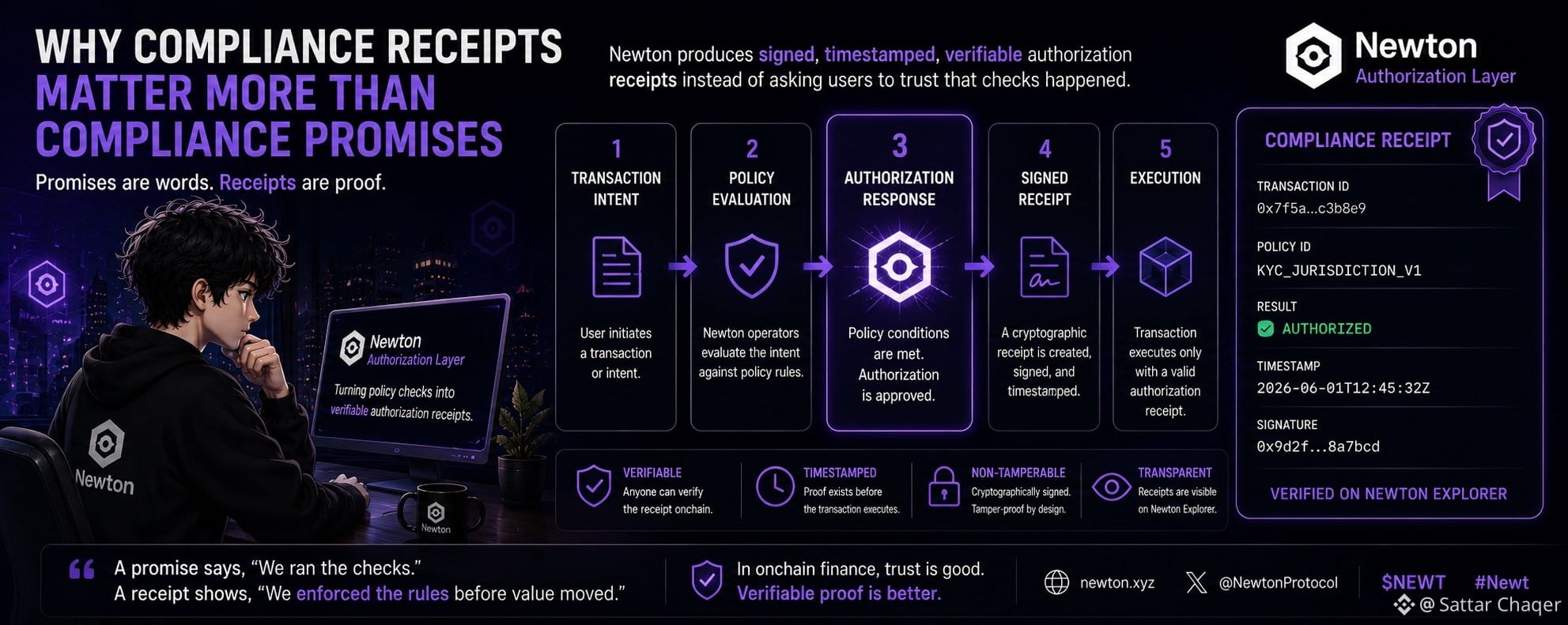

One thing I keep coming back to in onchain finance is how often compliance is described as a process instead of demonstrated as an outcome.
A platform says it screened a wallet. A vault manager says it followed the mandate. A protocol says it checked the relevant rules before allowing an action to proceed. In each case the user is being asked to trust that the right controls existed somewhere in the workflow.
That may have been acceptable when crypto was smaller and mostly self contained. But the more capital moves onchain the less convincing those promises become.
The problem is simple a compliance promise is an internal claim. It tells you what a team says happened. It doesn’t necessarily give you proof that the rule was actually enforced on the specific transaction that moved value.
That is where Newton’s idea of an authorization receipt becomes much more interesting than a normal compliance workflow.
Instead of saying the checks happened Newton’s model is designed to produce a signed timestamped verifiable authorization result tied to a specific transaction intent. In other words the system doesn’t just claim that a policy was applied. It creates a record showing that the policy was evaluated before execution and that the transaction was allowed to proceed only after that evaluation succeeded.
That difference matters more than it first appears.
A promise is soft. It lives in a process document a dashboard a compliance report or a team’s internal controls. It may still reflect a real effort but it depends on trusting the operator who describes it.
A receipt is harder. It is attached to the transaction path itself. It is evidence that the authorization layer produced an outcome for this specific action under this specific policy at this specific point in time.
That shift changes the role of compliance in the system.
Instead of being something a platform says it did compliance becomes something the infrastructure can show.
Newton’s architecture is built around this idea. Before a transaction settles operators evaluate the transaction intent against the relevant policy. If the policy conditions are satisfied the network produces an attestation authorizing the transaction to move forward. That authorization result is not just an internal green light. It becomes a verifiable output of the system designed to be checked independently rather than accepted on trust.
I think this is one of the most important distinctions in the whole protocol.
Crypto already has plenty of systems that can tell you what happened after the fact. Analytics tools monitoring dashboards, compliance vendors and risk platforms can all help reconstruct activity once a transaction has already occurred. But that is different from proving that a rule was enforced before the transaction executed.
Newton is trying to move the proof closer to the moment of authorization itself.
That’s why the phrase compliance receipt feels more useful than just attestation in practical terms. A receipt implies that something happened and left a record. In Newton’s case the record is tied to pre execution enforcement rather than post hoc reporting. The protocol is effectively saying this transaction was checked this policy was evaluated and this authorization result existed before value moved.
That creates a very different trust model.
Without a receipt the user or allocator is often left evaluating a system based on reputation process descriptions or assurances from the operator running it.
With a receipt the question becomes narrower and stronger.
Was there a verifiable authorization result for this transaction or not?
That is a much cleaner standard than asking whether a platform generally claims to have good controls.
Newton’s materials keep returning to this point from different angles. The mainnet beta announcement describes Newton as adding a step between transaction initiation and settlement where the protocol checks policy and writes a signed record onchain that anyone can verify. The authorization layer material uses similar language emphasizing that Newton doesn’t just monitor activity but enforces what is allowed before value moves and records the result in a legible form.
That’s a very different posture from most compliance language in crypto.
Normally the message sounds like this.
we have controls
we run checks
we review risk
we monitor behavior
Newton’s model changes the burden of proof.
Instead of asking others to believe those statements it tries to produce an authorization artifact that can be independently inspected.
The Persona integration makes the same point in a more concrete way. Newton describes its decentralized operator network as performing evaluations and producing a cryptographic attestation a compliance receipt recorded onchain and visible in the Newton Explorer. Smart contracts can then require that attestation at execution time which means a transaction without a valid receipt does not execute.
That is the part I find most important.
The receipt is not just a passive record for an auditor to look at later. It can become part of the actual transaction gate. If the receipt does not exist the transaction should not proceed. That turns the receipt from documentation into enforcement infrastructure.
And once you look at it that way the phrase compliance promise starts to feel much weaker.
A promise can still be broken bypassed forgotten or interpreted differently in practice.
A receipt is narrower and more mechanical. It doesn’t tell you that a team cares about compliance. It tells you whether the system produced proof that the required checks were actually passed for the action in front of it.
For onchain finance that feels like a much more useful standard.
Especially as the ecosystem tries to support larger pools of capital more constrained financial products and users who need something stronger than trust us we ran the checks.
Newton’s receipt model points toward a different answer.
Don’t just describe the controls.
Leave evidence that they were enforced.