When I hear people describe casual Web3 games as “finally ready for mass adoption” my first instinct is not excitement but hesitation because for years that claim has been repeated in cycles while the actual player experience remained fragmented, unintuitive and overly dependent on systems that felt more like financial tools than entertainment environments which is why when I look at Pixels on Ronin what stands out is not the promise of ownership or tokens but the way it quietly attempts to remove the constant friction that made casual gaming in Web3 feel anything but casual.
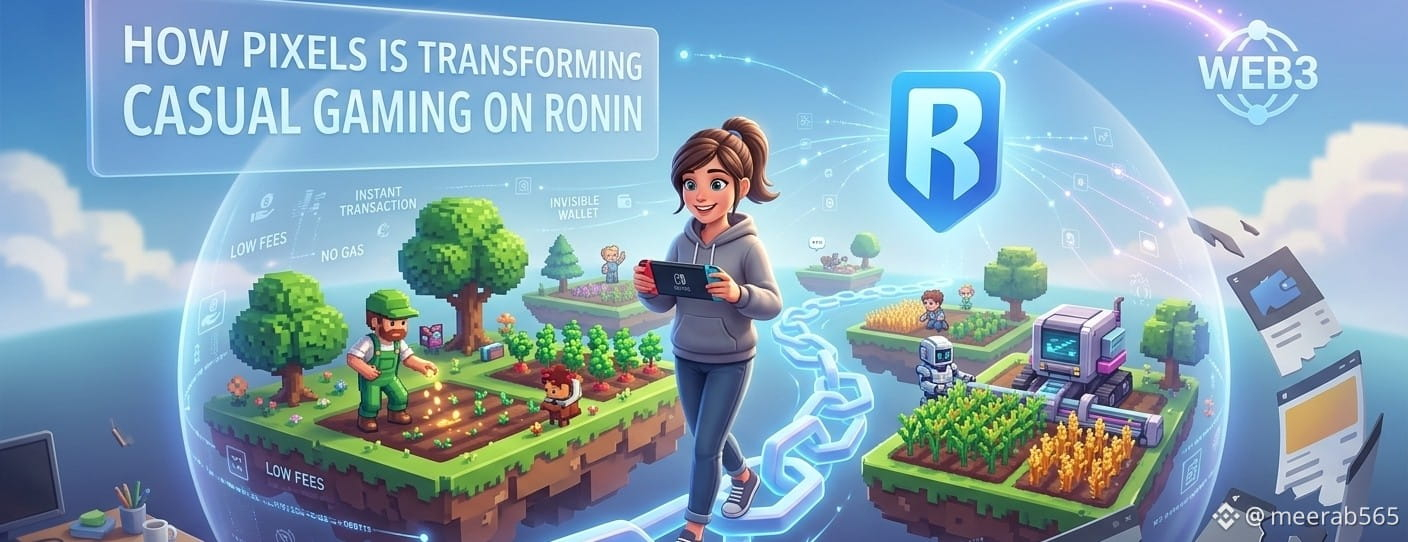
The real issue Pixels addresses is not that players lacked access to games but that the structure surrounding those games demanded too much cognitive overhead from users who simply wanted to log in, play, progress and leave without thinking about wallets, bridges, gas fees or asset management and by focusing on farming, exploration and social interaction within a persistent open world Pixels reframes the experience away from “interacting with blockchain” and toward “participating in a living game environment that just happens to be on chain.”
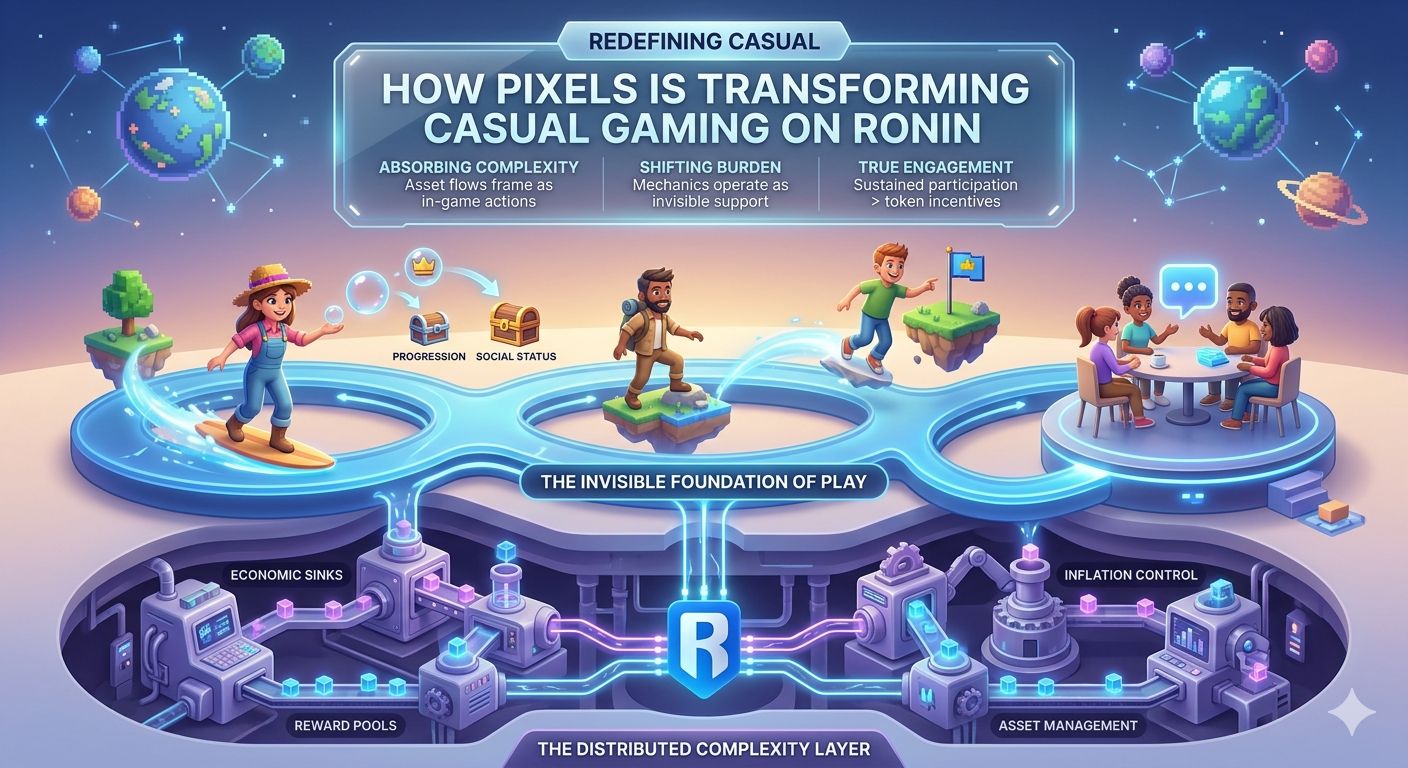
In the traditional Web3 gaming model, players were often forced into a sequence of preparatory steps before they could even begin enjoying the core loop, where acquiring tokens, setting up wallets and understanding transaction mechanics became prerequisites rather than optional layers and this created a dynamic where the most dedicated users were not necessarily the ones who enjoyed the game the most, but the ones who tolerated the surrounding infrastructure the best whereas Pixels shifts this burden by embedding these mechanics into the background allowing the gameplay loop to surface first and the blockchain layer to operate as invisible support rather than a constant interruption.
What makes this shift more meaningful is not simply that Pixels is easier to access, but that it changes where the complexity lives because instead of pushing users to manage assets manually and make constant micro decisions about transactions, the system begins to absorb those responsibilities into the game design itself which means that resource management, progression and even economic participation are framed as in game actions rather than external tasks creating a smoother cognitive flow that aligns more closely with how traditional casual games retain engagement.
However this abstraction does not eliminate complexity it redistributes it into the underlying infrastructure where asset flows, reward balancing and economic sinks must be carefully managed to prevent inflation, exploitation or disengagement and this introduces a different kind of challenge where the developers and ecosystem operators are no longer just building gameplay mechanics but are effectively managing a live economy that must remain stable while still feeling rewarding and fair to a diverse player base.
This is where the role of the Ronin network becomes particularly important, because by providing a more controlled and gaming-focused environment compared to general purpose blockchains, it allows Pixels to optimize for speed, cost efficiency and user experience in ways that would be harder to achieve in more congested or generalized ecosystems and this alignment between infrastructure and application creates a tighter feedback loop where improvements in one layer can directly enhance the other.
At the same time the success of this model introduces new forms of dependency that are easy to overlook because as players become accustomed to seamless interactions and low-friction gameplay, their expectations shift from “this is impressive for Web3” to “this should just work” and this raises the stakes for reliability, consistency and performance since any disruption in the underlying systems will be experienced not as a technical issue but as a failure of the game itself.
There is also a subtle but important transformation happening in how players perceive ownership and value because instead of being explicitly told that their assets are on chain and therefore valuable they begin to experience value through gameplay outcomes such as progression, customization and social status within the game world which means that the blockchain aspect becomes meaningful not as a selling point but as an enabler of persistence and interoperability that supports the player’s journey without dominating it.
From a competitive perspective this approach positions Pixels differently from many other Web3 games that still rely heavily on token incentives as the primary driver of engagement because it suggests that long term retention will not come from rewards alone but from creating an environment where players feel naturally invested in their activities, their land and their interactions with others and this shifts the focus from short term extraction to sustained participation.
What becomes particularly interesting in this context is how the in-game economy evolves as more players join and interact with the system because the balance between resource generation, consumption and trade will determine whether the game remains engaging or becomes saturated and managing this balance requires continuous adjustment and a deep understanding of player behavior which effectively turns the game into a dynamic system rather than a static product.
This is why the transformation Pixels represents is not just about making casual gaming on Ronin more accessible, but about redefining what “casual” means in a Web3 context where the goal is not to simplify the system by removing depth but to hide that depth behind intuitive interactions that allow players to engage at their own pace without feeling overwhelmed by the underlying mechanics.
If there is a broader takeaway from this shift it is that the future of Web3 gaming may depend less on introducing new features and more on deciding which parts of the system players should never have to think about because the more invisible the infrastructure becomes the more space there is for genuine gameplay experiences to emerge, and Pixels appears to be moving in that direction by treating blockchain not as the centerpiece of the experience but as the foundation that quietly supports it.
So the more important question is not whether Pixels can attract users with its current design but whether it can maintain a balance between simplicity and depth as the ecosystem grows because the real test of this model will not be how it performs in stable conditions, but how it adapts to changes in player behavior, economic pressure and network dynamics without reintroducing the very friction it set out to eliminate.