
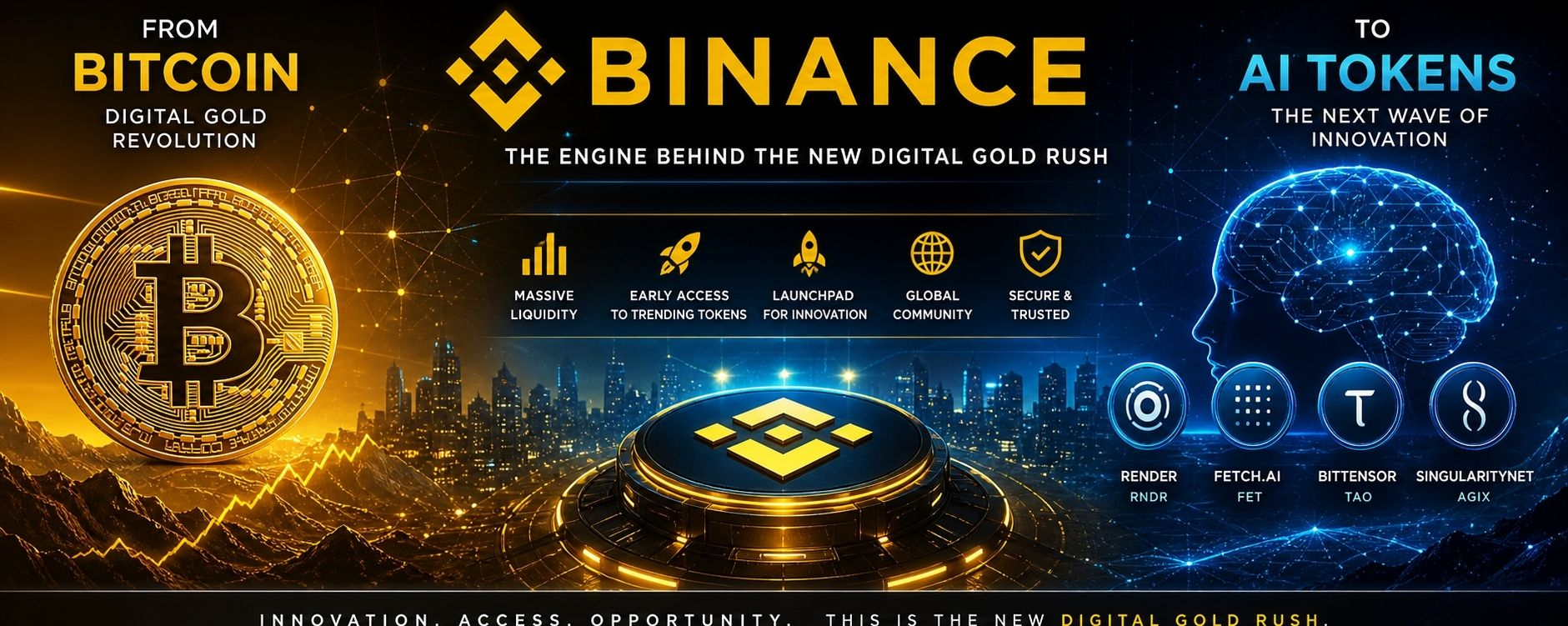

Most people think Binance is just a place where people buy and sell crypto.
That’s way too simple.
What Binance actually built is something much bigger — it became the place where new crypto trends often get real attention for the first time.
And that kind of power matters.
A lot.
People forget how badly Bitcoin was mocked in the beginning.
It was called fake money. A scam. A bubble. Something only tech geeks cared about.
Now look at what happened.
Big institutions are buying it. Governments are paying attention. Wall Street created Bitcoin ETFs. Companies are adding BTC to their balance sheets.
The same asset people laughed at is now being treated like digital gold.
But while everyone was focused on whether Bitcoin would survive, Binance was building quietly in the background.
And that’s what makes their story interesting.
They didn’t just focus on Bitcoin.
They prepared for everything that came after it.
Ethereum. DeFi. NFTs. Meme coins. And now AI tokens.
Every cycle brings a new narrative.
And Binance somehow keeps finding itself right in the middle of it.
That’s not luck.
It understands how crypto works better than most traditional companies ever did.
Crypto moves fast.
People want easy access. They want liquidity. They want early opportunities. They want fast execution.
Binance gave people exactly that.
And millions of users entered crypto through Binance because it felt simple compared to older platforms.
For many people, their first Bitcoin purchase happened on Binance.
Their first altcoin trade happened there too.
That first experience matters because users usually stay where they feel comfortable.
Now we’re watching another big shift happen with AI tokens.
And honestly, this trend feels bigger than many people realize.
AI is no longer some future concept people debate on podcasts.
It’s already part of daily life.
People use ChatGPT for work.
Designers use AI image tools.
Developers use coding assistants.
Businesses are trying to automate everything they can.
That created a new question:
What happens if AI becomes controlled by only a few giant tech companies?
That concern is why crypto AI projects started getting serious attention.
Projects like Render are working on decentralized GPU power.
Fetch.ai focuses on autonomous AI agents.
Bittensor is building decentralized intelligence networks.
SingularityNET is trying to create open AI marketplaces.
Some of these projects will fail.
That’s normal.
Every major innovation cycle has winners and losers.
Most internet startups failed too.
That didn’t stop the internet from changing everything.
And this is where Binance becomes important again.
A Binance listing can completely change a project overnight.
One announcement can bring massive volume, new users, and global visibility.
Sometimes that excitement fades quickly.
Sometimes it becomes the beginning of something huge.
That’s why people watch Binance so closely.
Not because Binance controls the future.
But because it often becomes the gateway where new narratives go mainstream.
And honestly, a lot of this is emotional too.
People want opportunity.
They see inflation rising.
Jobs feel less stable.
AI is changing industries faster than expected.
Owning a house feels impossible for many young people.
Traditional finance feels slow and closed.
Crypto feels risky, but it also feels open.
That feeling keeps pulling people in.
Sometimes for the wrong reasons.
Sometimes because they genuinely see where technology is heading.
Of course, there’s risk.
A lot of it.
Hype can get ridiculous.
Bad projects exist.
Regulators are still trying to figure everything out.
And not every token with “AI” in its name deserves attention.
That’s reality.
But ignoring this shift completely would be a mistake too.
Bitcoin proved digital scarcity could work.
Now AI tokens are trying to prove decentralized intelligence can work too.
And through every major shift, Binance keeps showing up at the center of the conversation.
That tells you something.
The next big opportunity in crypto may not come from what everyone already believes in.
It might come from what people are still underestimating right now.