For a long time, crypto treated transparency as if it were automatically synonymous with progress.
Every wallet visible. Every transaction permanent. Every interaction preserved forever inside an open ledger that anyone could inspect at any time. In the early years, this felt revolutionary because it solved a real problem: trust. Instead of relying on institutions or opaque systems, blockchains allowed strangers to verify activity independently. That openness became part of crypto’s moral identity.
But after watching several cycles unfold, I’ve started wondering whether the industry quietly underestimated the psychological and structural cost of living inside a fully transparent financial environment.
Most people don’t actually behave like ideological transparency maximalists in normal life. Businesses do not publish every supplier payment in real time. Individuals do not want their savings, spending habits, or transactional relationships permanently exposed to curious observers. Even institutions operating legally and compliantly still guard operational data because exposure itself creates risk. Transparency may strengthen verification, but at scale it also introduces surveillance, behavioral mapping, competitive intelligence leakage, and social friction that traditional financial systems spent decades trying to minimize.
That tension becomes harder to ignore as crypto attempts to move beyond speculation into infrastructure.
This is partly why @OpenLedger and the broader conversation around $OPEN has caught my attention recently. Not because privacy in crypto is a new idea it isn’t but because the framing feels slightly different from the older generation of privacy narratives that often drifted into ideological absolutism.
The interesting question around #OpenLedger is not whether privacy matters in theory. Almost everyone agrees it does once real money, real businesses, and real-world operations enter the picture. The more difficult question is whether privacy can exist without sacrificing the verifiability that made blockchains useful in the first place.
That balance has historically been difficult.
Most privacy-focused systems in crypto either became too opaque for regulators and institutions to comfortably interact with, or too complicated for average users and developers to adopt naturally. Elegant cryptographic ideas often looked brilliant inside research papers and conference presentations, only to become painfully impractical once they encountered actual users, production environments, wallet friction, liquidity fragmentation, or developer onboarding realities.
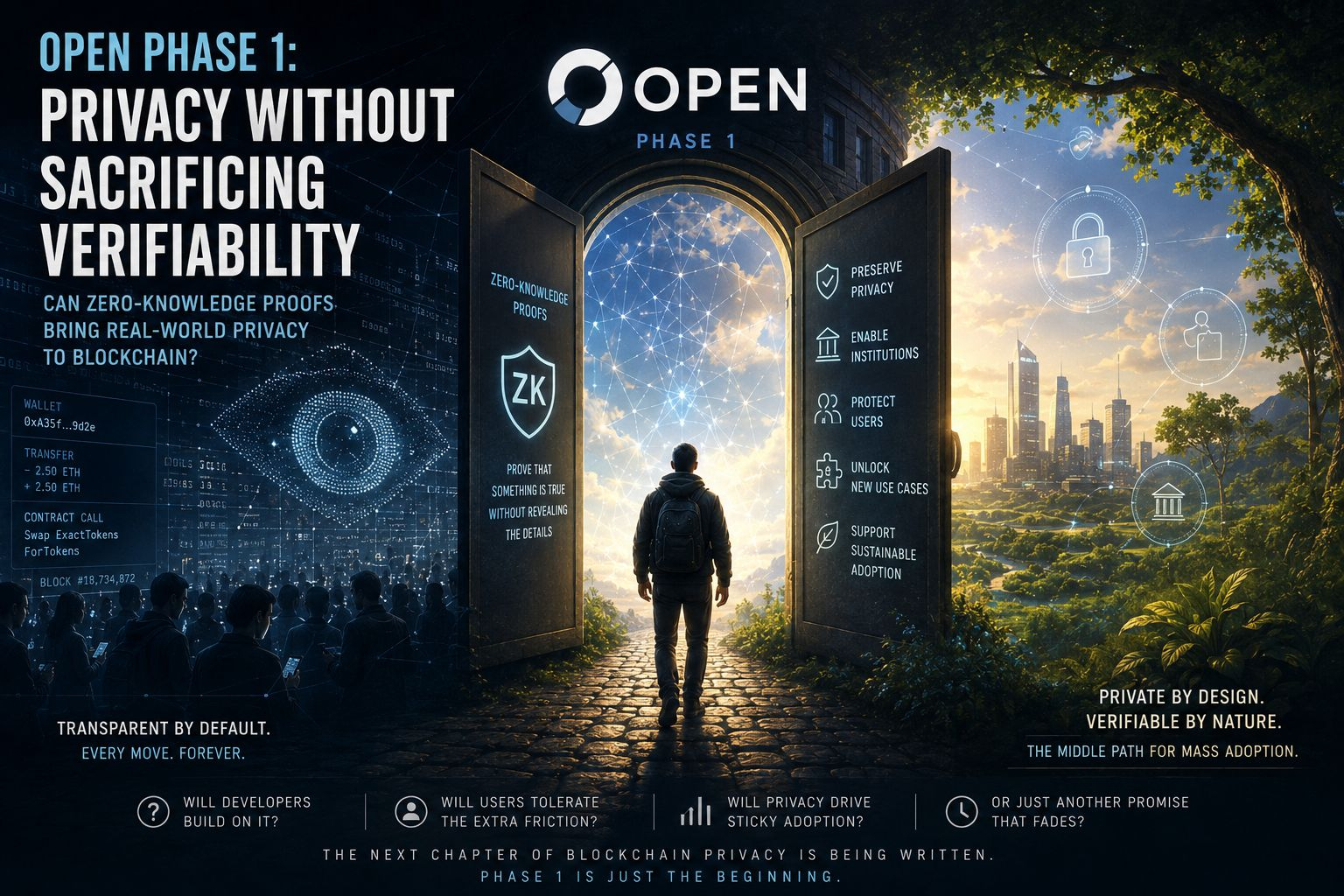
That’s where OPEN’s upcoming Phase 1 becomes interesting to observe.
From what’s publicly discussed so far, the architecture appears focused on using zero-knowledge systems to create a middle layer between full exposure and full secrecy. Instead of revealing all transactional information directly on-chain, the system attempts to allow verification without unnecessary disclosure. In simple terms, it tries to prove something is true without exposing every underlying detail.
Conceptually, that feels closer to how mature systems operate in the real world.
A bank auditor does not need to publish your entire financial history publicly to confirm compliance. A company does not need to expose every operational detail to prove solvency. Identity systems rarely require revealing every piece of personal information simultaneously. Real-world trust systems often depend on selective disclosure rather than radical exposure.
Crypto, however, largely evolved in the opposite direction. Transparency became absolute by default.
Over time, that default started creating strange contradictions. Wallets became pseudo-public identities. On-chain behavior became traceable across years. Sophisticated chain analysis firms emerged specifically because the transparency was so exhaustive. Even users attempting to remain anonymous frequently discovered how fragile pseudonymity becomes once behavioral patterns, exchange interactions, or KYC links enter the picture.
In that sense, privacy is no longer just a philosophical discussion. It increasingly looks like an infrastructure requirement if blockchains genuinely expect mainstream integration.
Still, experience makes me cautious.
I’ve watched too many projects introduce technically sophisticated architectures that failed to survive ordinary usage patterns. Crypto has a habit of overestimating how much complexity users are willing to tolerate in exchange for theoretical improvements. Developers often say they value privacy until debugging zk systems becomes difficult. Users often say they want confidentiality until additional transaction steps, proof delays, or unfamiliar interfaces appear.
Convenience remains brutally powerful.
Network effects are even stronger. People rarely migrate simply because a system is philosophically superior. They move when the experience becomes easier, faster, cheaper, or socially unavoidable. That’s one reason many privacy-focused ecosystems historically struggled to retain activity despite strong ideological communities behind them.
The uncomfortable possibility is that the market may admire privacy intellectually while continuing to behave transparently out of convenience.
That’s the challenge OPEN eventually has to confront beyond the excitement surrounding Phase 1. Not whether the cryptography works. Not whether the architecture sounds elegant. But whether ordinary users, developers, and institutions actually integrate these systems into repetitive daily behavior.
Real adoption is less emotional than crypto narratives often imply.
At first, every promising project feels transformative. Timelines fill with diagrams, technical threads, ecosystem roadmaps, and declarations about “the future of Web3.” Then the harder phase begins. Builders quietly stop updating repositories. User activity plateaus. Liquidity concentrates elsewhere. The broader market moves on toward the next compelling narrative before the previous one fully matures.
I don’t necessarily think OPEN falls into that category. In fact, the measured focus on balancing privacy with verifiability feels more grounded than many older privacy experiments that treated opacity itself as the goal. There is a practical realism in acknowledging that public blockchains probably need selective transparency rather than total invisibility.
But thoughtful design alone has never guaranteed survival in crypto.
The real test begins when systems leave theoretical discussions and enter ordinary human behavior. Can developers build efficiently on top of it? Can users interact with it naturally without feeling burdened by cryptographic complexity? Can privacy become seamless enough that people stop thinking about it altogether?
That last question may matter most.
Successful infrastructure usually disappears into habit. People rarely think about encryption while using modern messaging apps. They simply expect conversations to remain private. If blockchain privacy requires constant explanation, constant ideological defense, or constant technical accommodation, mainstream retention may remain difficult regardless of how sophisticated the architecture becomes.
So I find myself watching OPEN with cautious curiosity rather than excitement.
After enough cycles, you learn that survival in crypto is rarely determined by who has the most elegant whitepaper or the loudest community during launch phases. Survival belongs to systems that quietly integrate themselves into repetitive human behavior over long periods of time.
Phase 1 may reveal whether OPEN is building toward that kind of durability or whether privacy in crypto remains another compelling narrative that people admire briefly before drifting back toward the familiar gravity of transparent chains.
The ledger eventually answers these questions more honestly than social media ever does.