

I try not to judge projects by their labels, especially in the AI + blockchain space. That label has been overused, diluted, recycled. Same diagrams. Same promises. Same “AI will change everything” lines. My eyes glaze over.
OpenLedger is different. It’s not chasing hype. It’s tackling the messy, unpopular questions that actually matter:
Who owns the data feeding AI models?
Who gets paid when that data generates value?
How do you track a model’s contribution after it leaves the lab?
How do you trace the value chain of an AI agent’s decisions?
Friction. Marketing hates friction. Builders thrive on it. Because this is where real infrastructure—and real value—is forged.
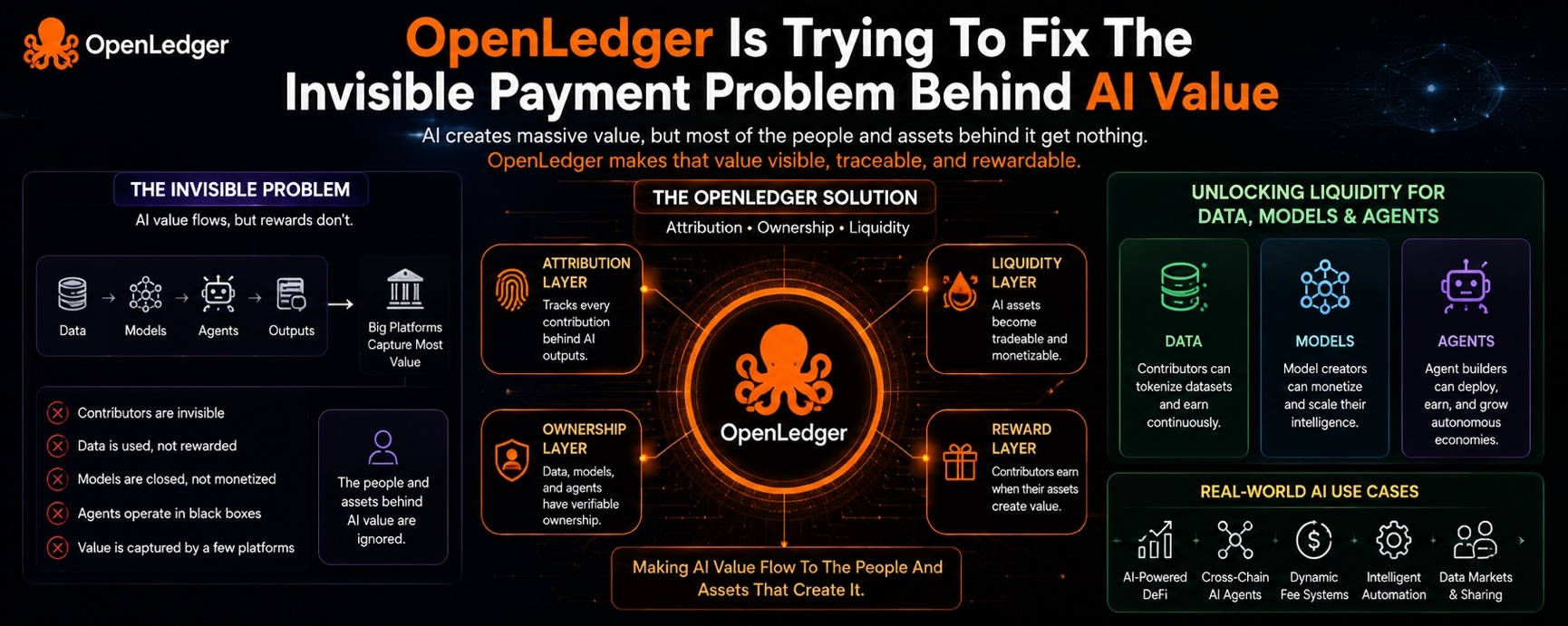
OpenLedger isn’t focused on flashy demos. It’s focused on data, models, and agents—the backbone of AI value creation. AI doesn’t produce value out of thin air. Every output leaves a hidden trail: datasets, feedback, design decisions, agent logic, human input, execution. And most of that trail disappears. People cheer the AI result but forget to ask: Who deserves credit? Who deserves payment?
OpenLedger wants to fill that gap.
The mission is simple but revolutionary: make data, models, and agents monetizable assets, not just internal tools.
A dataset helps train something valuable? Its creator should earn.
A model keeps generating value? Its contributors should benefit repeatedly.
An agent uses specific logic to make decisions? That value chain shouldn’t vanish into thin air.
AI is no longer just answering questions. Agents are executing tasks, automating workflows, interacting with markets, making decisions faster than humans can track. When money enters the equation, accountability becomes critical. If an agent fails—or succeeds—who takes responsibility? Who gets paid? OpenLedger aims to make the AI economy traceable, accountable, and fair before it spirals out of control.
But ambition alone isn’t enough. Execution is hard. OpenLedger needs:
Developers to build on it
Data contributors to participate
Agents producing real outputs
A token with functional value, not just narrative
The market doesn’t reward hype. It rewards usage. OpenLedger isn’t targeting one layer—it’s tackling the entire AI value chain: data feeds models, models power agents, agents generate outputs, outputs create value, and value flows back to contributors. Simple idea. Extremely hard to execute.
Current AI systems skew upside toward platforms. Contributors? Left behind. OpenLedger flips the script: reward creators, ensure accountability, make AI-generated value visible and monetizable.
Yes, it’s ambitious. Yes, it must navigate friction: data quality, verification, reward mechanics, agent accountability, developer adoption, liquidity, real demand. Infrastructure is messy, slow, and unglamorous—but that’s exactly where lasting value is built.
Timing is perfect. AI is moving toward specialized models and autonomous agents—market agents, research agents, workflow agents, gaming agents, industry-specific models. These systems need ownership, traceability, and ways to earn, not hype alone.
OpenLedger is not a flashy AI play. It’s a bet on whether AI value becomes financialized, open, and transparent. If it does, OpenLedger has a clear, central role. If not, it’s another brilliant thesis waiting for a market that never arrives.
For now, its appeal is obvious: OpenLedger asks the question the AI world keeps avoiding: When intelligence creates value, who actually gets paid? And maybe—just maybe—that’s where the story starts getting truly interesting.