
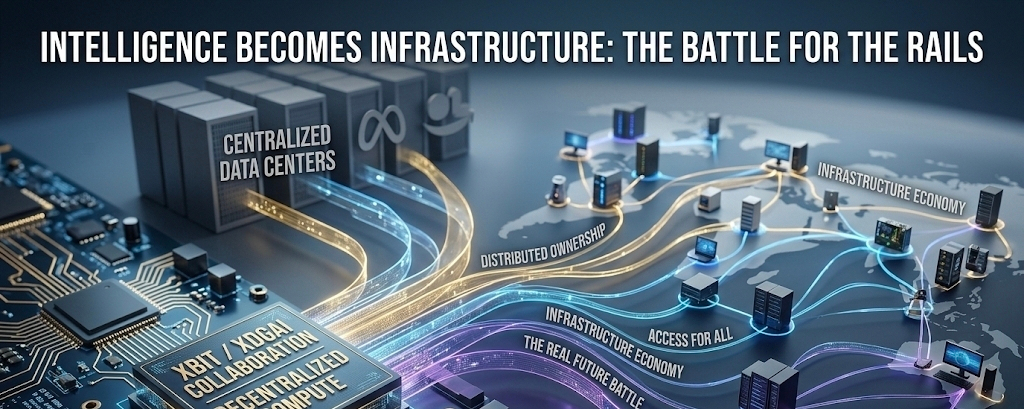

I have been watching the AI industry long enough to notice that most people are distracted by the surface of it.
Everyone talks about the models. The apps. The viral tools. The endless stream of AI-generated images, videos, assistants, and agents appearing almost every week. But the more time I spent researching where this industry is actually heading, the less interested I became in the flashy layer people interact with and the more obsessed I became with the invisible layer underneath it.
The compute.
Because the deeper I looked, the stranger the entire system started to feel.
AI is being presented as humanity’s next major technological leap, yet the infrastructure powering that leap still depends heavily on centralized control. A small number of companies own most of the processing power, most of the data pipelines, and most of the hardware needed to train and operate intelligent systems at scale. At first I ignored that reality because it felt too technical to matter. But after weeks of watching how fast AI adoption is accelerating, I started realizing compute may become one of the most valuable resources of the next internet era.
That was the moment my research started shifting in a completely different direction.
Instead of asking which AI model would win, I started asking who would own the infrastructure behind intelligence itself.
And honestly, that question led me into a much bigger rabbit hole than I expected.
I’ve spent a lot of time watching projects try to combine AI and blockchain over the past year. Most of them felt forced to me. Some looked like they were chasing narratives more than solving real problems. Others used decentralization as branding without explaining why decentralization would actually matter once AI systems become deeply integrated into the global economy.
That’s why the partnership between XBIT and XDGAI caught my attention differently.
Not because it sounded futuristic.
Because it sounded inevitable.
The more I researched what decentralized AI compute could actually mean, the more I realized we may be entering a stage where intelligence itself becomes infrastructure. And once that happens, the conversation changes completely.
AI is no longer just software at that point.
It becomes an operating layer for the internet.
I think people still underestimate how large this shift could become. We’re moving toward a world where AI agents may eventually manage digital marketplaces, automate financial systems, coordinate logistics, power virtual environments, personalize education, assist healthcare, and interact across networks continuously in real time. That kind of ecosystem demands enormous computational power. Not occasionally. Constantly.
And I keep coming back to the same thought every time I research this space: what happens if the future of intelligence depends entirely on centralized ownership?
That tension is becoming impossible to ignore.
I’ve been watching how aggressively the demand for GPUs, distributed processing, inference optimization, and AI infrastructure is rising across the market. Compute is quietly turning into the new digital oil. Most people just haven’t noticed yet because the transformation is still happening underneath the surface.
But infrastructure shifts always start quietly.
The internet itself did too.
What makes the XBIT and XDGAI collaboration interesting to me is that it reflects a growing realization inside the industry that AI scaling may eventually require decentralized coordination rather than purely centralized expansion. And the more I think about it, the more logical that idea starts to feel.
Because if AI truly becomes embedded into everything, then relying on a handful of dominant infrastructure providers creates enormous pressure points for the entire ecosystem. Cost pressure. Access pressure. Scalability pressure. Control pressure.
I spent weeks researching how different projects are trying to address those problems, and most solutions still feel early. But the direction itself feels important. It signals that the industry is beginning to recognize compute ownership as a foundational issue rather than a background technical detail.
That’s the part most people miss when they hear phrases like “Web4.”
They assume it’s another marketing term.
Another internet buzzword.
But after spending enough time watching how AI infrastructure is evolving, I think Web4 is less about websites becoming smarter and more about intelligence becoming native to the internet itself. An environment where AI systems interact dynamically with decentralized networks, where compute resources can be distributed globally, and where participation becomes part of the infrastructure economy instead of simply consuming it.
That changes the structure of the internet entirely.
And honestly, I don’t think we’ve emotionally caught up to how massive that transformation could become.
Because once intelligence becomes infrastructure, the battle is no longer only about who creates the smartest AI.
It becomes about who controls the rails powering intelligent systems at scale.
That’s why I keep paying attention to partnerships like this one.
Not because I think any single company has already solved the future.
But because I think the industry is slowly revealing what the real future battle may actually be about.
Ownership.
Access.
Compute.
And the architecture of intelligence itself.