
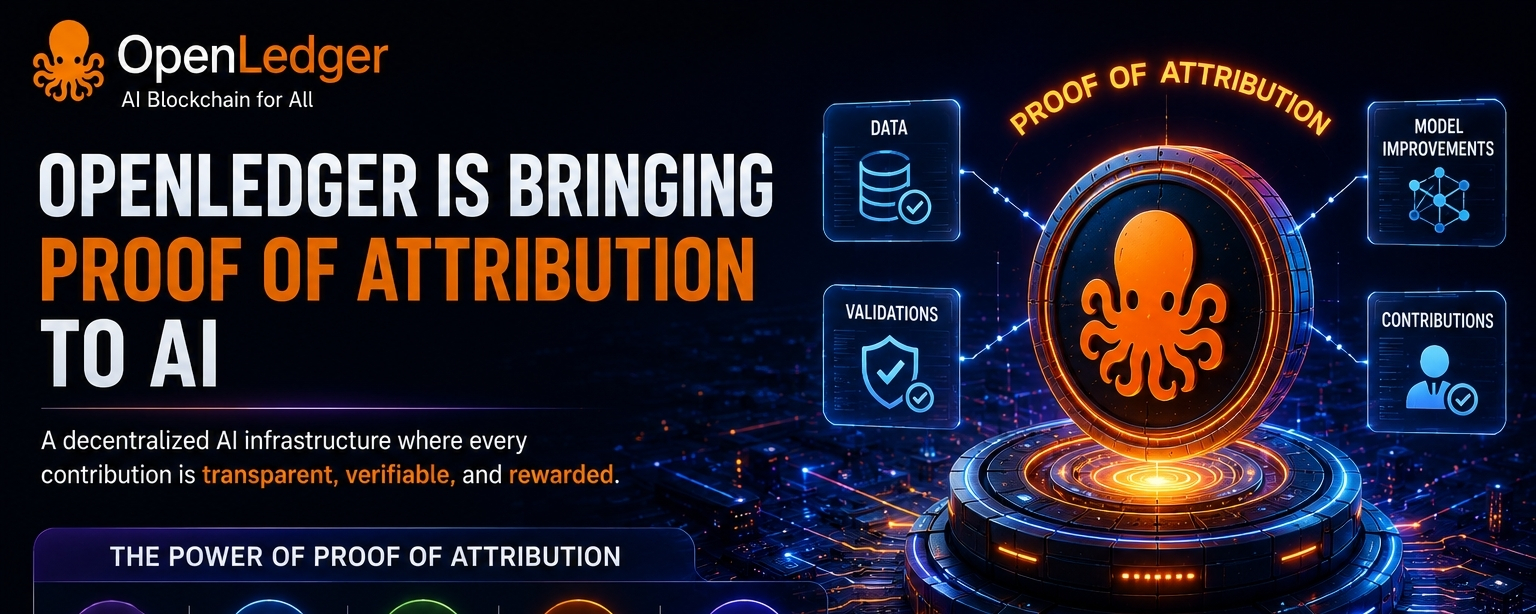
Artificial Intelligence is entering a new era where data, transparency, and ownership may become just as valuable as the models themselves. While the world focuses heavily on advanced AI systems and automation breakthroughs, a deeper issue continues to shape the future of the industry: contributors powering AI ecosystems are rarely rewarded fairly for the value they create.
OpenLedger is attempting to change that dynamic through a concept known as Proof of Attribution.
At its core, OpenLedger aims to build a decentralized AI infrastructure where every meaningful contribution inside the ecosystem can potentially be tracked, verified, and rewarded transparently. Instead of relying on centralized entities to control datasets, model improvements, and economic incentives, OpenLedger introduces a blockchain-powered coordination layer designed specifically for AI collaboration.
This idea could become increasingly important as AI ecosystems continue expanding globally.
Today, many AI models are trained using enormous quantities of data collected from users, researchers, developers, and online communities. However, the people contributing value to these systems often receive little visibility or compensation. Centralized organizations usually maintain ownership of both the infrastructure and monetization layers, leaving contributors disconnected from the long-term value their participation helps generate.
OpenLedger’s Proof of Attribution model attempts to address this imbalance.
By recording contributions on-chain, OpenLedger creates a transparent environment where datasets, validations, model tuning, and ecosystem participation can potentially become measurable components of network value. Rather than functioning as invisible contributors, participants gain traceable recognition connected directly to their activity and impact.
This approach introduces a more collaborative framework for AI development.
Another important aspect of OpenLedger is its focus on specialized AI ecosystems instead of purely generalized intelligence models. As industries continue integrating AI into real-world operations, demand for specialized models trained on curated datasets is expected to grow significantly. Sectors such as healthcare, cybersecurity, logistics, education, and finance all require refined intelligence systems optimized for specific use cases.
OpenLedger appears designed to support this evolution by enabling contributors and developers to work together within transparent incentive structures.
The project also highlights an increasingly important conversation around AI explainability and accountability. Around the world, governments and enterprises are beginning to demand greater transparency regarding how AI systems operate, how they are trained, and how outputs are generated. OpenLedger’s attribution-focused infrastructure may help support those requirements by maintaining visible records of contribution histories and ecosystem interactions.
What makes the concept especially interesting is the role blockchain plays within the system. In many projects, blockchain is added primarily as a payment mechanism or marketing narrative. OpenLedger approaches it differently by using blockchain as the infrastructure layer coordinating attribution, governance, rewards, validation, and ecosystem trust.
This creates stronger alignment between AI development and decentralized technology principles.
The future AI economy will likely depend on more than raw computational power alone. Trust, transparency, collaboration, ownership verification, and contributor incentives may become equally important as intelligent systems continue integrating into global industries.
That is where OpenLedger’s long-term vision becomes relevant.
By focusing on Proof of Attribution and decentralized AI coordination, OpenLedger is positioning itself within one of the most important technological intersections emerging today. Whether decentralized AI becomes dominant or evolves alongside centralized systems, projects solving infrastructure-level problems may ultimately shape the direction of the industry itself.
As AI adoption accelerates worldwide, transparent and collaborative ecosystems could become essential foundations for the next generation of intelligent technology.
#OpenAIToConfidentiallyFileForIPO #AIBlockchain #DecentralizedAI #Web3 #Crypto