
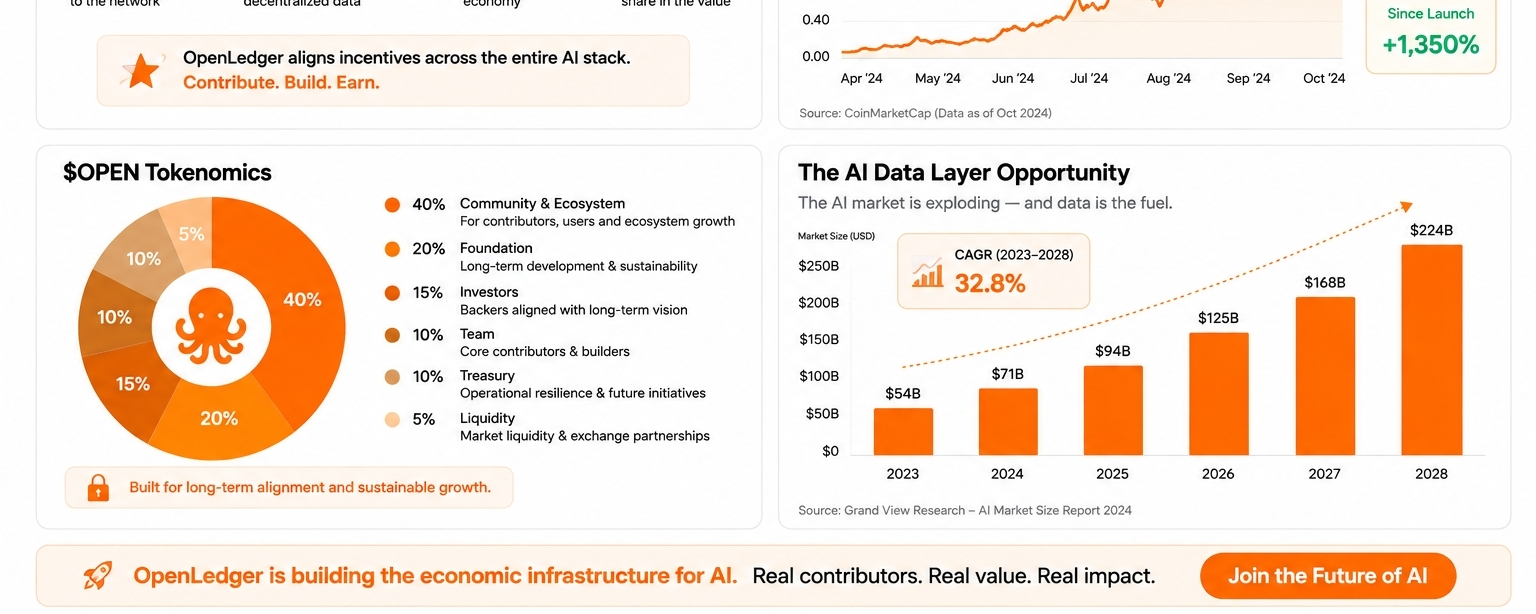

OpenLedger feels like one of those projects I. veI would normally ignore after five minutes, especially in a market where every second thing suddenly claims to be solving AI ownership, AI coordination, AI infrastructure, AI economics, or whatever new phrase people are using to attract liquidity this week. I’ve seen too many versions of the same story already. New chain. New token. Big words about the future. A few screenshots. A few partnerships. Then silence once the market gets bored and rotates somewhere else.
That cycle repeats so often now that I barely react to it anymore.
But OpenLedger stayed in my head longer than I expected, mostly because the problem underneath it does not feel imaginary. AI systems are absorbing massive amounts of value from data, behavior, research, interaction, labeling, and content, yet the people contributing to that machine rarely stay connected to the upside. Somewhere between training, deployment, and monetization, ownership becomes vague enough that nobody really knows where the value should flow anymore.
That tension feels real to me.
Not exciting. Not revolutionary. Just real.
And honestly, real problems are usually harder to deal with than the fake ones crypto likes to invent for engagement.
The more I looked at OpenLedger, the more it felt less like a polished crypto product and more like an attempt to force structure onto something chaotic before it becomes impossible to untangle later. Data marketplaces already exist in fragmented forms. AI models already depend on invisible contributors. Agents are starting to interact with each other in ways most people barely understand yet. Everybody talks about intelligence like it appears out of nowhere, but intelligence is built on inputs, labor, context, and systems constantly feeding themselves.
That feeding process is where things start getting uncomfortable.
Because once you ask who deserves compensation, attribution, ownership, or access inside an AI economy, the answers stop being clean very quickly. People love the idea of decentralization until actual incentives get involved. Then everything becomes messy. Spam appears. Quality drops. Verification becomes expensive. Platforms chase growth instead of integrity. Contributors want rewards without friction. Builders want scale without restrictions. Speculators arrive before the infrastructure is ready. It happens almost every time.
That is why I cannot look at OpenLedger with blind optimism even if I understand why the idea matters.
Crypto has a habit of taking serious concepts and turning them into shallow financial games before the underlying systems even have time to mature. Sometimes useful projects survive that phase. Most do not. Most get trapped between narrative expectations and real-world complexity. The market wants instant adoption while infrastructure usually develops slowly, awkwardly, and without applause.
I think that is part of what makes this project interesting to watch. Not because it looks guaranteed to succeed. More because it seems willing to sit inside a difficult problem instead of simplifying it into marketing language. That alone separates it from most AI-related crypto projects right now. A lot of them feel designed for announcements more than durability.
OpenLedger at least appears aware that AI economics are not simple.
That matters.
Still, awareness solves nothing by itself.
There is a huge difference between identifying a structural problem and building a system people consistently use. Especially in crypto, where attention spans collapse every few months. The market rewards momentum long before it rewards resilience. Traders move faster than infrastructure. Narratives move faster than adoption. Sometimes the loudest and dumbest ideas outperform the useful ones simply because they are easier to understand in a ten-second scroll.
I’ve watched that happen too many times to pretend good ideas naturally win.
They do not.
Sometimes they arrive too early. Sometimes users never care enough. Sometimes incentives become corrupted halfway through scaling. Sometimes complexity suffocates participation before the ecosystem becomes self-sustaining. That risk hangs over OpenLedger too whether people admit it or not.
Because the core challenge is not technological alone. It is behavioral.
Can contributors trust the system enough to participate long term? Can value actually be tracked in a meaningful way once AI agents start building on top of other AI systems? Can monetization remain fair without becoming painfully slow or bureaucratic? Can decentralized coordination survive once real financial pressure enters the network?
Those are ugly questions.
Important ones too.
And the market usually avoids ugly questions until they become unavoidable.
What keeps me paying attention is that OpenLedger does not feel entirely built around hype velocity. There is still speculation around it obviously. This is crypto. Speculation attaches itself to everything eventually. But underneath that, there seems to be an attempt to build economic rails around AI contribution itself rather than just launching another token wrapped in futuristic language.
Whether that works is another story entirely.
I still think there is a serious chance the market ignores projects like this in favor of simpler narratives. People say they care about infrastructure until they have to interact with infrastructure. Most users prefer convenience over philosophy every single time. If centralized AI systems stay faster, smoother, and easier to use, then decentralized alternatives may struggle regardless of how valid their principles are.
That is just reality.
And reality usually crushes elegant theories.
Still, I cannot completely dismiss what OpenLedger is trying to touch here. AI is becoming an extraction economy whether people want to frame it that way or not. Data is valuable. Human interaction is valuable. Context is valuable. Behavioral input is valuable. Somebody will eventually build systems attempting to organize, track, and monetize those flows more directly.
Maybe OpenLedger becomes part of that future. Maybe it becomes another unfinished experiment buried under newer narratives two years from now. Both outcomes feel possible from here.
I’m not looking at it with excitement anymore. I think I lost that style of thinking a while ago after watching too many cycles repeat themselves. I look at projects now more through tension than hype. Does the problem actually exist? Does the system understand human behavior? Does the structure survive once speculation fades?
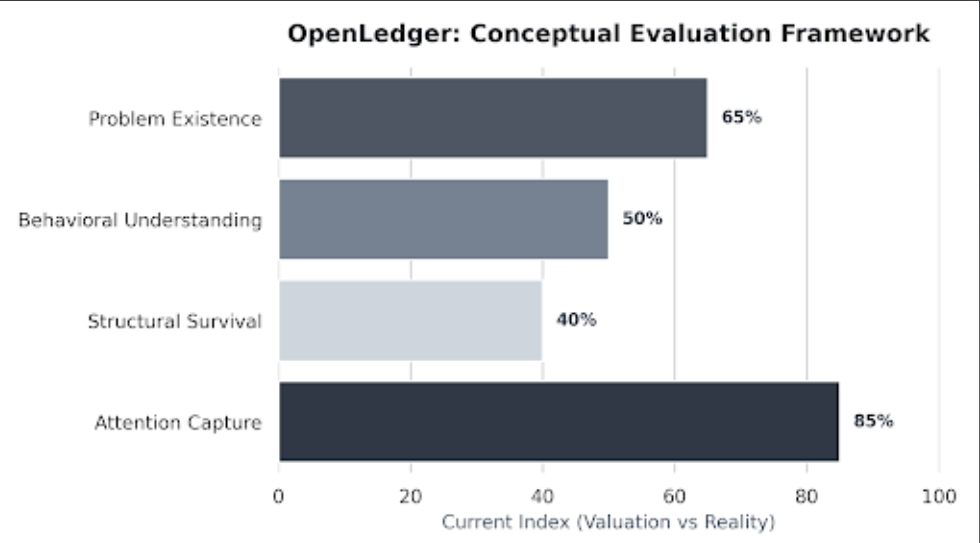
With OpenLedger, I still do not fully know the answer.
But I keep watching anyway.
That alone already says more than most projects manage to earn.