
A few nights ago I did something I keep pretending I’ve stopped doing.
I opened another thread about an AI crypto project, read three lines full of words like agents, intelligence layers, autonomous economies, rolled my eyes, closed the app, then came back ten minutes later and read the whole thing anyway.
That’s become one of the stranger habits in this industry.
Everyone acts tired of narratives while secretly waiting for the next one to work.
After enough years in crypto, I stopped believing the vocabulary matters as much as people think. The words change constantly. The behavior almost never does.
We had smart contracts. Then DeFi. Then NFTs became identity. Then modular systems became the answer to everything. Now almost every roadmap eventually bends toward AI because that’s where attention lives.
Sometimes I wonder if crypto innovates or just renames itself every eighteen months.
That thought was sitting in my head when I ended up reading more about OpenLedger.
Not because I thought I found some hidden gem.
Actually the opposite.
I think I’ve become naturally suspicious of anything that sounds too complete.
But something about it stayed with me—not the AI angle itself, because everyone suddenly has one—but the quieter question underneath it.
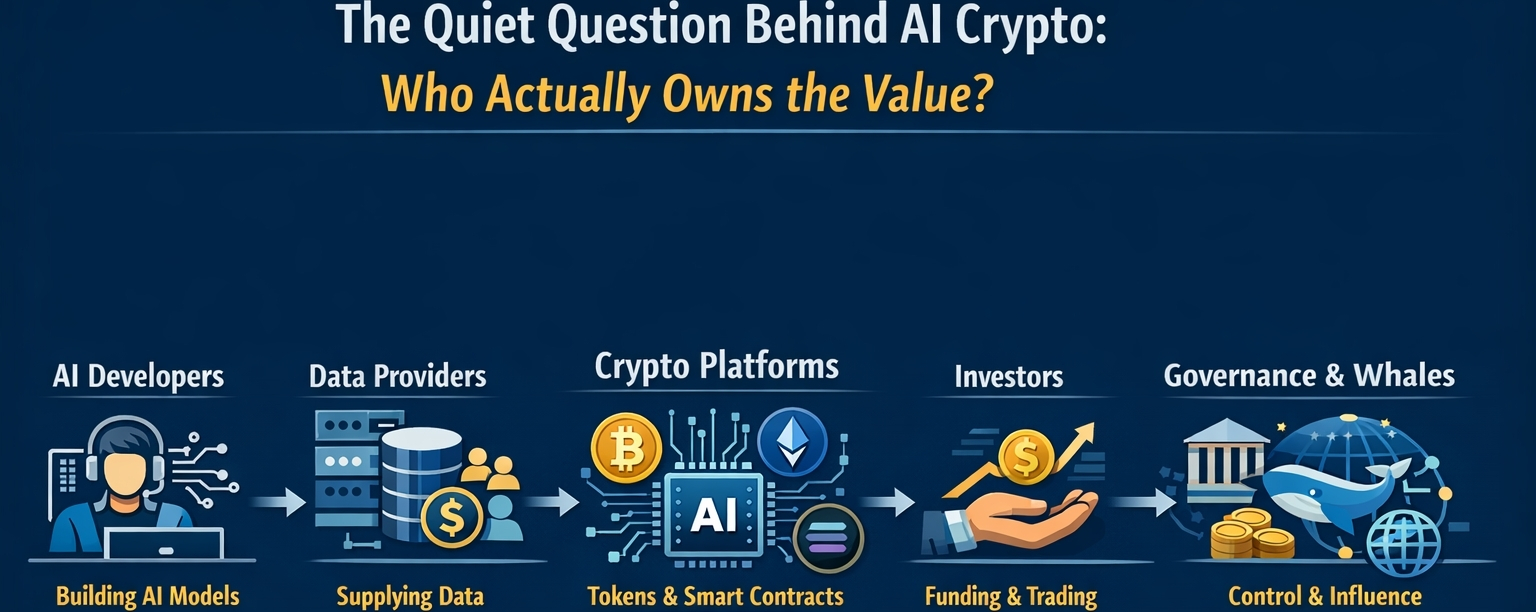
If AI becomes infrastructure instead of just software, who ends up owning the value?
That question feels uncomfortable because most people already know the answer today.
People generate data.
Systems absorb it.
Platforms capture the upside.
And everyone accepts the arrangement because convenience usually wins.
Crypto has spent years promising ownership as the alternative.
But if I’m honest, a lot of ownership in crypto ended up becoming speculation wrapped in ideology.
Tokens existed before users.
Markets appeared before utility.
Entire ecosystems got priced before anyone knew what problem they solved.
So when I looked at OpenLedger’s idea—trying to create economic attribution around data, models, and AI outputs—I didn’t immediately think it sounded revolutionary.
I thought it sounded difficult.
Which made it slightly more interesting.
Because difficult problems usually survive longer than fashionable ones.
The idea itself isn’t even that dramatic when stripped of presentation language.
If data contributes to intelligence, maybe there should be a way to track contribution and distribute value.
Simple sentence.
Complicated reality.
Crypto people sometimes talk like infrastructure doesn’t matter anymore.
I’ve never understood that.
Infrastructure matters most right after success.
That’s usually when things start breaking.
People love talking about throughput and scalability during quiet periods.
What nobody talks about enough is what happens after actual usage appears.
I’ve watched networks become unusable because users finally showed up.
I’ve watched incentive systems collapse because people optimized them too efficiently.
I’ve watched communities discover that decentralization sounds cleaner than it feels.
Technology rarely breaks first.
Human behavior usually gets there earlier.
That’s why I keep looking at projects through a slightly different lens now.
Not “does this sound smart?”
More like:
What happens if people actually use it?
What becomes expensive?
Who captures liquidity?
Where does friction appear?
Who leaves first?
OpenLedger seems to be aiming directly into that uncomfortable zone where AI stops being magic and starts becoming economics.
That part feels more real than the usual AI narrative.
Because eventually every intelligent system runs into the same old problems.
Coordination.
Ownership.
Payments.
Trust.
Distribution.
Things humans have been struggling with long before blockchains existed.
Lately I’ve noticed more teams talking about agents interacting with each other, paying each other, generating activity independently.
Maybe that happens.
Maybe it doesn’t.
But I also remember when people spoke about NFT identity layers with complete certainty.
And before that, yield forever.
And before that, endless scaling.
Crypto has a strange relationship with certainty.
The louder the prediction, the shorter the memory when it changes.
So I’m trying not to repeat that mistake.
I’m not looking at OpenLedger and seeing inevitability.
I’m looking at it and seeing a project testing whether attribution can become infrastructure instead of marketing language.
Maybe users care.
Maybe they don’t.
Maybe nobody wants ownership if convenience is easier.
That possibility feels more realistic than people admit.
Because outside crypto, most people already accepted platforms making decisions for them.
People say they want control.
But they usually choose simplicity.
That’s not criticism.
That’s just observation.
And maybe that’s the real thing I keep thinking about.
Crypto doesn’t usually fail because the ideas are impossible.
It fails because reality arrives.
Users arrive.
Latency appears.
Liquidity disappears.
People lose patience.
Systems reveal what they actually are.
I don’t know where OpenLedger ends up.
I’m not convinced it becomes a category winner.
I’m also not convinced the whole AI-chain narrative disappears.
What I do know is that after enough cycles, I’ve become more interested in projects that force awkward questions than projects with clean answers.
Those usually age better.
Or maybe I’ll read this again in six months while some completely different narrative dominates timelines and laugh at myself for paying attention.
That’s happened before.
Probably more times than I remember.
