
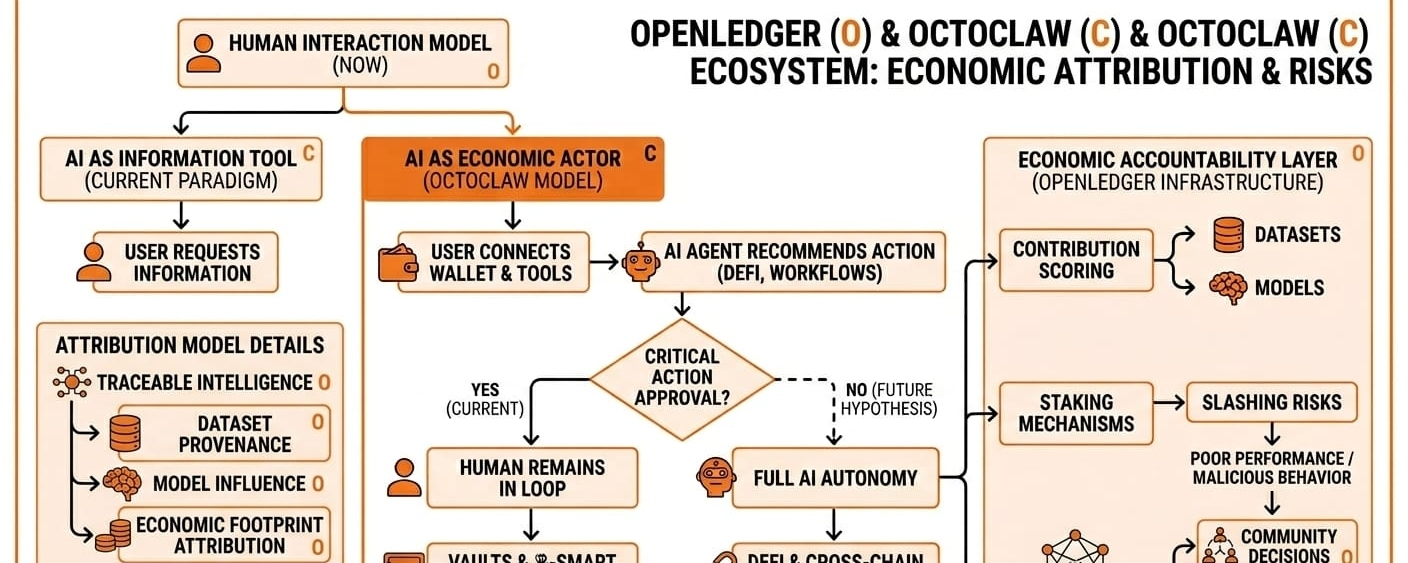
 I don’t think most people realize how psychologically strange OctoClaw actually is.
At first glance, it looks simple. A clean interface. A lightweight desktop app. Chat-style commands. Connect a wallet, connect a few tools, and suddenly an AI agent can help execute DeFi actions, analyze markets, coordinate workflows, and interact with on-chain systems almost like a digital operator sitting beside you.
That’s the surface-level experience.
The deeper experience feels very different.
Because the moment you let an AI interact with real assets, something changes mentally. The relationship stops feeling like “using software” and starts feeling like negotiating trust with a semi-autonomous system you don’t fully control.
And honestly… that tension may end up becoming the entire story behind OpenLedger’s long-term relevance.
Most AI projects today are still optimizing around convenience. Faster outputs. Cleaner interfaces. Smarter responses. But OctoClaw quietly introduces something much more uncomfortable into crypto:
Responsibility.
Not theoretical responsibility.
Economic responsibility.
That’s what caught my attention after spending time studying the mechanics underneath the launch.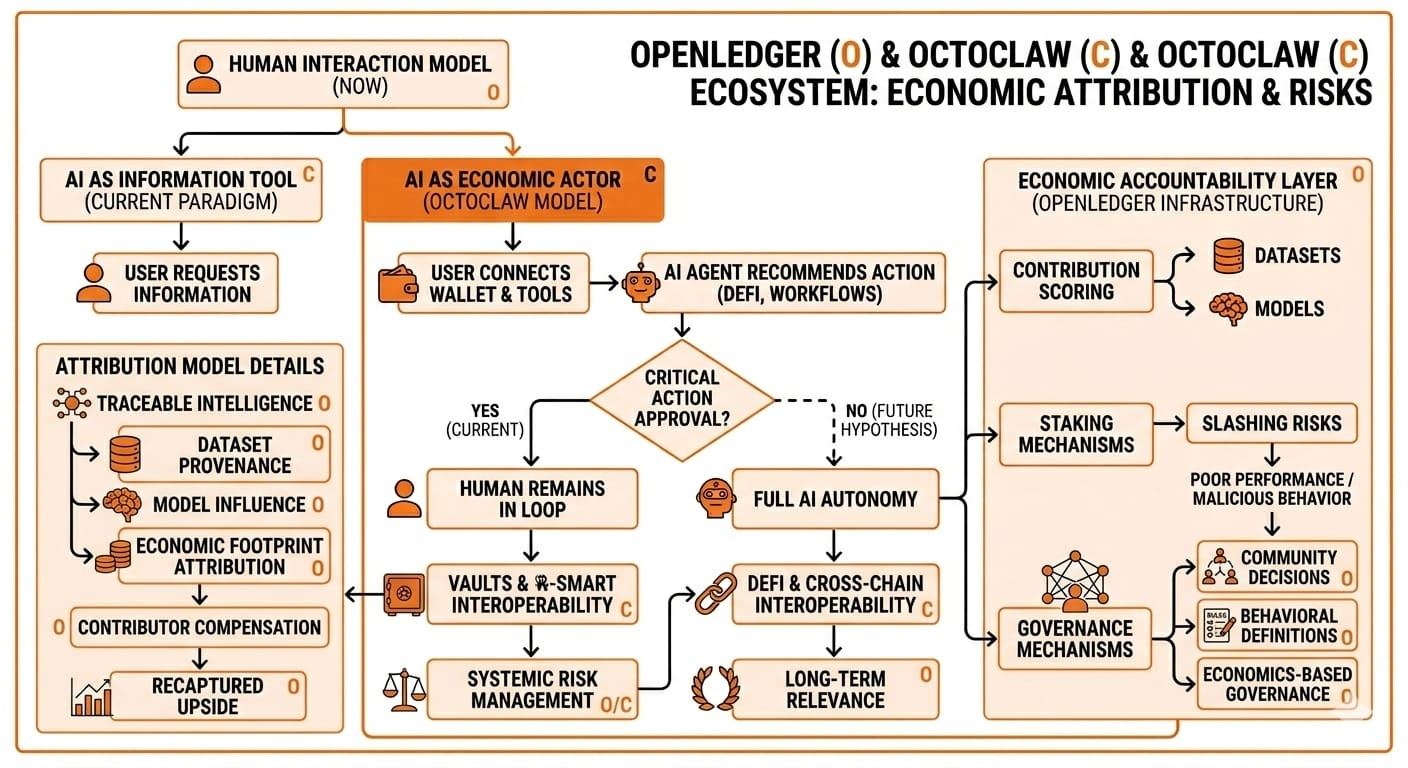
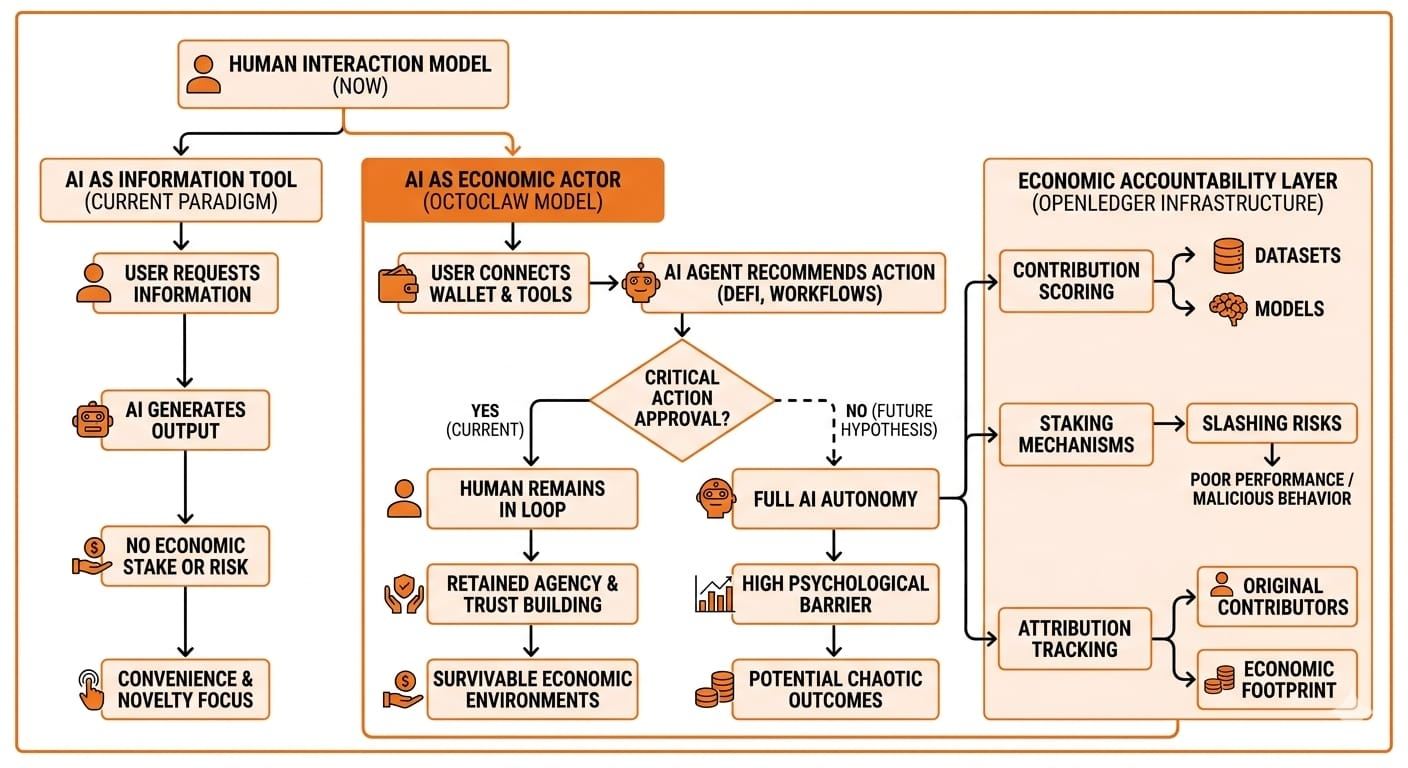
One of the most interesting parts is that OctoClaw deliberately avoids pretending full autonomy is safe. Even though the agent can orchestrate trades, strategies, vault interactions, and workflow execution, users still remain inside the approval loop for critical actions. That design choice says a lot.
Because the industry narrative right now keeps pushing toward fully autonomous agents replacing friction entirely.
OpenLedger seems far less naive about that future.
The system almost feels designed around the assumption that humans are not emotionally ready to surrender complete financial control to AI systems yet — and honestly, I think that assumption is correct.
There’s a huge psychological gap between asking AI for information and allowing AI to move your capital.
People underestimate that difference because current AI hype cycles still revolve around novelty. Everyone loves seeing agents complete tasks during demos. But the emotional experience changes completely when your own assets are involved.
That’s when trust stops being abstract.
And OctoClaw forces users directly into that realization.
Another thing that stood out to me is how aggressively the ecosystem ties intelligence to economics. Most AI systems today operate without meaningful accountability. If a model gives bad outputs, the consequences are usually social at worst.
OpenLedger is trying something very different.
Agents operate with economic weight attached to them.
Staking mechanisms. Slashing risks. Attribution tracking. Contribution scoring.
That architecture changes the nature of AI interaction entirely.
Now poor performance is no longer just “bad output.” It can become economically punishable behavior inside the network itself.
That creates a fascinating but dangerous shift.
Because suddenly the ecosystem has to answer questions the AI industry usually avoids: What qualifies as malicious behavior? What qualifies as low-quality intelligence? Who decides when an AI agent crossed the line? Should communities govern machine behavior economically?
Those are not small governance questions.
And honestly, I think most people still underestimate how messy these systems could become once real money starts flowing through autonomous agents at scale.
The deeper I looked into OpenLedger’s attribution model, the more interesting this became.
The ecosystem keeps emphasizing traceability between outputs, contributors, datasets, and models instead of treating AI generation as some magical black-box process. In theory, every meaningful interaction leaves an economic footprint tied back to participants who contributed value.
That’s a radically different direction from most centralized AI ecosystems.
Right now the dominant AI model across the industry is extraction: users contribute data, platforms absorb intelligence, corporations capture upside, contributors disappear.
OpenLedger seems to be trying to build a system where intelligence becomes economically traceable instead of economically absorbed.
And if AI agents become major economic actors later, that distinction becomes much bigger than people realize today.
Because eventually markets stop caring only about what AI can generate.
They start caring about: where the intelligence originated, who trained it, who influenced outcomes, and who deserves compensation when value is created.
That’s the future OpenLedger appears to be positioning for quietly beneath the OctoClaw launch.
Not just AI execution.
AI accountability.
And honestly, that may become one of the defining infrastructure battles of the next AI cycle.
What makes this even more interesting is that OctoClaw isn’t operating purely inside isolated AI environments. The system is already designed around broader interoperability — vaults, swaps, cross-chain functionality, integrations, APIs, external workflows.
That creates huge opportunity.
But it also dramatically increases systemic risk.
The more interconnected AI agents become with financial infrastructure, the more dangerous mistakes become too. A broken chatbot is annoying. A poorly behaving autonomous financial agent interacting across chains is something completely different.
That’s why I think OpenLedger’s emphasis on attribution and governance matters more than the market currently realizes.
The project feels less focused on making AI look magical…
and more focused on making AI behavior survivable once these systems start operating continuously inside economic environments.
That’s a much harder problem.
And honestly, probably a much more important one.
Of course, none of this guarantees success.
The risks here are enormous. Users may reject the complexity. Governance disputes around slashing and contribution scoring could become chaotic. Regulatory pressure around autonomous financial agents could intensify quickly. Most people still prioritize convenience over transparency.
All of that is real.
But I also think OpenLedger is tapping into something the market hasn’t emotionally processed yet:
The next phase of AI is not about whether machines can think.
It’s about whether humans can trust them enough to let them act.
And OctoClaw feels like one of the earliest real experiments testing that boundary in public.