


Smarter models.
Faster inference.
Bigger benchmarks.
More impressive demos.
That’s the visible layer.
The less discussed layer is where value actually settles.
And honestly, that part still looks messy.
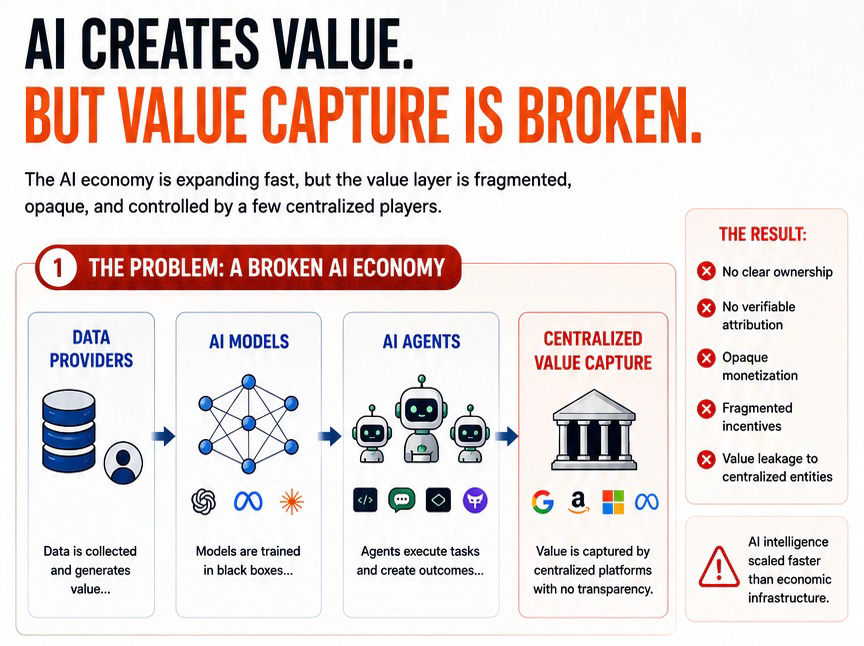
Data powers models.
Models power agents.
Agents increasingly power execution.
Yet when you trace who captures economic upside across that chain, things get blurry fast.
That’s why OpenLedger stands out to me less as an “AI coin” and more as infrastructure trying to solve a coordination problem.
Because right now, the AI economy feels structurally uneven.
Data contributors help create foundational value but rarely capture proportional upside.
Model builders often operate inside ecosystems where monetization remains platform-dependent.
Agents are hyped constantly, but many still exist as disconnected execution experiments instead of economically native participants.
That’s not an intelligence issue.
That’s infrastructure.
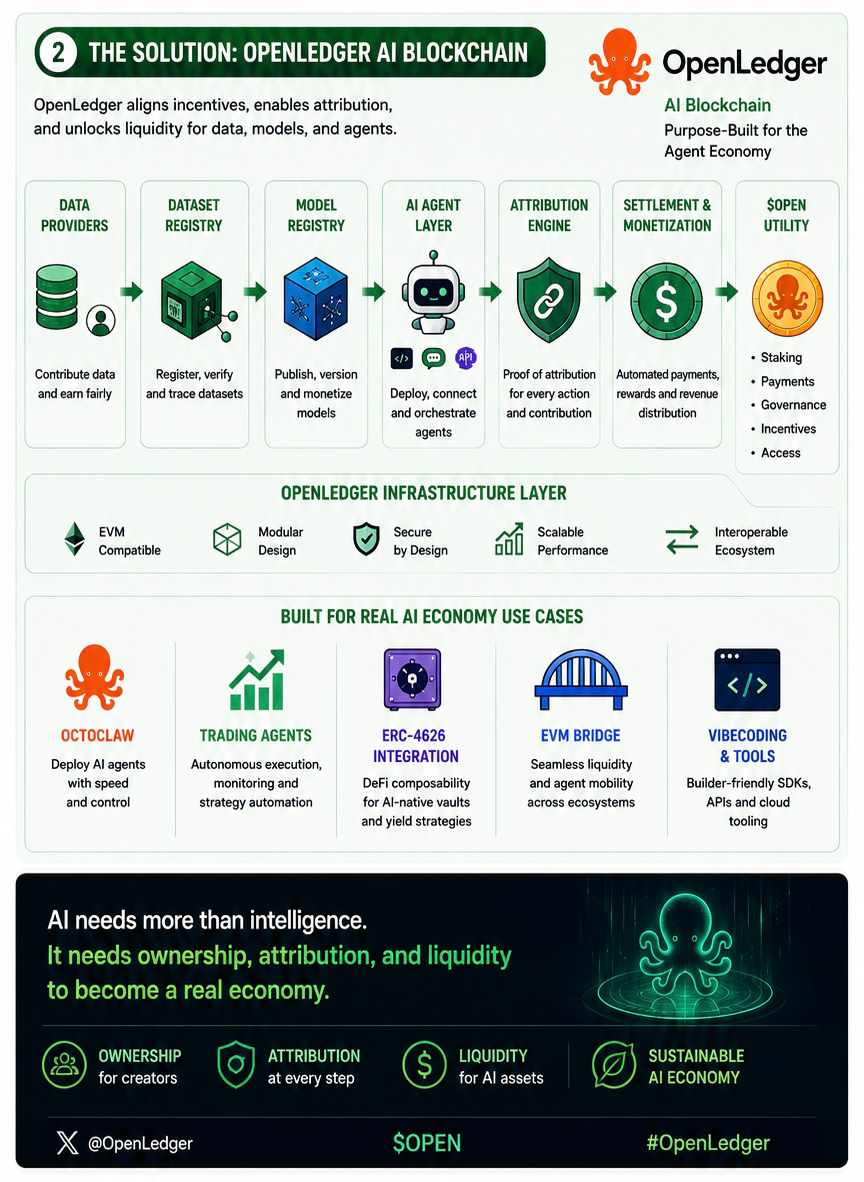
OpenLedger’s thesis is interesting because it tries to treat data, models, and autonomous agents as economic primitives rather than disconnected technical components.
That shift matters.
If attribution becomes native infrastructure instead of afterthought bookkeeping, incentives change.
If contribution becomes verifiable, monetization becomes harder to centralize unfairly.
If agents can operate with actual economic rails instead of isolated logic loops, the “agent economy” stops sounding theoretical.
That’s the real narrative here.
The architecture reflects that direction.
Dataset registries create traceable contribution layers.
Model registries create clearer monetization pathways.
Agent execution infrastructure gives autonomous systems actual operating rails.
Settlement mechanisms matter because contribution without economic recognition is incomplete.
This is where OpenLedger feels more infrastructure-native than narrative-native.
And practical tooling matters too.
Octoclaw is interesting because agent narratives usually collapse once deployment friction shows up.
People love futuristic AI automation ideas until actual implementation becomes painful.
If deployment becomes simpler, experimentation scales faster.
That’s real utility.
Trading agents are another practical angle.
Forget sci-fi framing for a second.
Automated monitoring, strategy execution, condition-based workflows—those are immediately understandable use cases.
That’s how infrastructure adoption starts. Not through slogans. Through usable workflows.
The interoperability side matters too.
The EVM bridge isn’t just cosmetic ecosystem expansion.
Fragmented liquidity kills growth.
Fragmented execution kills adoption.
If OpenLedger wants builders, agents, and applications interacting at scale, isolated infrastructure would be a ceiling.
Same story with ERC-4626 integration.
Most people ignore technical standards because they sound boring.
But composability is where infrastructure compounds.
If AI-native economic systems can connect into broader DeFi liquidity environments, utility expands dramatically.
And I think that’s where weaker AI narratives get exposed.
They sell intelligence.
They avoid economic design.
They promise disruption.
They ignore incentive coordination.
OpenLedger seems to be making a different bet:
AI doesn’t just need smarter systems.
It needs ownership rails.
Attribution rails.
Liquidity rails.
Execution rails.
That’s a much harder infrastructure problem.
But also a much more meaningful one.
Still early, obviously.
Execution matters more than positioning.
But if autonomous agents become meaningful participants in digital economies, the monetization layer may end up being more important than the intelligence layer people obsess over today.
That’s what makes this worth watching.