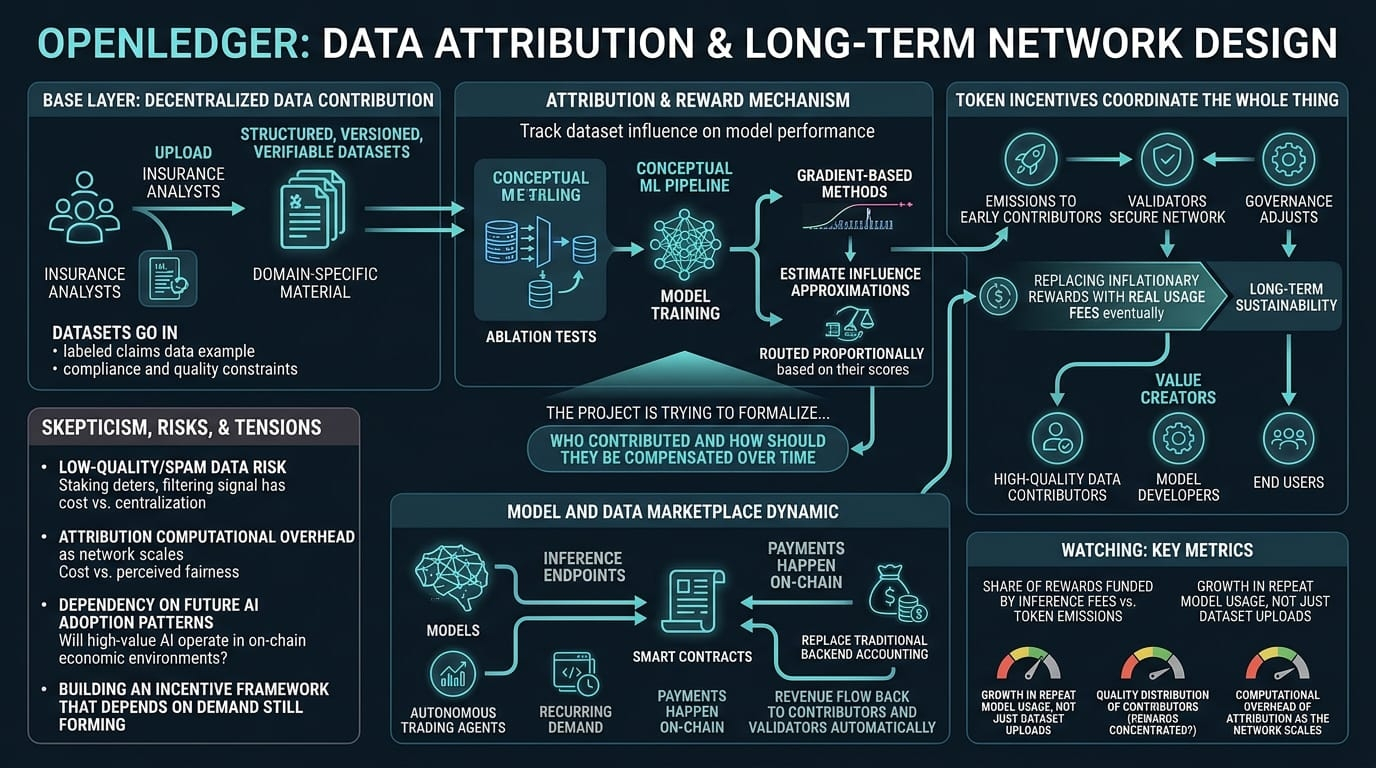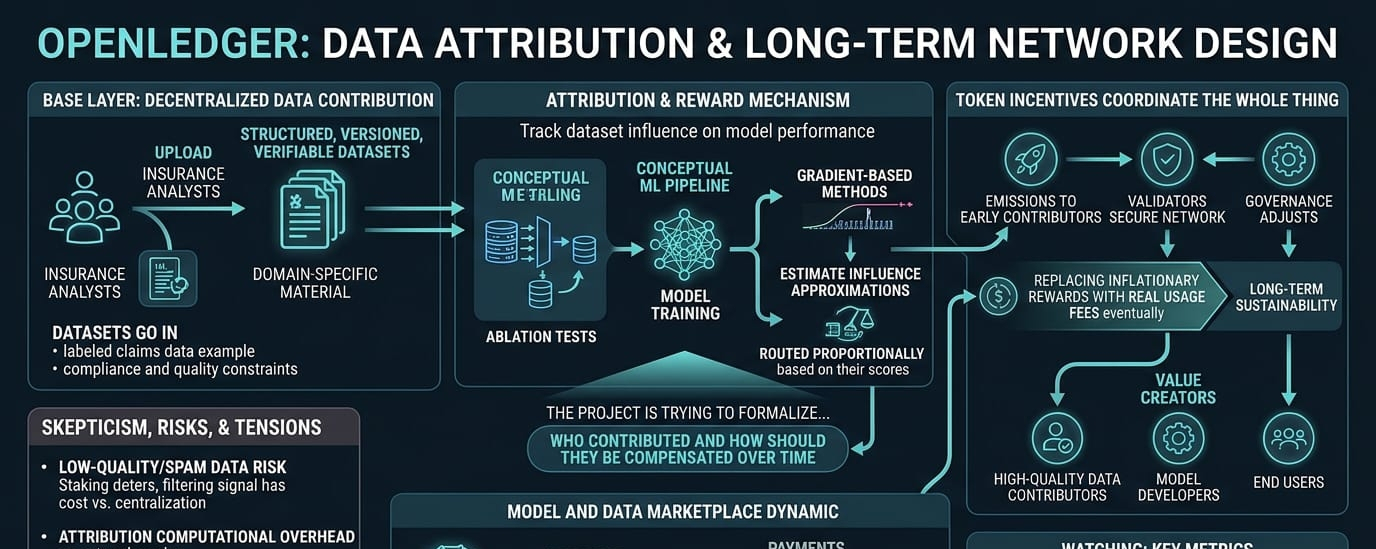
most people think openledger is just another ai + crypto token datasets go in rewards come out done. that framing feels too shallow. what caught my attention is that the project is trying to formalize something that's usually hidden inside private infrastructure who contributed to a model’s performance and how should they be compensated over time?
at the base layer there's the decentralized data contribution system. contributors upload datasets that are meant to be structured versioned and verifiable. ideally this isn't just scraped web text but domain specific material. for example imagine a network of independent insurance analysts contributing labeled claims data to train fraud detection models. that kind of dataset has clear value but also real compliance and quality constraints.
then there's the attribution + reward mechanism. and honestly this is the part i keep thinking about. openledger proposes tracking dataset influence on model performance and routing rewards proportionally. that sounds clean but attribution in machine learning isn't straightforward. once a model has been trained across multiple data sources marginal contribution becomes fuzzy. you can estimate influence with ablation tests or gradient based methods, but those are approximations. the system depends on contributors believing those approximations are fair.
the third component is the model and data marketplace dynamic. models trained on openledger-sourced data can expose inference endpoints, and payments happen on-chain. revenue flows back to contributors and validators automatically. architecturally, this ties ai production directly to programmable economic rails. it replaces traditional backend accounting with smart contracts.
what caught my attention here is the assumption embedded in the design that ai usage will increasingly require transparent, composable revenue sharing. that might be true for crypto native applications say autonomous trading agents calling prediction models on chain. but outside of that context most ai systems today operate perfectly fine with centralized billing and private contracts.
token incentives coordinate the whole thing. early contributors earn emissions. validators secure the network. governance adjusts parameters. but long term sustainability depends on real usage fees eventually replacing inflationary rewards. otherwise the system risks becoming a closed loop of token redistribution.
so who actually creates value? high quality data contributors. model developers who turn that data into something people are willing to pay for. and end users generating recurring demand. the protocol itself is a coordination layer useful only if both sides need it.
this is where skepticism creeps in. low quality or spam data is an obvious risk. staking mechanisms can deter some abuse, but filtering signal from noise isn't free. if verification becomes expensive or centralized decentralization weakens. if it's too loose model quality suffers.
and attribution at scale raises technical questions. as the dataset pool grows calculating contribution scores across multiple training runs could become computationally heavy. if the cost of attribution rises faster than fee revenue, economics get strained. simplifying attribution might reduce cost but also reduce perceived fairness.
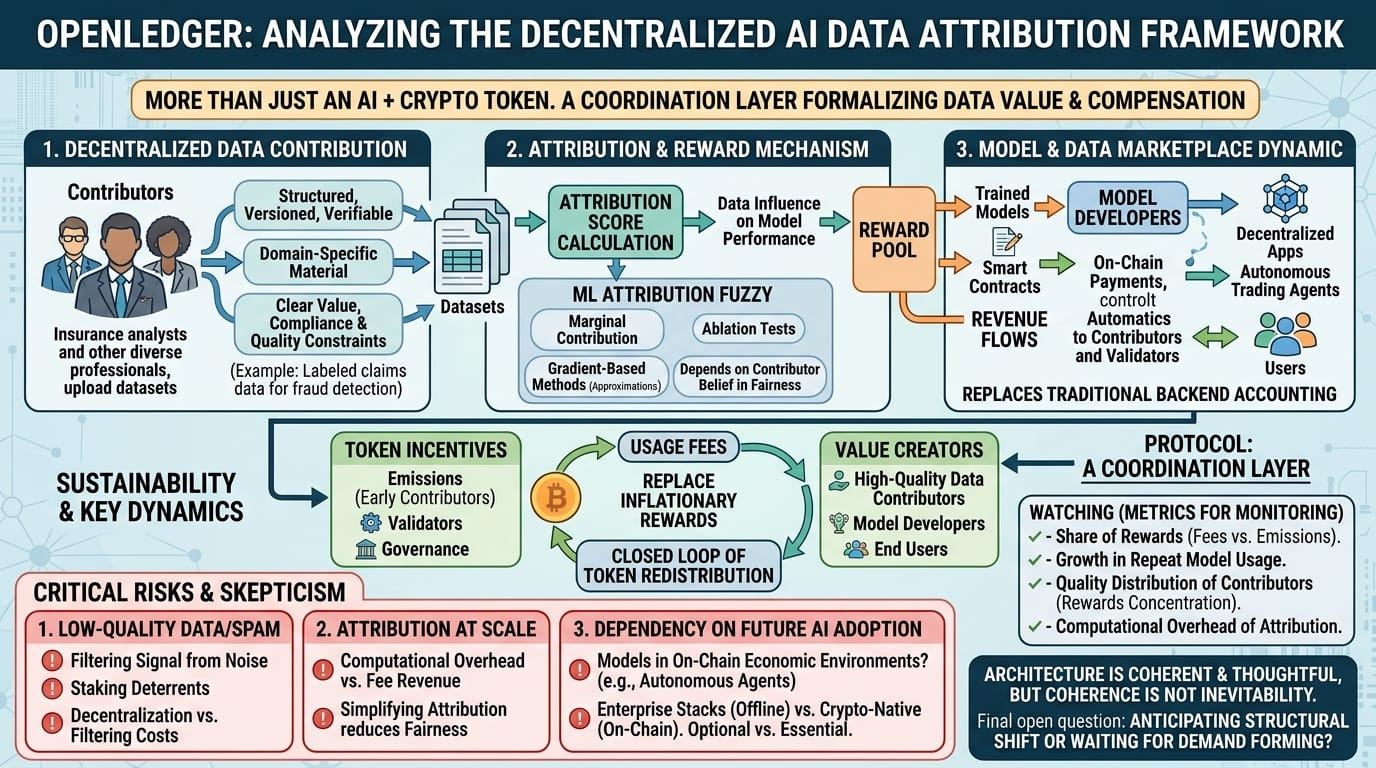
the bigger tension is dependency on future ai adoption patterns. openledger assumes that ai models will operate inside on chain economic environments often enough to justify this coordination layer. maybe decentralized agents and applications create that pull. maybe they don't. if most high-value ai remains inside traditional enterprise stacks, openledger’s model may feel optional rather than essential.
watching
share of rewards funded by inference fees vs token emissions
growth in repeat model usage, not just dataset uploads
quality distribution of contributors (are rewards concentrated?)
computational overhead of attribution as the network scales
i don't see a fatal flaw in the architecture. it’s coherent and technically thoughtful. but coherence isn't the same as inevitability. the open question for me is whether openledger is anticipating a real structural shift in how ai value is coordinated or building an incentive framework that depends on demand still forming.