
Most beginners want to build a trading bot before they can even read a chart properly.
That is the part nobody wants to hear.
A bot does not magically create an edge.
It only automates whatever logic you give it.
If your logic is bad, the bot just loses money faster, cleaner and with less emotion.
That is why I think every beginner should understand one thing before touching automation:
Charts are not optional.
You do not need to become a professional technical analyst.
You do not need 27 indicators.
You do not need to stare at candles 12 hours a day.
But you do need to understand the basic structure of a market.
Where is price rejecting?
Where is liquidity sitting?
Where are late longs trapped?
Where are shorts getting squeezed?
Where does the trend actually change?
Because most trading bot mistakes are not coding mistakes.
They are market-reading mistakes.
A bot that buys every “dip” in a clear downtrend is not a strategy.
It is a liquidation machine with extra steps.
A bot that enters on random RSI signals without context is not systematic trading.
It is just gambling with cleaner formatting.
The real edge usually starts before the bot.
It starts with asking better questions:
Is the market trending or ranging?
Is volume confirming the move?
Is this a breakout or just exit liquidity?
Is the setup still valid if price retests?
Where is the invalidation level?
The order should be:
1. Learn market structure
2. Learn risk
3. Learn entries and invalidation
4. Then think about automation
5. Then improve the bot slowly
Most people skip straight to step 4.
That is why their first bot becomes an expensive lesson.
If you are serious about crypto trading, futures or bot-building, start with the chart first.
The bot should execute the plan.
It should not replace the thinking.
Tomorrow’s article:
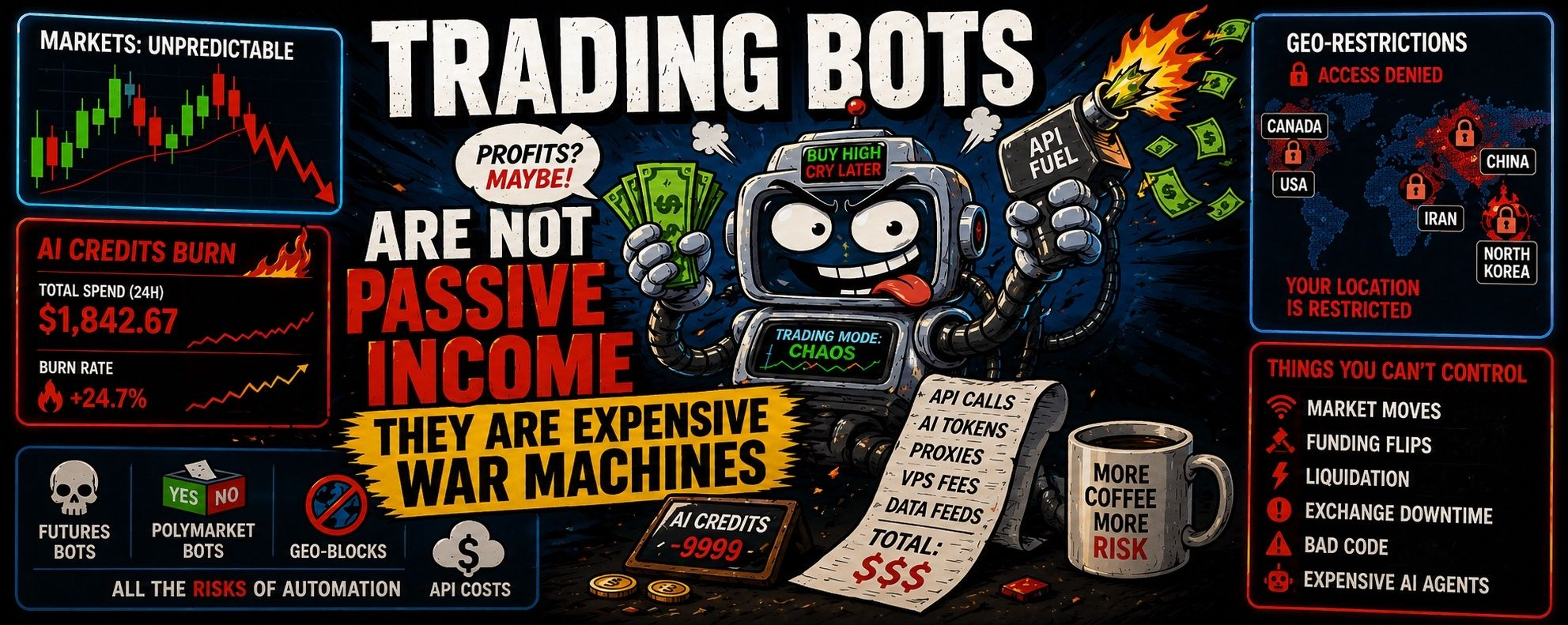
"Trading Bots Are Not Passive Income 🤖⚠️"
Most beginners think bots are money printers — until they learn that automation only makes your rules faster, not smarter. Tomorrow I’ll break down why bots still need strategy, risk limits, monitoring, and human judgment.