
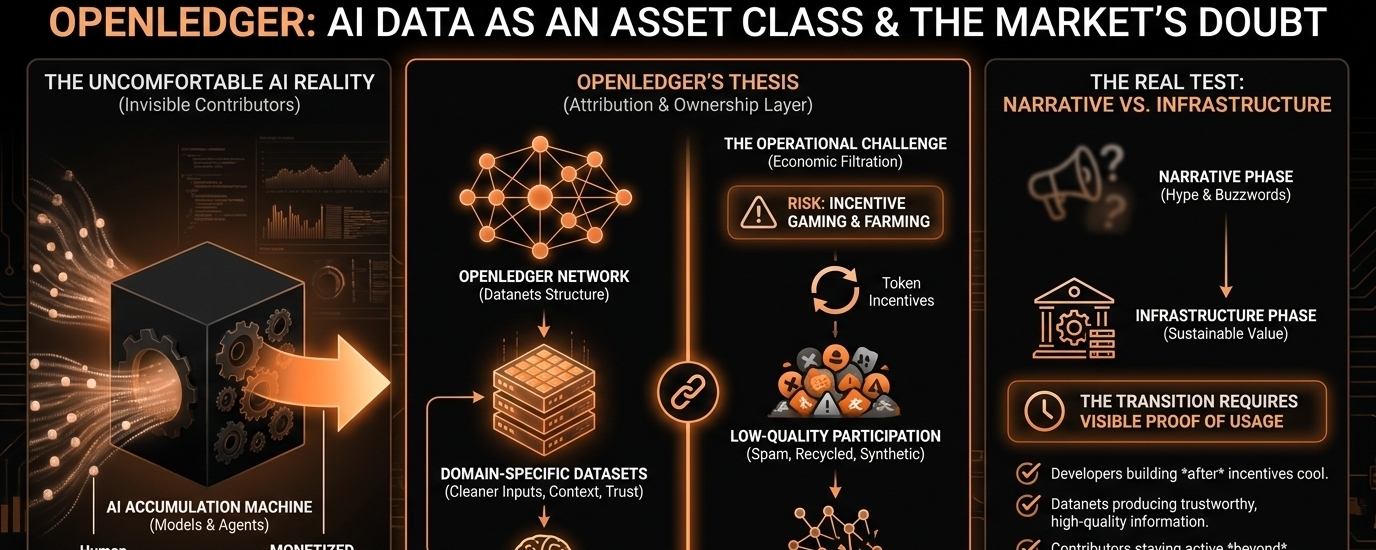
OpenLedger caught my attention for a reason that had very little to do with the AI narrative itself.
I’ve watched enough cycles in crypto to know that the loudest sectors usually become the noisiest first. The moment capital finds a new theme, the market floods with projects repeating the same language until everything starts sounding interchangeable. Infrastructure. Decentralization. Ownership. Agents. Compute. Scale. Coordination. It becomes harder to tell the difference between a real problem and a well-packaged trend trade.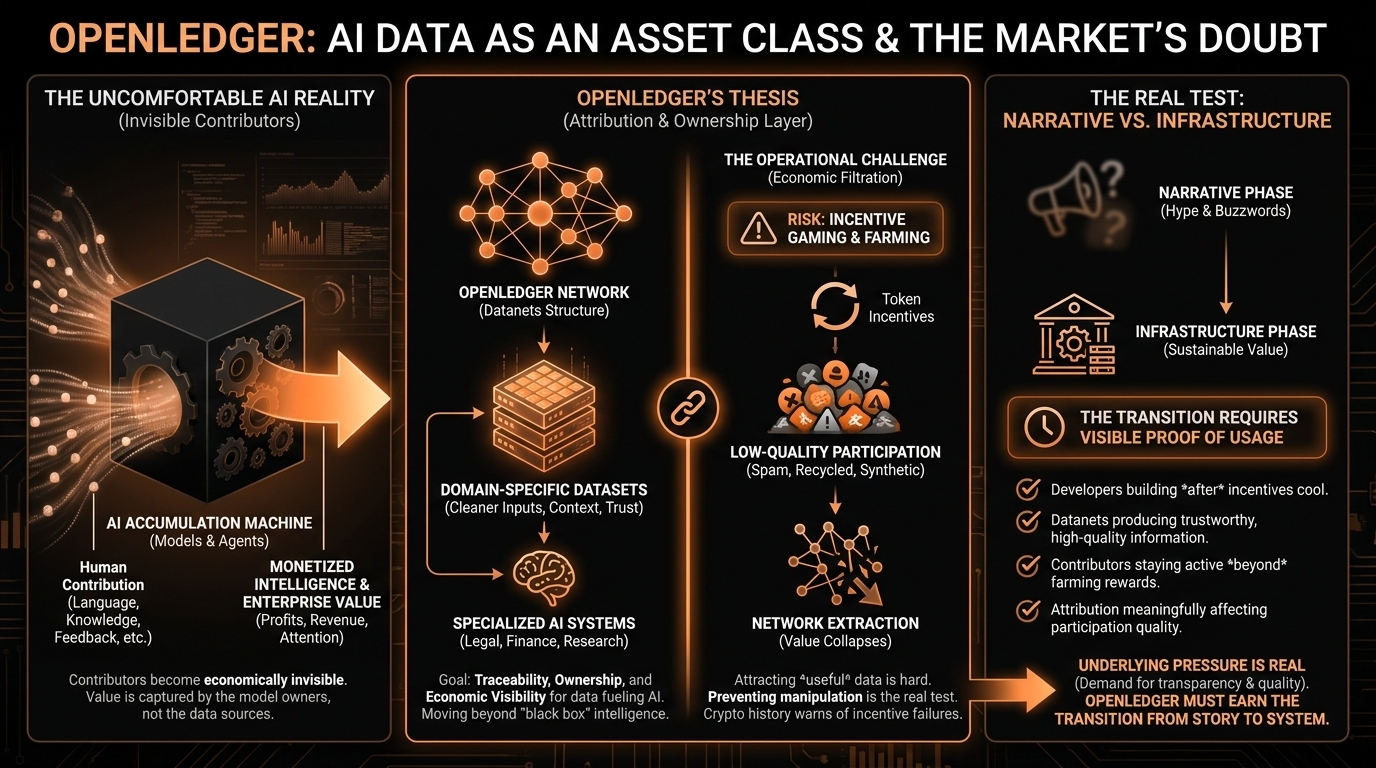
AI is going through that exact phase right now.
Every week another project appears claiming it will power the future of intelligence. Some focus on models. Some on inference. Some on agents. Some on decentralized compute. Some are serious. Some are just riding liquidity while the story is hot. Most of them eventually run into the same problem: the narrative moves faster than the actual demand.
That is why I did not initially care much about OpenLedger being labeled an AI-chain project.
The interesting part was somewhere underneath the branding.
It was the attempt to focus on attribution, ownership, and economic visibility around AI data itself.
That matters more than most people realize.
Because beneath all the excitement around artificial intelligence sits a very uncomfortable reality that the market still has not fully processed: modern AI systems are built on massive layers of human contribution, but the people behind those contributions usually disappear once the model becomes profitable.
And honestly, I think that tension is only going to get bigger from here.
I’ve seen people treat AI like magic over the past two years, but most AI systems are really accumulation machines. They absorb language, behavior, knowledge, culture, expertise, archives, conversations, corrections, feedback loops, and years of public human output. Then those systems become products generating enterprise value, subscription revenue, market share, and investor attention.
The intelligence gets monetized.
The contributors become invisible.
That is not necessarily a bug in the system either. It is simply how the incentives evolved.
The internet trained people to create value for free long before AI arrived. Social platforms monetized attention. Search engines monetized information indexing. Recommendation algorithms monetized engagement. AI is just extending that pattern into model intelligence itself.
Which is why I think OpenLedger is at least pointing at a legitimate fracture in the current AI economy.
The project is essentially asking a question most people still avoid because the answer is messy:
If data is the fuel powering AI systems, should the source of that data remain economically invisible forever?
That is where the idea becomes more interesting than the average AI token pitch.
OpenLedger is trying to build infrastructure where datasets, contributors, models, and agents can exist inside a system with traceability attached to them. Instead of intelligence appearing out of a black box, the network attempts to create attribution around where useful intelligence actually came from.
At least conceptually, that is the goal.
And I think the reason this idea resonates with people is because AI attribution is becoming impossible to ignore.
Artists are questioning model training practices.
Publishers are questioning content scraping.
Developers are questioning code reuse.
Communities are questioning ownership.
Businesses are questioning model reliability.
Governments are questioning accountability.
Everyone suddenly wants transparency after spending years prioritizing scale above everything else.
That shift matters.
Because the AI market is slowly entering a stage where data quality may become more valuable than data quantity.
And those are two very different games.
Large general-purpose models can survive by consuming oceans of information. They improve through scale. But specialized systems operate differently. A financial analysis model, legal reasoning assistant, scientific research agent, regional-language model, or healthcare workflow assistant cannot rely entirely on random internet data forever.
Those systems require cleaner inputs.
They require context.
They require trust.
They require provenance.
That is where OpenLedger’s thesis starts feeling more practical instead of purely narrative-driven.
Its Datanets structure makes logical sense on paper. Communities contribute domain-specific datasets. Those datasets become usable AI resources. Builders can access them. Contributors can potentially receive attribution or economic participation based on the value their data creates inside the network.
Simple conceptually.
Extremely difficult operationally.
And honestly, that difficulty is the part that makes me take the idea more seriously.
The easiest thing in crypto is building a clean theory.
The hard part is surviving contact with incentives.
I have watched too many systems collapse because the mechanism underneath them could not survive human behavior once money entered the equation.
The pattern repeats constantly.
A protocol wants participation.
It adds token incentives.
Participation explodes.
Quality collapses.
Farming begins.
Real users disappear.
The network slowly turns into a machine optimized for extracting rewards instead of creating value.
That risk is sitting directly in front of OpenLedger too.
Because attracting data is easy.
Attracting useful data is brutally hard.
The moment contributors believe rewards are available, the system will naturally attract recycled uploads, spam participation, synthetic engagement, low-effort labeling, copied material, and incentive gaming. Crypto has trained entire groups of users to optimize extraction over contribution.
That is not cynicism. That is just pattern recognition at this point.
Which means OpenLedger’s biggest challenge may not be technical infrastructure alone.
It may be economic filtration.
How does the network distinguish valuable data from noise?
How does it prevent manipulation?
How does it measure meaningful contribution?
How does it maintain openness without sacrificing quality?
How does it create enough reward to attract contributors without attracting endless farming behavior?
Those are not side questions.
That is the actual business model.
And I think this is where a lot of AI projects underestimate reality. They assume the presence of a real problem automatically creates a sustainable token economy around solving it.
Crypto history says otherwise.
The market has already seen dozens of sectors where the narrative made sense but the incentive structure quietly failed underneath it.
GameFi had this problem.
Play-to-earn systems attracted users, but many attracted extractive behavior faster than real demand.
NFT ecosystems had this problem too.
Ownership alone did not create sustainable utility.
Even parts of DeFi ran into it.
Liquidity incentives worked temporarily until emissions overwhelmed organic usage.
That is why I keep coming back to the same question with OpenLedger:
Does the token strengthen the network mechanics, or does it eventually become the only reason people participate?
Because there is a massive difference between those two outcomes.
OPEN cannot survive long-term as just another AI narrative asset floating around speculative rotations. The token has to sit inside actual network behavior in a meaningful way. Contribution systems. Dataset access. Reputation layers. Agent activity. Governance. Validation. Usage incentives. Something structural.
Otherwise the market eventually strips the story down to momentum trading.
And traders are already exhausted from recycled infrastructure narratives.
That fatigue is real now.
You can feel it across crypto.
A few years ago, projects could raise attention purely from abstract future promises. That environment has changed. People have watched too many ecosystems overpromise and underdeliver. The market has become harsher toward theoretical infrastructure with no visible demand behind it.
Which means OpenLedger does not just need a compelling vision.
It needs visible proof of usage.
And I think that distinction matters more now than at any other point in the cycle.
Not social engagement.
Not AI buzzwords.
Not conference appearances.
Actual usage.
Are developers building on it when incentives cool down?
Are Datanets producing information serious AI builders trust?
Are contributors staying active beyond reward farming?
Are agents or models generating demand for specialized datasets?
Does attribution meaningfully affect participation quality?
Those are the questions that eventually decide whether the network becomes infrastructure or just another temporary narrative container.
And I do think OpenLedger has one advantage working in its favor.
The underlying pressure behind AI attribution is probably going to grow over time, not shrink.
Businesses increasingly care about where model outputs come from.
Regulators increasingly care about accountability.
Enterprises increasingly care about trustworthy inputs.
Creators increasingly care about ownership.
Specialized AI increasingly cares about cleaner data.
Those forces are real even if the market has not fully priced them yet.
The problem is timing.
Crypto often identifies real problems years before sustainable markets form around them.
I’ve seen that happen repeatedly across sectors. Sometimes the thesis is correct but the infrastructure arrives too early. Sometimes the incentives mature later. Sometimes the market simply is not ready to care yet.
OpenLedger may eventually become important.
It may also spend years proving why its coordination layer matters before the broader market fully understands the value proposition.
That middle phase is usually uncomfortable.
And honestly, I think OpenLedger is still inside that phase right now.
Not empty.
Not proven.
Not something I would blindly dismiss.
Not something I would blindly trust either.
The idea has weight because AI ownership and attribution are becoming harder to ignore. The challenge is converting that pressure into a functioning economic system without collapsing into speculation, farming, or low-quality participation.
That is the real test.
Because ultimately, OpenLedger is trying to make AI remember where its intelligence came from instead of treating data like an invisible resource that disappears once the model becomes valuable.
That is a meaningful idea.
But crypto has heard enough beautiful ideas already.
Now the market wants evidence that the system actually works when hype disappears, liquidity slows down, and the only thing left is whether people still find the network useful.
That is when projects stop being narratives and start becoming infrastructure.
And I think OpenLedger still has to earn that transition.
@OpenLedger #OpenLedger #openledger $OPEN
