

I used to think infrastructure only became important once people could clearly see it.
Roads. Financial systems. Energy grids. The assumption was always that visibility arrived before dependence. But watching AI systems evolve over the last few years starts to distort that sequence a little. What becomes noticeable is not how visible the systems are becoming, but how much coordination quietly disappears underneath them before most people fully realize dependence already exists.
At first it still feels like software improving efficiency.
Faster execution. Less friction. Shorter distance between intention and outcome.
But after watching enough AI systems operate continuously without much supervision, it starts to feel like speed was never really the important part. The deeper shift is that human judgment keeps getting removed from the middle of processes that still appear human directed from the surface.
You can already see fragments of it in places people barely register anymore. Algorithms adjusting prices while entire cities sleep. Recommendation systems shaping attention before intention fully stabilizes. AI support agents communicating with logistics platforms, payment systems, verification layers, scheduling infrastructure software negotiating with other software inside loops no single person fully observes from beginning to end.
Most people still call these systems tools, which makes them sound passive. Temporary. Something waiting to be used.
But what looks like assistance on the surface increasingly behaves more like coordination infrastructure underneath.
An agent completes a task, identifies another model better suited for part of the workload, transfers execution, verifies the output, settles payment somewhere in the background, then continues operating without interruption. One machine quietly hires another machine. Not metaphorically. Economically.
And at some point the center of the conversation shifts almost without warning.
The question stops being whether AI can replace human labor and starts becoming about who controls the environments where autonomous systems exchange value with each other financially, computationally, and informationally.
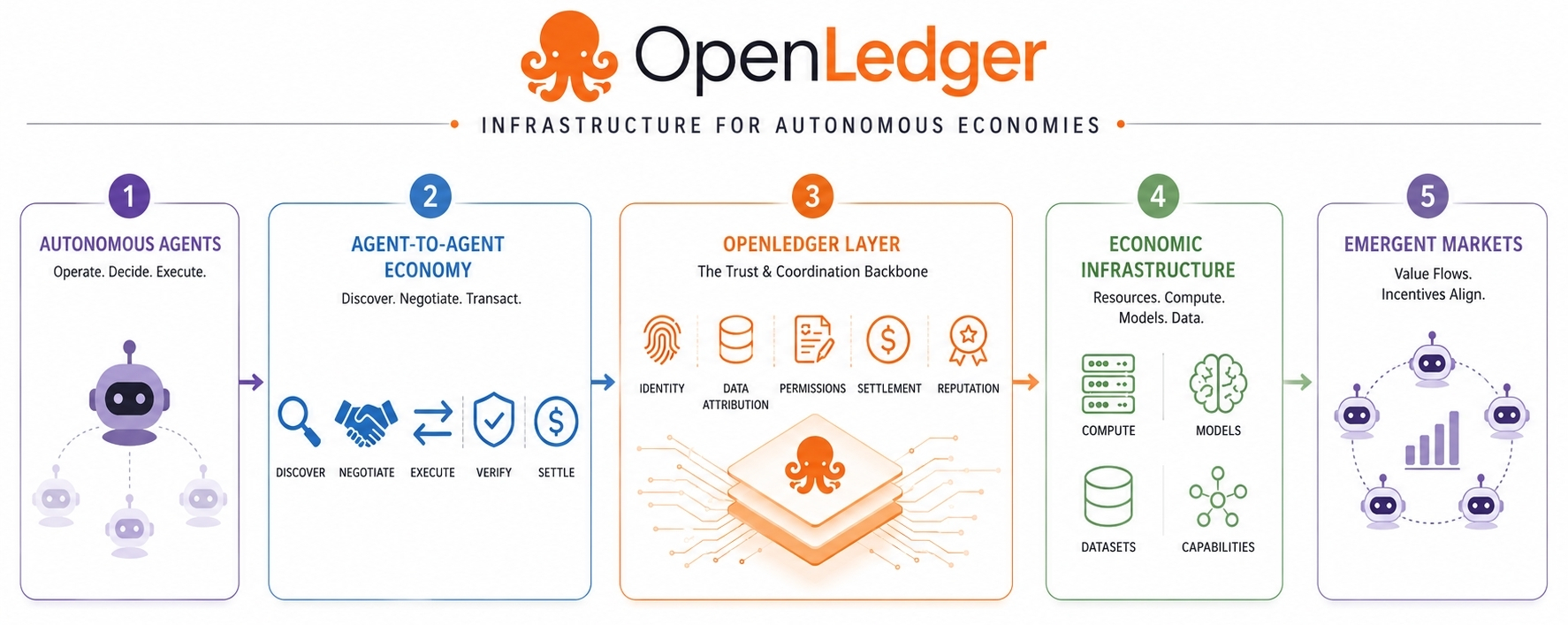
That is partly why systems like OpenLedger start feeling important in a way that has less to do with intelligence itself and more to do with coordination. Most public AI discussion still revolves around outputs. Better reasoning. Better generation. Better automation. But the deeper tension underneath these systems is economic before it is technological.
Once agents begin operating semi-independently, they require mechanisms for attribution, verification, settlement, permissions, access, and incentive distribution between entities that are no longer entirely human-directed in real time. What starts as automation slowly begins producing markets.
And markets have a tendency to reorganize behavior around whatever becomes measurable.
Inside systems like OpenLedger, data stops behaving like passive information and starts behaving more like productive infrastructure. Models become economically active. Datasets become monetizable coordination assets. Agents outsource inference, purchase external capabilities, optimize execution paths around latency and cost conditions, reroute workloads dynamically, then continue operating long after the original participant has stopped directly supervising the process.
At a certain point it becomes difficult to separate computation from commerce because the two systems begin reinforcing each other underneath the network continuously.
A lot of this still sounds abstract until you notice how much of modern finance already functions impersonally most of the time. Markets react automatically to signals most people never directly observe. Liquidity moves through coordination systems long before public narratives catch up to whatever already changed underneath. Autonomous commerce seems less like an entirely new structure and more like existing economic logic extending itself outward into software capable of acting on its own.
But systems without sleep cycles create unfamiliar pressures.
Efficiency improves while visibility starts thinning out almost immediately. Decision making accelerates faster than accountability structures adapt around it. And the deeper these environments become, the harder ownership starts feeling in practical terms.
If an autonomous agent inside OpenLedger uses privately aggregated data to hire another agent trained on external models, who exactly owns the resulting value? The infrastructure provider facilitating settlement? The dataset contributor whose information shaped the output? The model creator? The operator who initiated the original process but no longer supervised every downstream interaction afterward?
The answer starts fragmenting surprisingly fast.
Partly because the economic activity itself becomes difficult to see clearly. Not hidden exactly. More distributed across systems optimized for machine coordination rather than human legibility. Attribution layers track contributions. Settlement systems route incentives. Reputation mechanisms influence execution paths. But the overall process starts becoming too continuous for ordinary oversight. Human participants increasingly observe the system through summaries generated after the important interactions already happened.
That may be the more disorienting shift underneath AI infrastructure.
Not that machines are replacing people outright, but that economic activity itself starts becoming structurally less interpretable to the humans still participating inside it.
Which is probably why OpenLedger feels less interesting as an application and more interesting as a governance structure hiding inside infrastructure. The difficult problem no longer seems to be building autonomous systems themselves. It starts to feel more like building environments where autonomous systems can coordinate economically without concentrating too much invisible leverage around whoever controls attribution, permissions, settlement, and access underneath the network.
Because autonomous systems do not remove human behavior from the equation.
They compress human priorities into optimization structures, ranking systems, incentive mechanisms, permissions, and datasets embedded deeper inside architectures that fewer people can meaningfully inspect.
The human layer never fully disappears.
It just becomes infrastructural.
And maybe that is the uncomfortable thing about watching AI infrastructure mature in public. Systems like OpenLedger increasingly present themselves as independent while remaining deeply shaped by the coordination logic designed underneath them. What looks like automation from the surface sometimes starts resembling institutional architecture when observed long enough.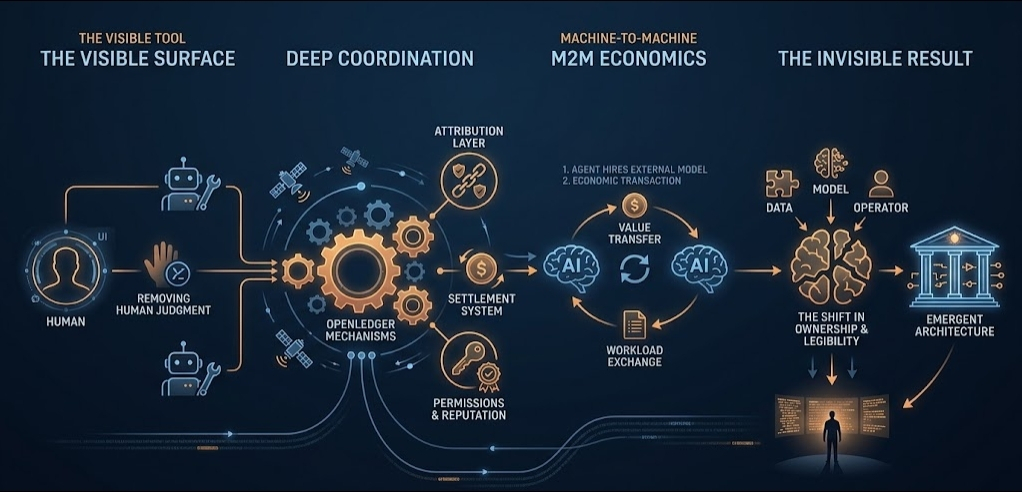
Not institutions built from laws or physical borders.
More like institutions emerging from incentives, access layers, attribution systems, and invisible coordination happening continuously between machines while most humans interact only with the simplified surface left visible above them.
