

Yesterday I caught myself thinking about something strange.
For the last two years, almost every conversation about AI has revolved around intelligence.
Which model reasons better?
Which one writes better?
Which one scores higher on benchmarks?
And honestly, I understand why. Intelligence is easy to see. You ask a question, you get an answer.
But the more I look at what @OpenLedger and $OPEN have been building recently, the more I think we may be focusing on the wrong part of the story.
Because intelligence alone doesn't create outcomes.
Execution does.
A model can identify an opportunity.
An agent can act on it.
That difference sounds small.
I don't think it is.
For years, AI has mostly lived inside chat windows. It could explain strategies, summarize research, and generate ideas. Useful? Absolutely.
But at the end of the process, a human still had to do the work.
Open the application.
Move the capital.
Configure the workflow.
Monitor the position.
Execute the transaction.
The model generated the insight.
The human generated the outcome.
Now that line is starting to blur.
And I think that's why some of OpenLedger's latest developments are more important than they initially appear.
Take the updated Trading Agent.
At first glance, it looks like another AI tool for traders.
But the more I read about it, the more it feels like a glimpse into a different type of infrastructure.
The focus isn't simply on generating market analysis.
The focus is on execution.
Low-latency processing.
Continuous monitoring.
Automated decision flows.
Integration with real financial environments.
That's a very different role for AI.
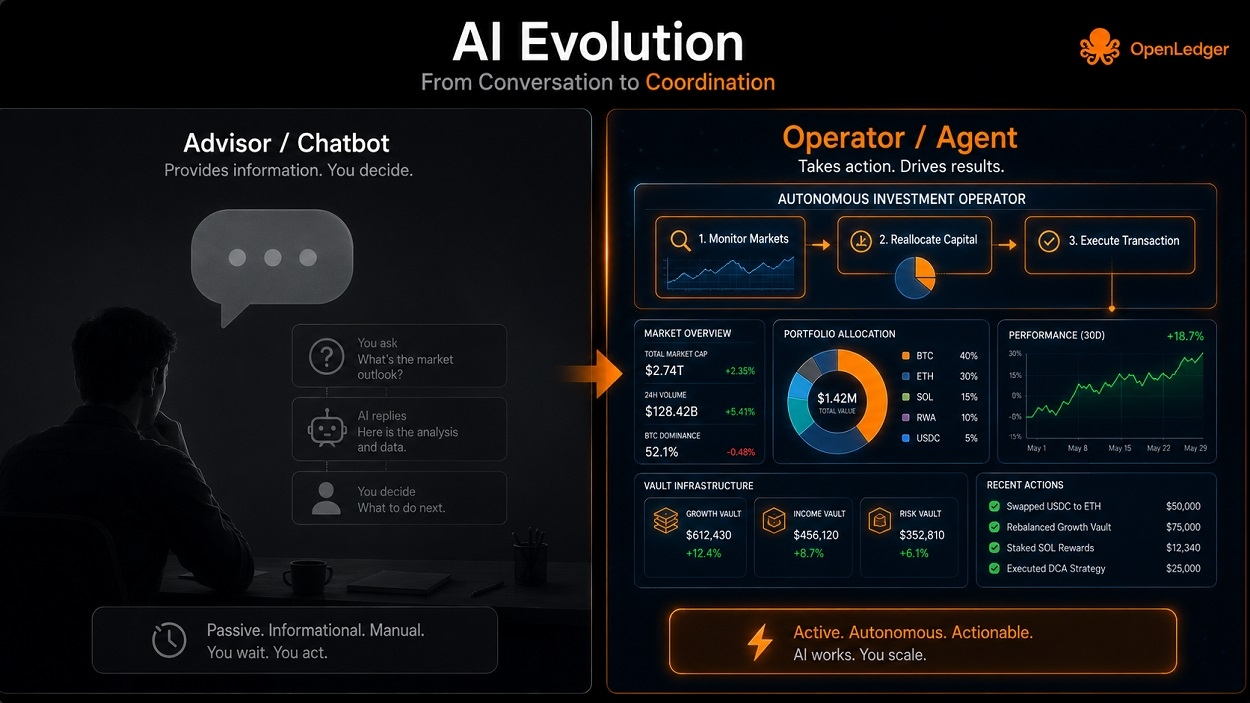
Not advisor.
Operator.
And things become even more interesting when you combine that with OpenLedger's ERC-4626 integration.
One description from the community stuck with me:
"The agent finally has a stomach for yield."
It's a funny phrase.
But it captures something important.
Before, an agent could potentially buy or sell assets.
Now it can understand standardized vault structures, interact with yield-generating environments, and evaluate what idle capital should be doing.
Deposit.
Withdraw.
Rebalance.
Seek opportunities.
Optimize allocation.
Suddenly we're not talking about a chatbot anymore.
We're talking about software that can participate in financial systems.
Whether that ultimately works at massive scale is another question.
Honestly, I don't know yet.
But I do think the direction matters.
Because once agents start managing actions rather than generating suggestions, infrastructure becomes far more important than intelligence alone.
And this is where OpenLedger's architecture starts looking surprisingly coherent.
The Trading Agent isn't operating in isolation.
Neither is OctoClaw.
Neither is the EVM Bridge.
Neither is Proof of Attribution.
Each piece seems designed around the same idea: making AI systems capable of operating across real economic environments.
The EVM Bridge is a good example.
Most people hear the word "bridge" and immediately think about moving tokens.
But the more interesting implication may be execution.
An agent that can interact across Ethereum-compatible ecosystems isn't just moving assets.
It's expanding its operational territory.
More liquidity.
More vaults.
More protocols.
More opportunities.
A larger economic environment to navigate.
The bridge becomes less about transportation.
And more about reach.
Then there is Proof of Attribution.
And personally, I think this might be one of the most overlooked pieces of the entire architecture.
Because if agents are executing trades, using models, consuming datasets, and generating economic activity, someone eventually asks a simple question:
Who contributed value?
Which model influenced the outcome?
Which dataset improved performance?
Which contributor helped create the intelligence being deployed?
Most AI systems still struggle to answer those questions clearly.
OpenLedger is at least attempting to build infrastructure where those relationships become visible instead of disappearing inside a black box.
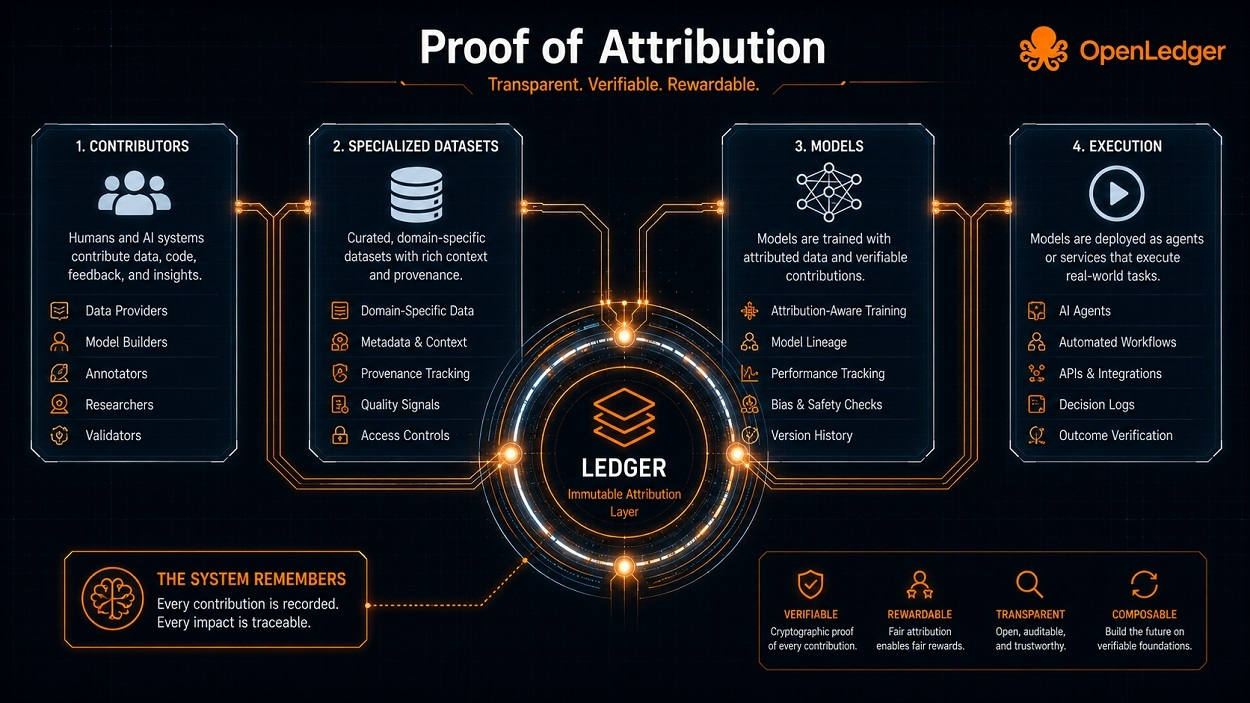
The system remembers.
The contributor shouldn't disappear.
That's a powerful idea.
And maybe that's why the recent Mainnet developments feel different to me.
They're not just about making AI smarter.
The industry already knows how to make AI smarter.
The harder challenge is making intelligence operational.
Making it accountable.
Making it attributable.
Making it economically useful.
That's a much bigger problem.
And perhaps a much more valuable one.
Maybe I'm wrong.
Maybe autonomous agents managing capital remain a niche experiment.
Maybe humans continue making most important decisions manually for decades.
That's entirely possible.
But if AI eventually becomes a participant rather than a tool, the projects building execution infrastructure today may end up being far more important than the projects simply building better conversations.
Because intelligence can generate ideas.
Execution changes reality.
And lately, OpenLedger seems far more focused on the second part of that equation than most people realize.