

Most people only see the surface of AI. They see the chatbot answering questions in seconds, the image generator creating art from a sentence, or the agents slowly learning how to automate real work. What they don’t see is the invisible world underneath it all — the millions of people whose data, ideas, conversations, and creativity quietly trained these systems into existence.
That part of the story is usually ignored.
Somewhere along the way, the internet normalized the idea that human contribution could be endlessly collected, packaged, and monetized without the original contributors ever sharing in the value. People gave platforms their attention. Creators gave platforms their content. Communities gave platforms knowledge. Then AI arrived and absorbed everything at a scale the world had never seen before.
#OpenLedger ($OPEN ) feels like a response to that reality.
Not in a loud or dramatic way, but in a way that asks a very uncomfortable question: if AI is learning from everyone, why does the value only flow back to a few?
That question sits at the heart of what OpenLedger is trying to build.
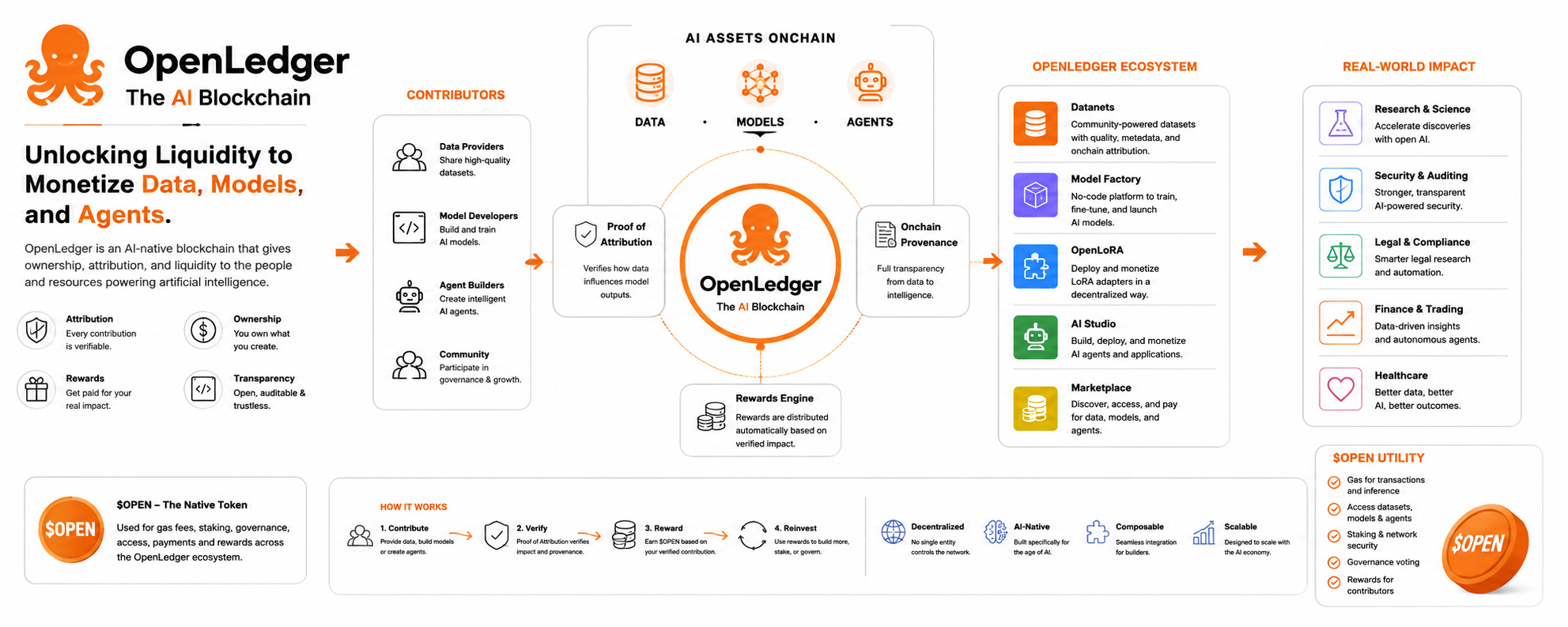
Instead of treating AI like a closed machine hidden behind corporate walls, OpenLedger wants to create an open system where data, models, and AI agents can exist onchain with transparent attribution. In simple words, the project is trying to make sure contributions are not forgotten. If someone provides valuable data, improves a model, or helps power an AI ecosystem, the network is designed to recognize that influence instead of burying it inside a black box.
And honestly, that idea feels bigger than crypto.
Because people are starting to realize that AI is becoming the new economy. Intelligence itself is turning into infrastructure. The companies controlling data today may end up controlling enormous parts of the future tomorrow. That creates excitement, but it also creates fear. A lot of people are watching AI evolve and quietly wondering whether ordinary contributors will once again be left behind while a small group captures most of the value.
OpenLedger seems built around the belief that this future can work differently.
The project talks a lot about attribution, ownership, and liquidity for AI resources, but underneath the technical language there is something deeply human. It is trying to give visibility back to contribution. That matters because the current AI landscape often feels emotionally disconnected. Models become more powerful every month, yet the people whose knowledge shaped those models remain invisible.
OpenLedger wants to change that relationship.
Its ecosystem is designed around the idea that datasets should become valuable digital assets, models should have traceable origins, and AI agents should operate inside transparent economic systems instead of isolated silos. The network introduces things like Datanets for community-driven data contribution, tools for decentralized model deployment, and infrastructure where AI agents can interact economically onchain.
For some people, those features sound technical.
But emotionally, it represents something simpler: recognition.
Recognition that intelligence does not appear out of nowhere. Recognition that human input matters. Recognition that data is not just fuel for machines, but the digital memory of real people living real lives.
And maybe that is why OpenLedger has started attracting attention inside both AI and blockchain circles. It is not just selling speed or hype. It is trying to connect two industries around a larger idea — that the future of AI should be more open, more transparent, and more fair than the systems that came before it.
Of course, none of this guarantees success.
The project still has enormous challenges ahead. Building decentralized AI infrastructure is extremely difficult. Coordinating incentives between contributors, developers, validators, and autonomous agents is not simple. The competition in both crypto and AI is brutal. Many projects promise transformation and disappear before they ever achieve meaningful adoption.
But even with those risks, OpenLedger feels connected to something real happening beneath the surface of technology right now.
People are becoming tired of opaque systems. They are becoming tired of giving value away without ownership. They are starting to question who benefits when intelligence becomes centralized.
That shift in thinking is important.
Because the next generation of AI will not just answer questions or generate images. It will trade, negotiate, automate businesses, manage capital, and interact with digital economies in ways most people still underestimate. When that world arrives, the infrastructure underneath it will matter just as much as the models themselves.
#OpenLedger is betting that AI agents will need decentralized coordination, transparent attribution, and programmable ownership to function at scale. And if that prediction turns out to be right, then the value of systems like this could become much larger than people currently imagine.
But beyond all the technology, there is one reason the project leaves an emotional impression.
It understands something many others ignore.
The future of AI is not only about machines becoming smarter.
It is also about whether humans remain visible inside the intelligence they helped create.