

One question has dominated the AI discussion in trading for years: Can AI forecast the future direction of the market? Assuming that knowing the next move would yield the biggest advantage, traders pursued stronger signals, more intricate models, and quicker forecasts.However, that presumption is being rewritten by onchain markets.
The decentralized ecosystem of today is dispersed throughout chains, liquidity pools, Open bridges, and quickly changing market conditions. Two systems may have entirely different results even if they receive the exact same market signal. Execution quality is frequently the only factor that makes a difference.
An opportunity can be found through prediction. Whether that opportunity truly turns a profit depends on how it is carried out.Simple forecasting engines are gradually giving way to multi-layered decision-making frameworks in modern AI systems. Autonomous systems are asking more questions than just "Where will the price go?"
• What location has the best liquidity?
• What is the risk of slippage?
• Does market volatility fluctuate quickly?
• Should we split or postpone the order?
• How should real-time adjustments to risk exposure be made?
• Is it possible for several strategies to work together across chains?
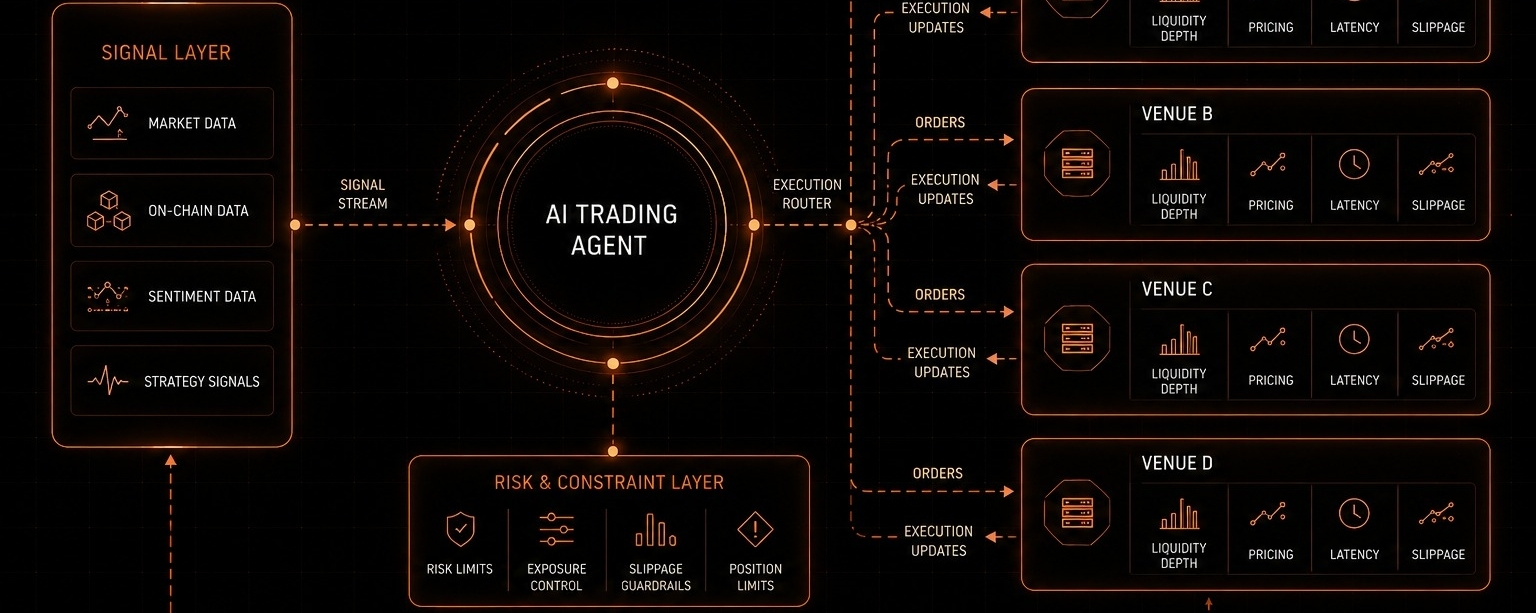
A new AI Open stack for onchain markets is being created as a result of this change.
Signal ingestion, where systems take in information from market activity, social sentiment, liquidity movement, and network data, is the cornerstone. Above that are risk-control measures intended to avoid overexposure in uncertain circumstances. Next is routing intelligence, in which systems look for the best route through environments with fragmented liquidity.Open
Cross-venue coordination is the next layer, where things get even more intriguing open.
There is no longer a single location where liquidity resides. Capital is constantly shifting between ecosystems. Future AI systems might function similarly to race engineers overseeing a high-speed strategy environment, constantly modifying routes, reallocating resources, and reacting quickly to shifting circumstances.
The last component is continuous feedback loops Of Open.
Conventional systems frequently make choices and end there. Autonomous systems pick up knowledge from results. Every execution generates fresh data that can enhance the subsequent action. Instead of static automation, this eventually produces adaptive behavior.
The outcome is a significant shift in the process of edge creation.Open
Systems that merely make more accurate market predictions might not be the future of AI trading. It might be a part of systems that perform more accurately, adjust more quickly, and coordinate actions more effectively in progressively complex environments.
Prediction could lead to opportunities in fragmented onchain markets.
Who gets through it is determined by execution.
