
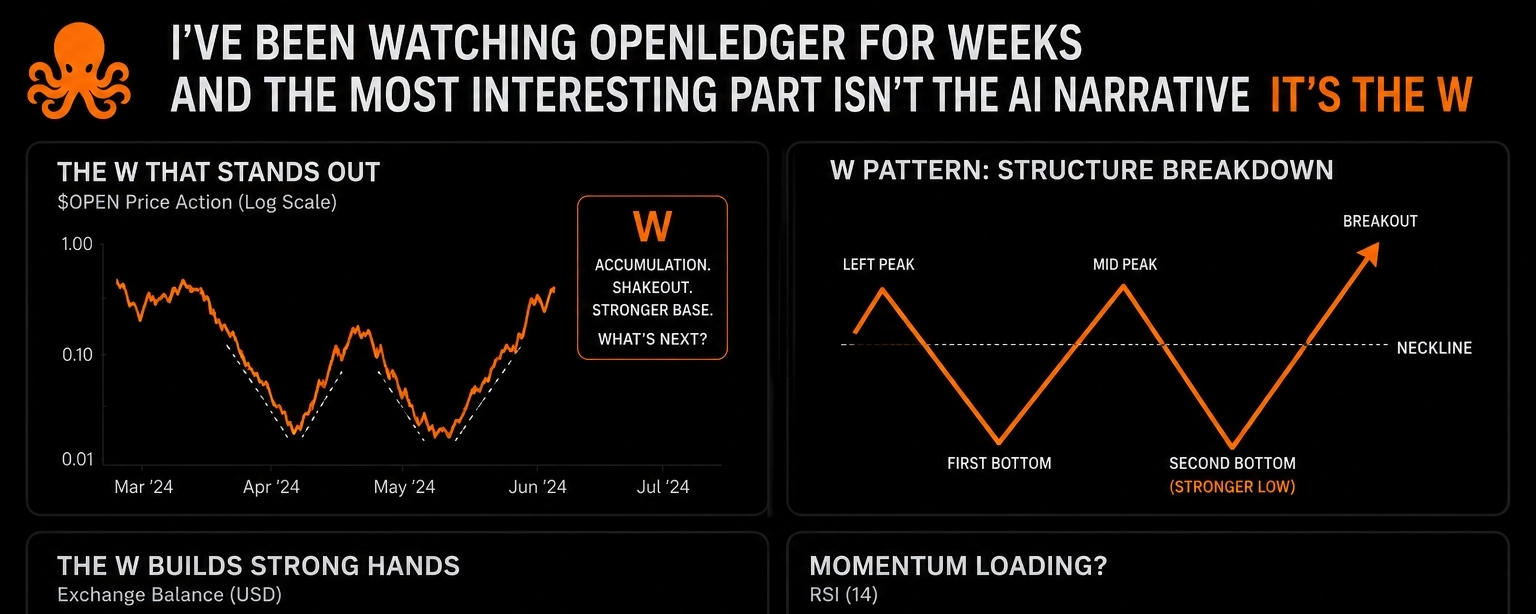

OpenLedger keeps showing up in my head at weird times during the day because the more I watch the AI narrative inside crypto, the more distorted everything starts feeling. Imwatching timelines filled with people pretending every AI token is infrastructure. Imtracking liquidity rotating from one “agent economy” narrative to another like nobody learned anything from previous cycles. Imreading threads written with absolute certainty from people who probably discovered the sector six months ago. And somewhere inside all that noise, OpenLedger keeps sitting there in this uncomfortable spot where I cant fully dismiss it but I also cant blindly trust it.
That tension matters to me more than hype does.
Because usually the projects worth watching dont feel obvious early. They feel unfinished. Slightly confusing. Full of unanswered questions. ThatswhereIstartpayingattention.
OpenLedger talks about monetizing data, models, and agents, and honestly most people reading those words probably dont stop long enough to think about how difficult that actually becomes once real incentives enter the system. Everybody says they want decentralized AI until you start asking who verifies the data, who filters manipulation, who handles malicious behavior, who owns outputs, who gets rewarded fairly, and how the network avoids collapsing into spam extraction.
Thats usually when the conversation gets quiet.
Ikeepseeing the same contradiction across crypto AI right now. People talk about intelligence like its the scarce asset, but Imstartingtothink trusted data becomes more valuable than intelligence itself once AI content floods everything. Thats the part OpenLedger seems to understand better than some of the louder projects chasing this narrative.
Because models are easy to talk about.
Data isnt.
Real datasets are messy. Ownership is messy. Attribution is messy. Incentives are messy. And crypto historically becomes even messier the second financial rewards appear. People stop optimizing for quality and start optimizing for extraction. Thats human behavior. The market doesnt magically become ethical because theres a blockchain involved.
Themarketalwaysstress-testsnarratives.
Always.
And AI infrastructure is about to get stress-tested harder than most people realize.
What keeps pulling my attention back toward OpenLedger is that the project feels less focused on surface-level AI branding and more focused on the economy underneath AI systems. Thats a very different conversation. Most AI projects want to sell the illusion of intelligence. OpenLedger seems more interested in the movement of value around intelligence.
ThatswhereIstartlookingdeeper.
Because crypto at its core is really just incentive engineering mixed with liquidity behavior. Thats it. Every cycle people wrap it in new language, but underneath all the narratives youre still dealing with coordination problems, trust problems, ownership problems, and financial behavior under pressure.
And pressure changes everything.
Projects always sound coherent during bullish conditions. Communities always sound intelligent when liquidity is flowing upward. The real test comes later when rewards weaken, attention disappears, and people start asking whether the infrastructure still matters without speculation attached.
Executionmattersmore.
Ive watched too many sectors inside crypto collapse after the narrative cooled. DeFi promised infinite financial transformation before unsustainable incentives exposed weak foundations. Metaverse projects sold digital futures nobody actually wanted to live in. Even a lot of Layer 1 ecosystems turned out to be temporary liquidity arenas more than sustainable economies.
So now when I look at OpenLedger, I dont care much about the AI buzzwords anymore. I care about behavioral durability.
Will contributors still participate once easy rewards disappear?
Will developers actually build inside the ecosystem during low attention periods?
Can decentralized data coordination survive manipulation attempts?
Can the network maintain trust without becoming centralized for efficiency?
Mostpeopleneverlookthatdeep because markets reward emotional momentum faster than structural understanding.
But infrastructure always reveals itself eventually.
And honestly the hardest thing about AI in crypto right now is separating technological potential from pure narrative inflation. The sector is overloaded with both. Every founder presentation sounds massive. Every roadmap sounds ambitious. Every ecosystem claims its building the future of autonomous coordination.
Meanwhile most users are still just chasing volatility.
Thats the reality nobody likes admitting.
OpenLedger exists inside that reality too. It isnt immune to speculation just because the underlying idea is interesting. If anything, AI narratives make projects more vulnerable to distorted expectations because people start pricing in futuristic dominance long before systems prove survivability.
Icantignore that risk.
At the same time, I also cant ignore how important data ownership and verification might become over the next few years if AI systems continue scaling aggressively. Because once synthetic content becomes endless, trust itself becomes infrastructure.
And thats where things get interesting.
Crypto spent years trying to financialize assets. OpenLedger feels like its attempting to financialize participation inside AI ecosystems themselves. Data contributors, models, agents, coordination layers. Not just ownership in theory, but liquidity around contribution.
Very ambitious idea.
Very difficult execution environment.
Especially because decentralized systems almost always sacrifice convenience somewhere along the way. Thats the hidden tradeoff crypto communities constantly underestimate. People say they want ownership and transparency until centralized systems offer faster experiences with less friction.
So OpenLedger isnt just competing against crypto projects. Its indirectly competing against massive centralized AI ecosystems with insane amounts of capital, infrastructure, and distribution power.
Thats not impossible to overcome.
But pretending its easy would be dishonest.
Imstudying how projects behave during quieter periods now because thats usually where the truth leaks out. Bull markets hide weaknesses. Bearish conditions expose operational reality. Thatsusuallywhenthecracksappear.
What I notice with OpenLedger is that the conversation around it still feels unresolved. Not polished into certainty yet. Some people think its positioned early around a real infrastructure problem. Others think its another AI narrative that sounds smarter than it functions.
Honestly I understand both perspectives.
And maybe thats why Imstillwatching.
Because crypto has a habit of dismissing important ideas early while simultaneously overvaluing narratives before they mature. Both things happen at the same time constantly. Thats what makes this market psychologically exhausting after enough years.
You stop trusting excitement completely.
You start watching behavior instead.
And when I watch OpenLedger, Im not looking for perfect answers anymore. Imlookingforwhetherthesystemkeepsdevelopingwhenattentionmoveselsewhere. Thats usually the difference between temporary narrative extraction and infrastructure trying to survive long-term pressure.
I dont know if OpenLedger ultimately succeeds. Nobody knows that no matter how confidently they post online. But I do think its touching a real problem inside the next phase of AI development, and real problems tend to outlive temporary market cycles.
Thats enough to keep me paying attention.