
Most AI conversations today revolve around models getting smarter, faster, and more autonomous. But one important question still feels unresolved across the industry: who actually owns the value created behind AI systems?
That’s where @OpenLedger has started standing out to me.
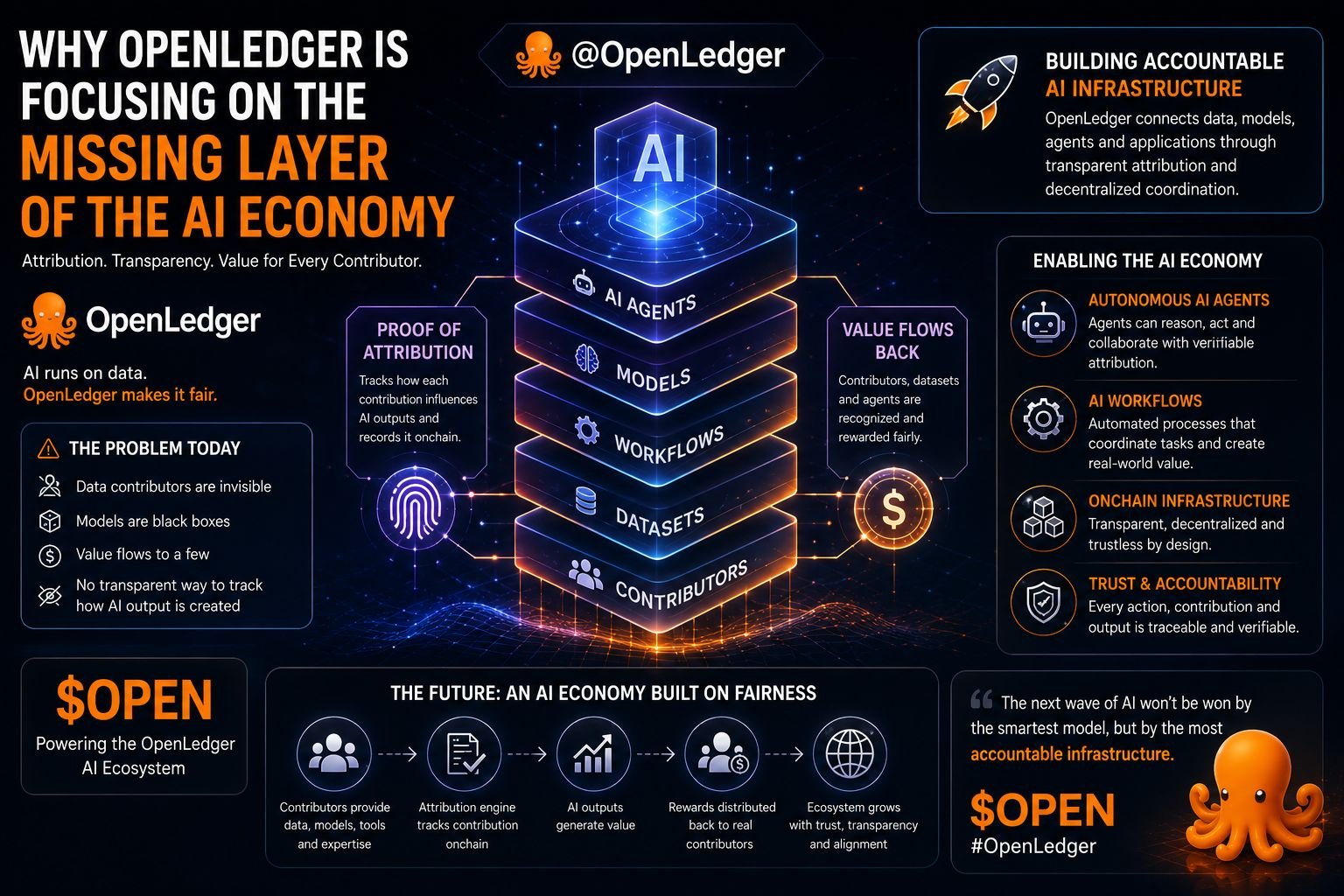
Instead of treating AI like another closed infrastructure race, OpenLedger is building around attribution, transparency, and coordination between datasets, models, workflows, and AI agents. The project keeps pushing the idea that contributors should not disappear once their data enters the system.
I think this matters more than people realize.
The next phase of AI probably won’t just be humans interacting with chatbots. It’ll involve autonomous agents working across applications, executing workflows, exchanging information, and generating economic activity automatically. Once that happens at scale, attribution becomes a serious issue.
How do you verify which data influenced an output?
How do developers prove contribution?
How do AI systems coordinate trustlessly without relying on centralized control?
OpenLedger seems focused on solving that layer through Proof of Attribution and onchain AI infrastructure. Instead of only monetizing AI outputs, the system attempts to connect value back to contributors, datasets, and agents participating inside the network.
The interesting part is that this feels less like short-term AI hype and more like foundational infrastructure being built early before the AI economy matures.
Right now most people still focus on front-end AI products.
But over time, the invisible coordination layer underneath AI may become even more valuable.