


The more I read about OpenLedger's recent updates, the more I keep coming back to the same question:
What if we've been focusing on the wrong problem in AI?
For the last few years, almost every conversation has revolved around intelligence.
Can models reason better?
Can they write better?
Can they solve harder problems?
Those are important questions.
But honestly, I'm starting to think intelligence was never the biggest bottleneck.
Execution was.
I realized this while reading about OctoClaw and the recent cloud configuration updates from @OpenLedger .
At first glance, they look like infrastructure improvements.
The kind of updates people usually scroll past.
But the more I looked at them, the more interesting they became.
Because they seem to address a problem that has existed long before AI.
The gap between having an idea and actually deploying it.
For years, building anything useful required navigating an entire maze of technical friction.
Servers.
APIs.
Deployment pipelines.
Monitoring systems.
Backend infrastructure.
Security configuration.
Maintenance.
The idea itself was often the easy part.
The implementation was where projects slowed down.
Or died.
And honestly, I think that friction has been one of the most underestimated constraints in technology.
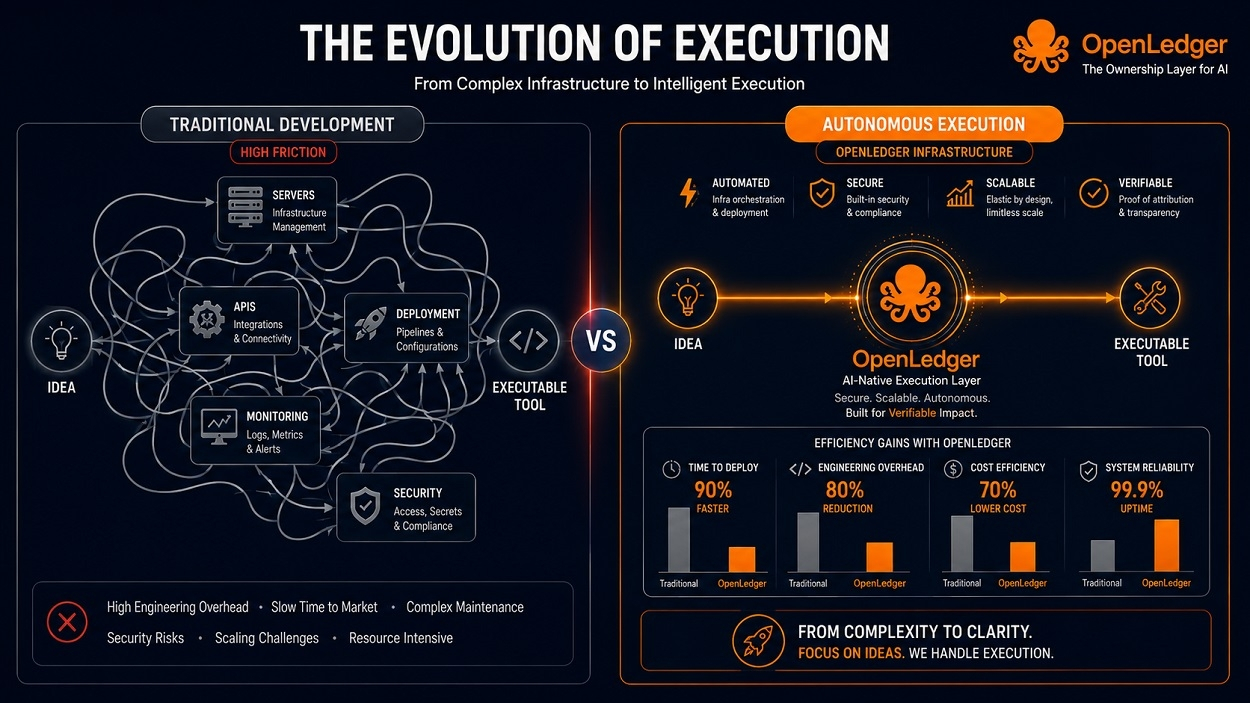
This is where OpenLedger's direction starts looking different to me.
OctoClaw isn't simply another AI application.
It appears to function more like an execution environment.
A place where language models, data pipelines and on-chain actions can be coordinated through a unified operational layer.
That distinction matters.
Because intelligence without execution is just potential.
Potential doesn't create outcomes.
Execution does.
The recent Vibecoding narrative highlights this shift particularly well.
One example from the ecosystem stood out immediately.
A user can describe a strategy in natural language:
"Monitor negative funding rates and rebalance when open interest spikes."
That's not remarkable anymore.
Large language models have been generating strategies for a while.
The interesting part is what happens next.
The infrastructure can transform that instruction into executable tools connected to real systems.
No manual API integrations.
No custom backend architecture.
No building everything from scratch.
The bottleneck starts moving.
Less time spent asking:
"How do I build this?"
More time spent asking:
"Is this idea worth building?"
That may sound subtle.
I don't think it is.
Historically, technological progress often came from compressing execution cycles.
Factories compressed manufacturing.
Cloud computing compressed deployment.
Modern AI may compress software creation itself.
And OpenLedger seems to be positioning several pieces of infrastructure around exactly that trend.
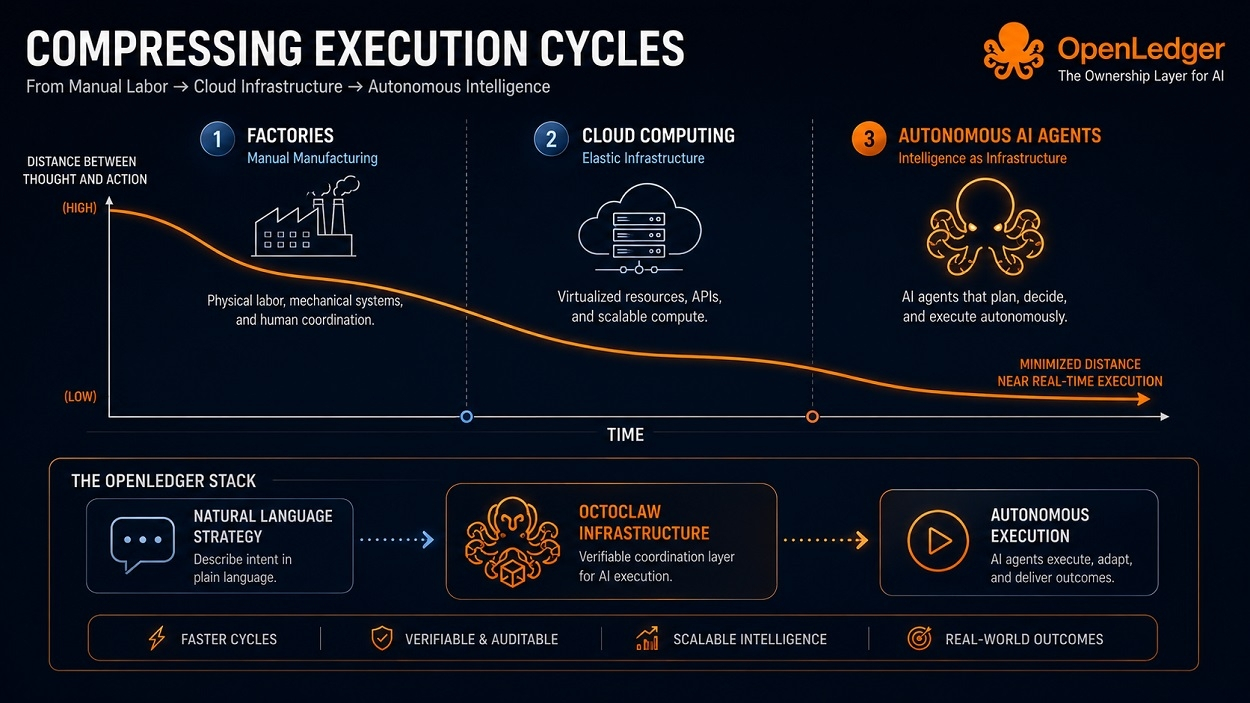
OctoClaw coordinates execution.
Cloud Config allows agents to remain active continuously without relying on local hardware.
Trading Agents connect decision-making with financial actions.
ERC-4626 allows those agents to understand standardized yield-generating vaults.
The EVM Bridge expands their operational environment across multiple ecosystems.
Individually, these look like product updates.
Collectively, they look like infrastructure for autonomous execution.
And maybe that's the more important story.
Not whether AI becomes smarter.
But whether AI becomes easier to deploy, coordinate and operate.
Because eventually intelligence becomes abundant.
Execution remains difficult.
Even today, countless people have valuable ideas.
Far fewer have the infrastructure required to transform those ideas into functioning systems.
Maybe that's why these updates caught my attention.
They aren't trying to teach AI how to think.
The industry is already investing billions into that problem.
They're trying to reduce the distance between thought and action.
Will that vision ultimately scale?
Honestly, I don't know.
Autonomous systems still face enormous challenges:
Security.
Reliability.
Governance.
Economic incentives.
All of those questions remain open.
But one thing feels increasingly clear:
The future winners in AI may not simply be the systems with the highest intelligence.
They may be the systems that make intelligence easiest to execute.
Ideas are everywhere.
Execution is scarce.
And lately, OpenLedger seems far more focused on that scarcity than most people realize.