
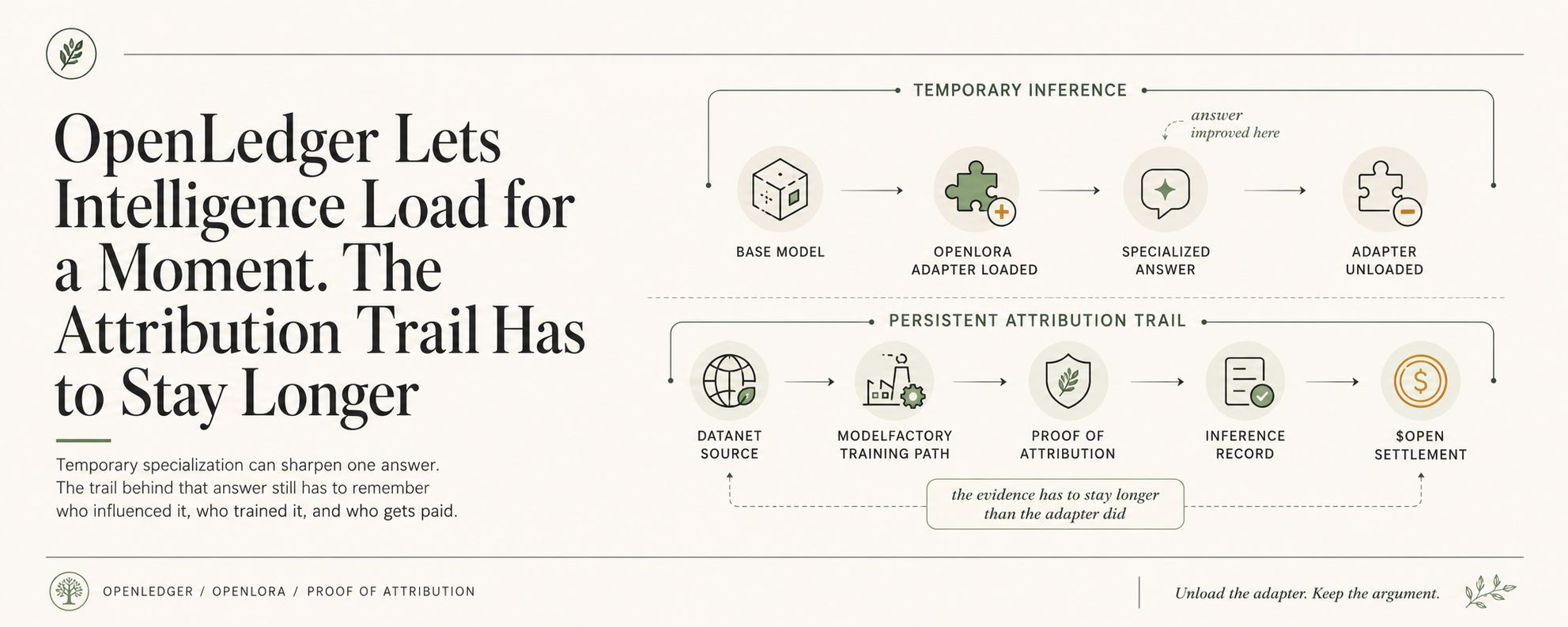


A model output lands.
Three minutes later the same Datanet gets queried again, same adapter path, same retry window.
Great. The output is traceable and the rhythm is still talking.
That is the version of OpenLedger that keeps getting harder to ignore. Not the nice clean AI provenance pitch. Not the one where Proof of Attribution does its careful little thing, the contribution path stays legible, the model lineage checks out, and everyone gets to feel like the hard part is over.
Good.
OpenLedger should be good at that. Centralized AI still makes too many workflows feel like somebody cooked the answer in a locked room and then called the smoke intelligence. Too much hidden training context. Too much unpriced contribution. Too much trust the model from people who never had to explain where the answer actually came from.
Alright.
The part nobody likes talking about is everything around the output.
Timing. Sequence. Frequency. Which Datanet got queried. Which adapter path woke up. Which agent retried. Which route fired after the same pause. Which marketplace query always shows up before a trading route resizes.
The output can stay clean and the pattern around it can still talk plenty.
That is where the nice provenance story starts looking a little fake.
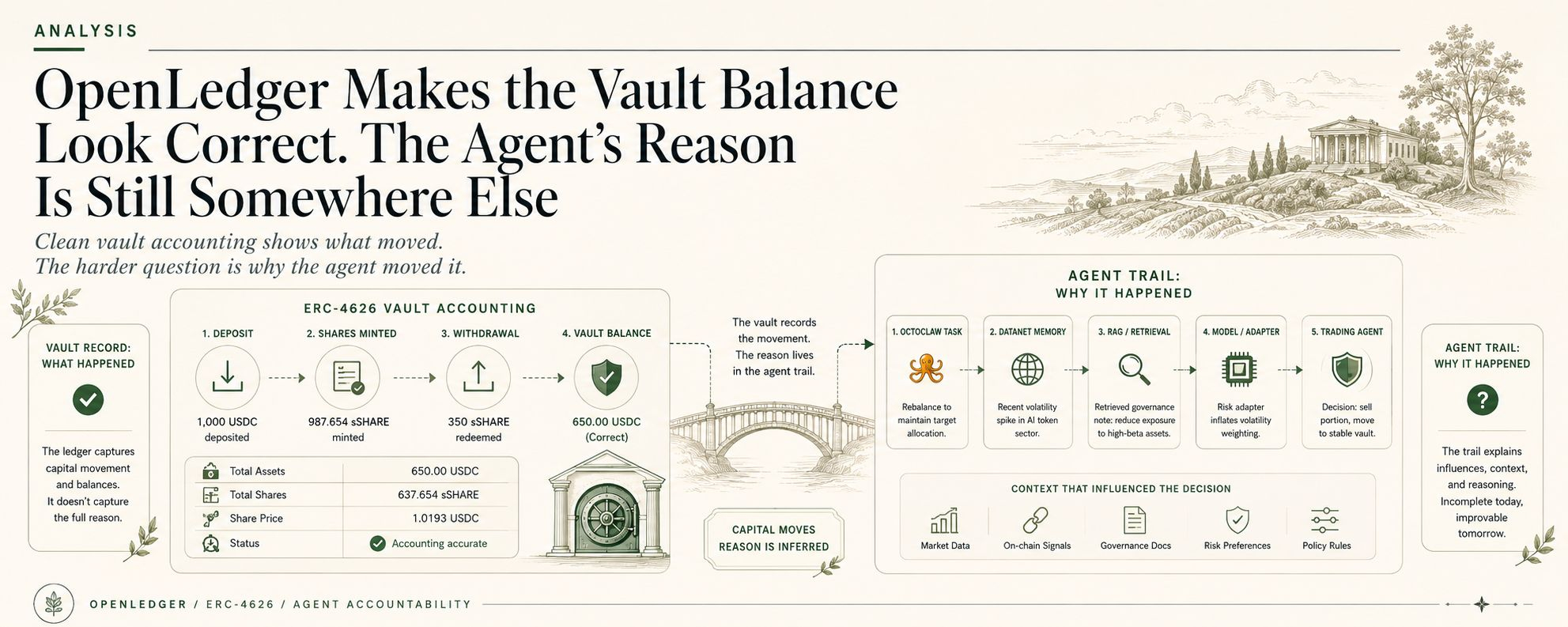
Say a team builds a trading or research agent on OpenLedger. A Datanet call leaves timing. An OpenLoRA path leaves version and retry behavior. A ModelFactory deployment leaves usage shape. PoA can trace contribution after the fact. None of that is the private answer itself. Still, together, it gives observers a rhythm to watch.
Now stop staring at the trace for a second and look at the outer shell.
One agent call always adds the same delay before execution.
One supposedly quiet research flow always creates the same query burst before a portfolio shift.
One Datanet cluster lights up right before a market-facing agent starts changing route.
One class of retries keeps bunching around the same kind of event.
A trading agent does not need to expose its prompt to leak intent. If the same Datanet lights up, the same adapter retries twice, then the same execution route waits ninety seconds before firing, that is already a shape. Not the answer. Enough of the answer. Uncle
After a while you do not need the full output. You just need the rhythm and a reason to care.
And that is where it starts getting annoying.
OpenLedger’s traceability protects the contribution path. Fine. Great even. Cadence is another problem. Same with retries. Same with route choice. The stack can keep the model path legible while the surrounding exhaust still leaks enough for somebody patient to reconstruct what kind of workflow is probably happening.
Not every detail.
Doesn’t need every detail.
Just enough shape to make the transparent-but-controlled part feel less controlled than the pitch suggests.
And people absolutely do this.
Markets do it.
Counterparties do it.
Strategy desks do it.
Analysts with too much time definitely do it.
Hide the exact prompt, fine.
Hide the full output, alright.
Hide the source weighting... maybe.
Can you hide that the same Datanet keeps getting hit three minutes before a route changes?
Can you hide that an agent retry pattern shows up every time volatility crosses a certain line?
Can you hide that one supposedly independent workflow is obvious from adapter-call frequency alone once somebody watches long enough?
People glide past that because it ruins the nice version.
OpenLedger does not escape that just because the AI path is more traceable. In some ways it makes the outer pattern matter more. Once contribution and lineage get cleaner, observers start learning from shape. From repetition. From sequence. From the boring exhaust around the thing they no longer need to read directly.
And now the pattern is doing the talking.
Not is PoA valid.
More like...how much can I still infer without the output telling me?
That matters economically too.
A desk can widen around that route. A builder can copy the cadence. A counterparty can infer which Datanet is becoming valuable before the attribution graph says it plainly.
Same with a market participant. Same with anyone trying to decide whether an agent workflow is actually private to the builder or just quieter.
An AI system can be traceable and still leak enough through pattern to create pricing consequences, strategic consequences, even basic social consequences around who is doing what and when.
Great.
The output is traceable.
Shame about the footprints.
So no, I do not think OpenLedger’s hard problem is only tracing the data.
It is also protecting the story the system keeps accidentally telling through query cadence, adapter retries, agent-call frequency, Datanet timing, all the little external traces nobody puts in the hero graphic because that part is harder to sell than AI attribution finally works.
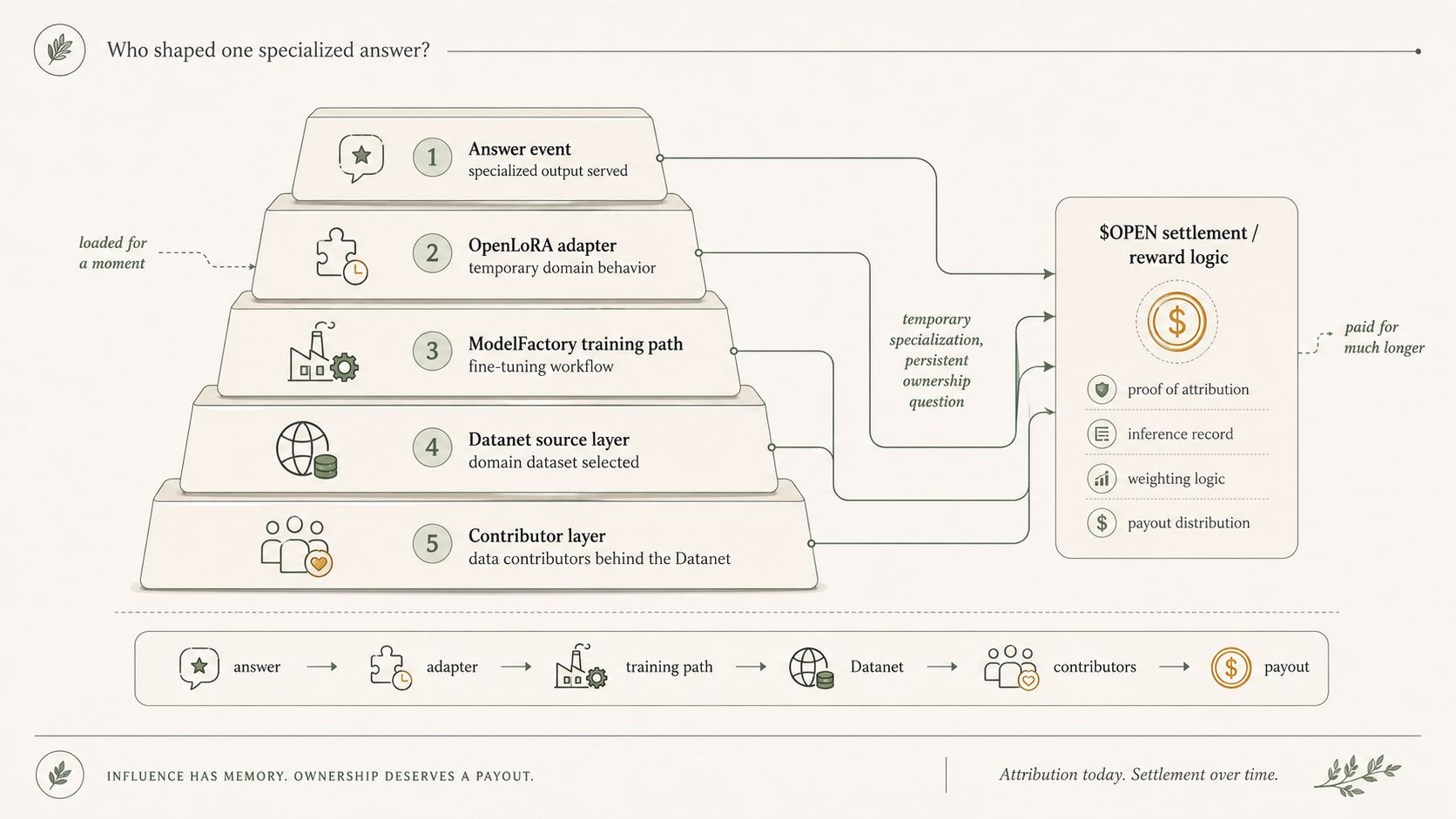
And if OpenLedger gets real adoption in serious environments... trading agents that resize routes, research agents that query niche Datanets before reports, treasury workflows that retry through the same adapter path, prediction markets that wake up around event feeds... that problem gets bigger, not smaller.
More volume means more pattern.
More pattern means more chances for someone to stop caring about the exact output and start learning from the rhythm around it.
That is the part I cant really stop looking at.
The attribution graph can be clean.
The inference exhaust can still be loud.
Because once the output stops mattering and the query rhythm is enough, the AI path can stay perfectly traceable and the system still says more than anyone wanted. $OPEN
