
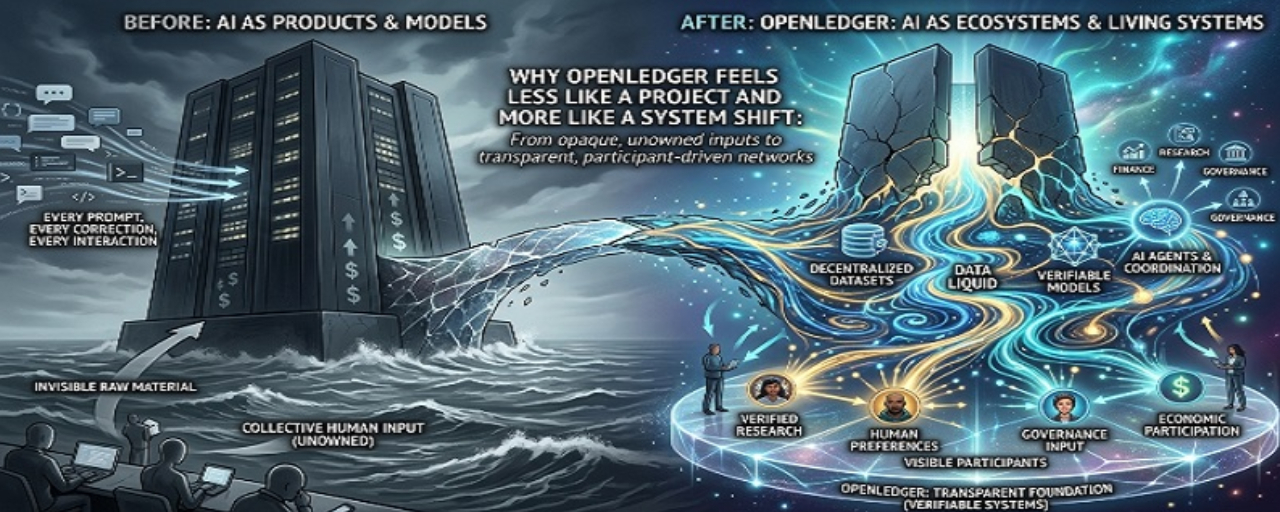

I’ve been thinking about this lately while watching how AI keeps moving faster than almost everything around it.
A few months ago, most conversations were still about models themselves. Which one is smarter, faster, cheaper, more human. But recently it feels like the conversation quietly changed. Now people are starting to ask where all this intelligence actually comes from.
Not the models.
The data behind them.
And honestly, that changes everything.
I noticed something interesting while reading through @OpenLedger discussions and community threads. The idea doesn’t really feel centered around “building another AI platform.” It feels more like questioning the structure underneath AI itself.
Because right now, most people contribute to AI systems without even realizing it.
Every prompt.
Every correction.
Every interaction.
Every preference.
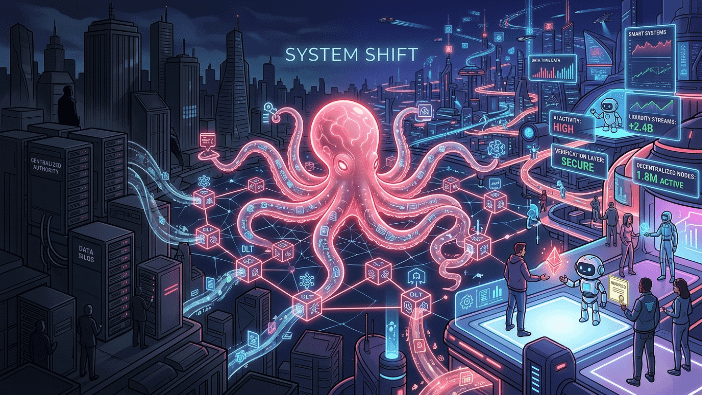
Somewhere along the way, human knowledge became fuel for machines, but the ownership part disappeared from the conversation completely.
That part stayed in my mind longer than I expected.
I remember watching crypto go through its early phases where people talked nonstop about financial ownership. Self custody. Permissionless systems. Removing middlemen.
But AI feels different.
It’s not only about money anymore. It’s about intelligence becoming dependent on collective human input while the value mostly accumulates in closed systems.
Maybe that’s why #OpenLedger feels different to me.
Not because it promises some futuristic dream overnight, but because it approaches AI from a direction that actually feels necessary.
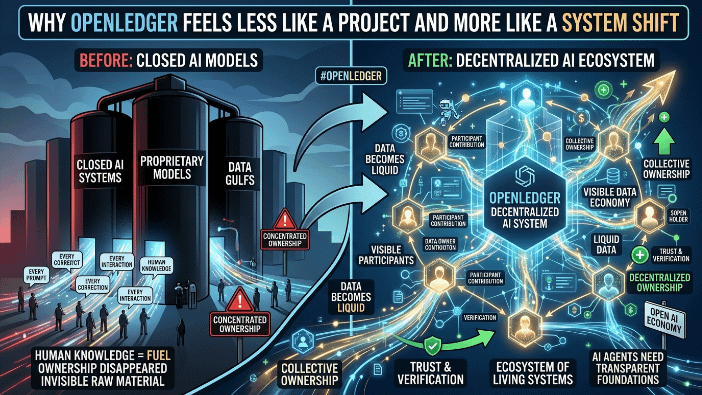
The idea of data becoming liquid feels strange at first.
I had to sit with that thought for a while.
Data has always existed, but most people never saw it as something active. It was just background noise generated from daily life online. Now suddenly we’re entering a period where data can train systems, shape decisions, influence economies, and even affect how AI agents behave.
So naturally the question becomes:
Who benefits from that?
That’s probably the first time I started understanding why decentralized AI infrastructure matters beyond just technology discussions.
If AI becomes part of daily life, then the systems feeding it probably shouldn’t belong to a tiny group of entities forever.
And I think $OPEN quietly sits inside that conversation.
Not loudly.
Not aggressively.
Just steadily building around the idea that contributors inside AI ecosystems should actually exist as visible participants instead of invisible raw material.
For some reason, that feels like a bigger shift than people realize.
I’ve also been noticing how conversations around AI agents are evolving recently. Everyone talks about autonomous systems, automated workflows, intelligent coordination. But very few people stop to ask what those agents are actually built on top of.
Trust matters more than people admit.
Verification matters too.
Especially once AI starts interacting with finance, communication, research, or governance systems.
That’s another reason #openledger keeps appearing in discussions that feel more structural than speculative.
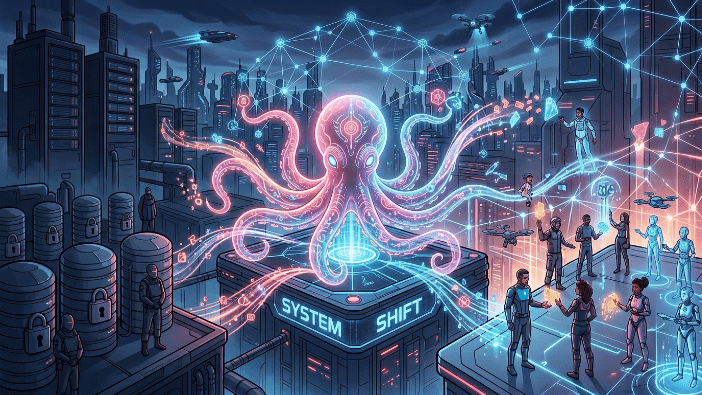
It feels less connected to short-term excitement and more connected to the uncomfortable realization that AI economies probably need transparent foundations if they’re going to scale responsibly.
Otherwise we just recreate another version of the internet where participation is massive but ownership is concentrated.
I’m not even saying blockchain solves everything.
Sometimes crypto communities oversimplify problems.
But combining verifiable systems with AI contribution models does feel like one of the few directions that actually acknowledges where this entire industry is heading.
And maybe that’s why the word “system shift” keeps coming to mind.
Not because everything changes tomorrow morning.
But because once people start recognizing data, models, and agents as economic participants instead of invisible background processes, the structure around AI starts looking incomplete without networks like #open .
I was surprised by how much this changed the way I think about AI infrastructure.
Before, I mostly saw models as products.
Now I’m starting to see ecosystems.
Living systems built from millions of small human interactions constantly flowing underneath the surface.
That perspective feels hard to unsee once it clicks.
And maybe that’s the most interesting part about @OpenLedger to me.
It doesn’t really feel like it’s chasing attention.
It feels like it noticed where the world is already moving.
