
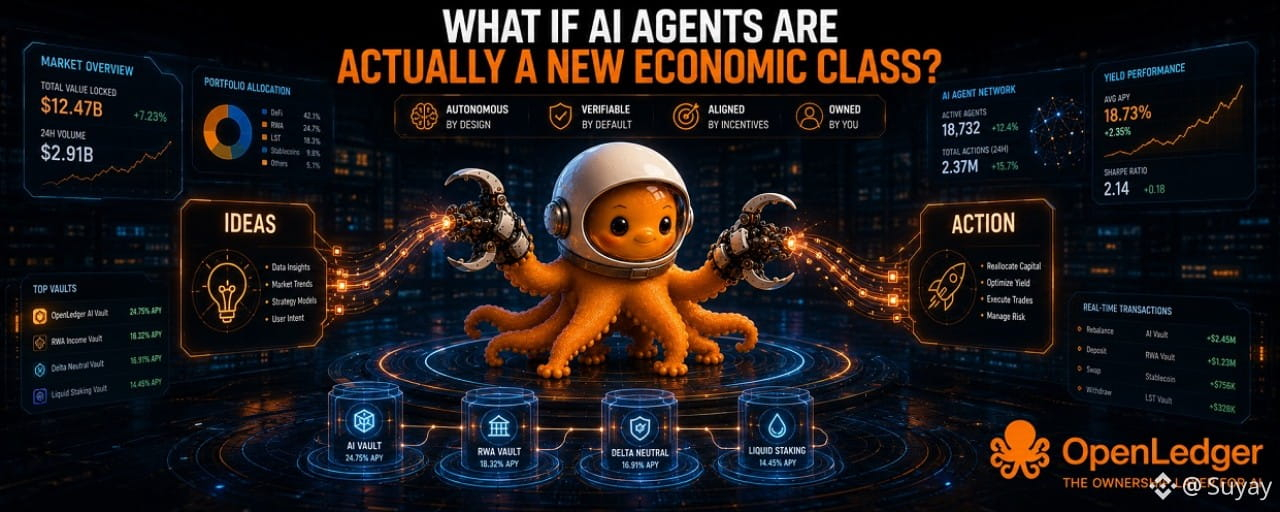

Yesterday I found myself reading through OpenLedger's latest updates again, and one thought kept coming back.
Maybe we're still describing these systems the wrong way.
We call them AI agents.
We call them automation.
We call them software.
But the more I look at where this technology is heading, the less those words seem to fit.
Because software traditionally waits.
You open the application.
You click the button.
You initiate the process.
You decide what happens next.
The software responds.
That's the relationship we've had with technology for decades.
But what happens when the software doesn't wait?
What happens when it's monitoring markets while you're sleeping?
Comparing opportunities across protocols?
Managing positions continuously?
Interacting with infrastructure without needing a new prompt every five minutes?
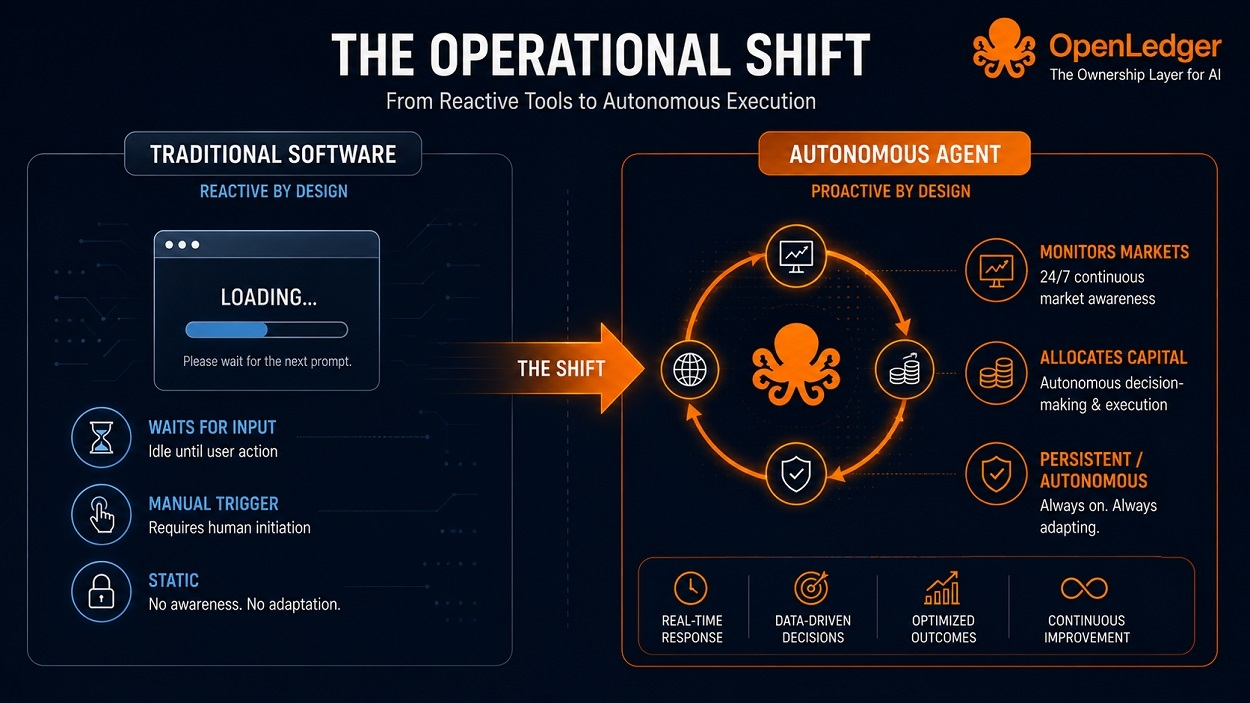
At some point, it starts feeling like something different.
And honestly, that's why OpenLedger's recent ecosystem developments caught my attention.
Not because they're building another AI assistant.
The industry already has thousands of those.
What interests me is the gradual shift from intelligence to participation.
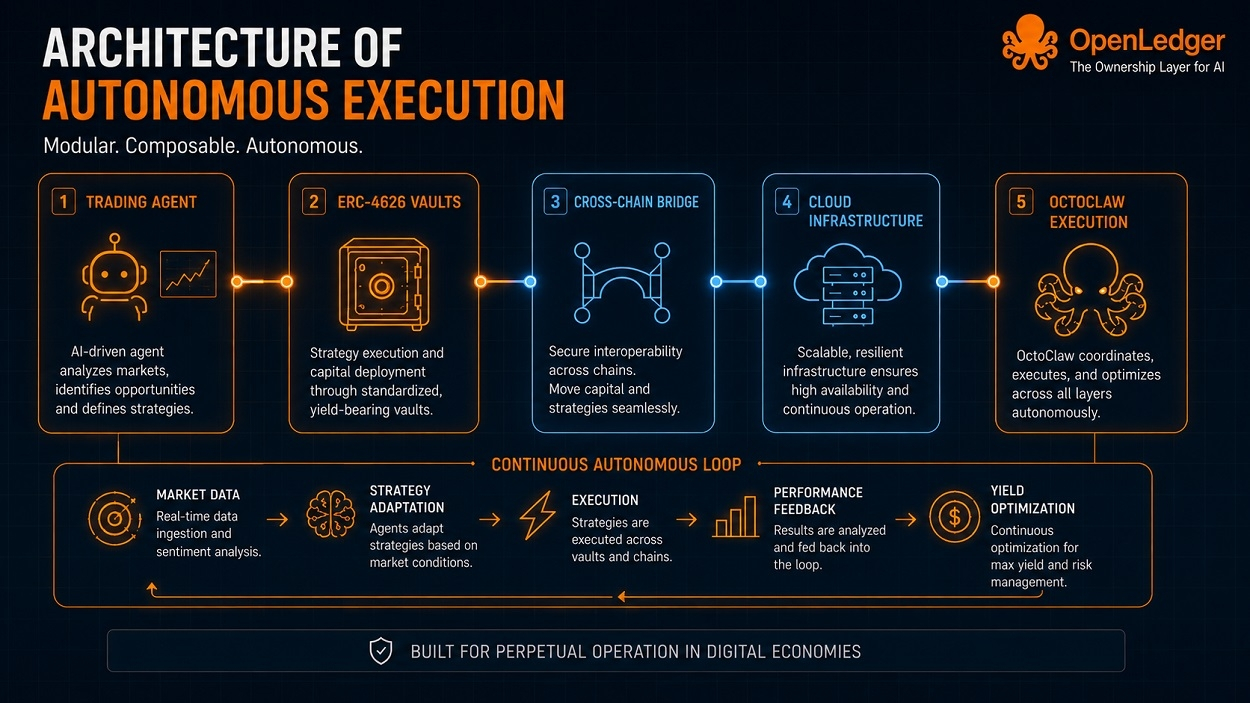
Take the Trading Agent.
Most people immediately focus on the AI component.
I think the more interesting part is the operational component.
The agent isn't simply generating opinions about markets.
It's designed to observe conditions, evaluate signals, and interact with financial environments in real time.
That may sound like a small distinction.
I don't think it is.
Analysis creates possibilities.
Participation creates consequences.
And consequences are where economies actually exist.
The same thought crossed my mind when reading about the ERC-4626 integration.
On paper, it's a technical standard.
Most people scroll past that kind of announcement.
I almost did too.
Then I stopped and thought about what it actually means.
An autonomous system can now understand a standardized vault structure.
Deposit.
Withdraw.
Allocate.
Reallocate.
Evaluate opportunities.
Potentially across multiple environments.
Suddenly we're not talking about software that explains finance.
We're talking about software that interacts with financial systems.
That's a completely different category.
Tools assist.
Participants act.
The line between those two things is becoming increasingly blurry.
Then there is the EVM Bridge.
Most conversations around bridges focus on assets.
Moving value from one chain to another.
Useful, obviously.
But I keep thinking about something else.
Reach.
Every new ecosystem expands the operational territory available to an autonomous system.
More protocols.
More liquidity.
More vaults.
More opportunities.
A larger environment to navigate.
The bridge isn't only moving assets.
It's expanding where an agent can operate.
And that's where the picture starts becoming interesting.
The Trading Agent.
ERC-4626 integration.
Cross-chain infrastructure.
Cloud-based deployment.
OctoClaw execution environments.
Individually they look like product updates.
Collectively they look like the early architecture of systems designed to participate continuously inside digital economies.
Maybe that's why I'm becoming less interested in benchmark discussions.
Every week another model becomes smarter.
Reasoning improves.
Context windows expand.
Performance scores increase.
That's great.
But intelligence alone doesn't participate in economies.
Actors do.
And I'm starting to wonder if autonomous agents eventually become something closer to economic actors than traditional software.
Not human.
Not independent.
Not conscious.
But operational.
Persistent.
Capable of generating actions rather than simply generating answers.
Capital never sleeps.
Neither do autonomous systems.
Of course, there are still enormous questions.
Maybe we're decades away from trusting autonomous financial agents at meaningful scale.
Maybe security challenges prove harder than expected.
Maybe most users continue preferring direct control.
Honestly, I don't know.
And I think anyone claiming certainty right now is probably guessing.
But I do think we're watching an important transition.
For years, AI has mostly been measured by how well it responds.
Increasingly, it may be measured by how effectively it operates.
That's a different challenge entirely.
And perhaps that's why #OpenLedger feels interesting to me at this stage.
Not because it's asking how to make AI smarter.
But because it seems to be exploring what happens after intelligence becomes actionable.
The model generates an idea.
The agent generates an action.
And economies have always cared more about actions than ideas.
Maybe that's the real story hiding underneath all these infrastructure updates.
We're not just building better software.
We may be building the first generation of autonomous economic participants.
Let's see.