
I used to think attribution infrastructure was mostly about rewarding contributors when AI products succeeded. That felt like the obvious story. Build a useful model, track who helped create it, split the economics more fairly than the current black-box mess. Clean enough.
Lately I’m less sure that’s the interesting part.
The more I watch AI infrastructure discussions, the more they feel strangely optimistic. Everyone talks about scale, monetization, agent economies, autonomous execution. Very little conversation about what happens when the business itself breaks.
And businesses break all the time.
A startup raises money, integrates multiple datasets, licenses external models, hires annotation providers, builds some vertical AI tool, gets early traction, then six quarters later it’s done. Revenue misses. Legal pressure rises. Burn gets ugly. Product shuts down.
People usually think the AI dies there.
But does the economic responsibility die too?
That question kept bothering me while looking at OpenLedger.
Because OpenLedger is usually framed as attribution infrastructure. AI contributors get recognized. Data becomes economically visible. Models can trace provenance. Fair enough. But I keep coming back to a less comfortable interpretation.
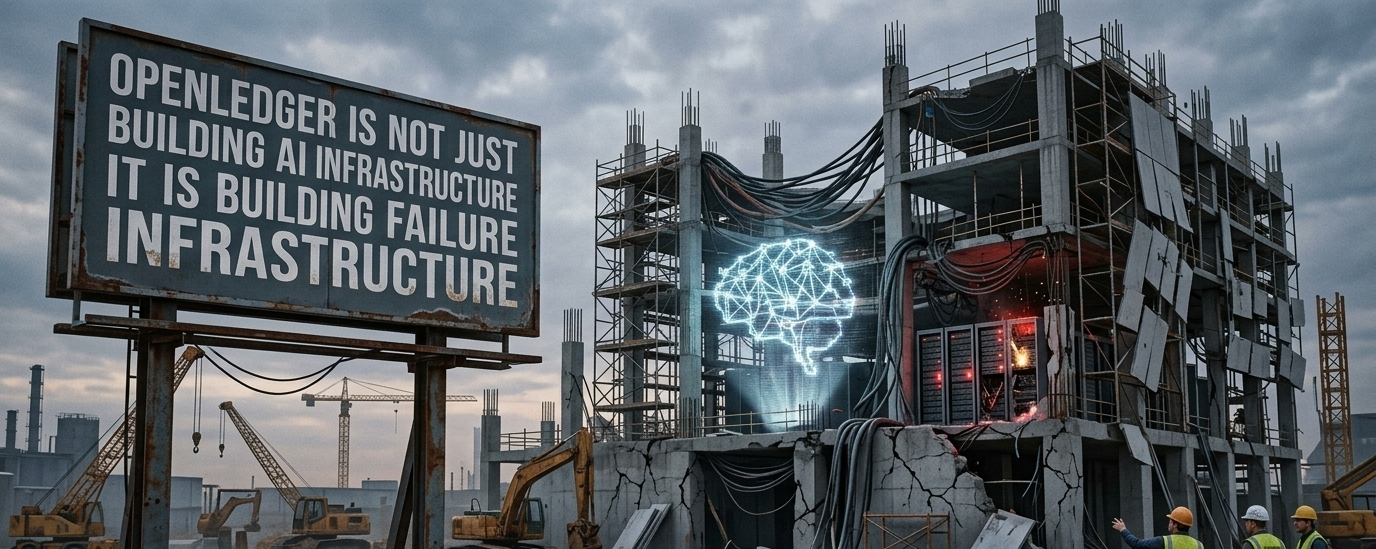
Maybe this is not just infrastructure for success.
Maybe it’s infrastructure for failure.
That sounds dramatic. I don’t mean it that way.
I mean mature economic systems need mechanisms for unresolved obligations. That’s normal. Traditional finance has settlement layers. Corporations have bankruptcy procedures. Supply chains have dispute processes. Software licensing has audit trails because nobody trusts memory once money gets involved.
AI, oddly, still behaves like we can skip that institutional layer.
Which feels naive.
Take a simple example. A medical AI company builds a diagnostic assistant using several licensed health datasets, a third-party model architecture, proprietary fine-tuning, external annotation labor, and maybe some retrieval layer plugged into live clinical sources. Entirely plausible.
Now imagine the company fails.
Not hypothetically impossible. Just ordinary failure.
Who gets paid if prior contracts were vague? What happens if a data provider claims the model commercially depended on their contribution more than disclosed? What if regulators ask for provenance clarity? What if investors selling distressed assets need to understand ownership exposure?
That is where attribution stops being a nice creator economy concept.
It becomes forensic infrastructure.
And honestly, this is where OpenLedger starts looking more interesting to me.
Not because it magically solves legal disputes. It doesn’t. Let’s be serious.
But because machine-readable provenance changes the shape of economic disagreement.
That matters.
Most AI systems today operate with deeply messy dependency chains. Data comes from multiple places. Model components get inherited. Fine-tunes build on prior work. Agents call external tools. APIs stack on APIs. The final product looks singular from the outside, but structurally it’s a patchwork.
That patchwork is manageable while revenue flows and everyone behaves.
Stress changes things.
Stress always changes things.
The crypto market should understand this better than anyone. Everything looks coordinated during expansion. The moment incentives compress, invisible assumptions become explicit conflict.
I’ve seen this in DeFi treasury disputes. Validator economics. Governance expectations that seemed obvious until money disappeared.
AI will not be different just because the branding is cleaner.
What OpenLedger appears to be building, at least conceptually, is infrastructure where contribution history becomes economically legible instead of socially remembered.
That distinction is bigger than it sounds.
Social memory is weak. Documentation gets selective. Teams dissolve. Cloud services disappear. People reinterpret agreements when outcomes change.
On-chain provenance does not create truth, but it creates durable evidence.
Different thing.
Still not enough on its own.
This is where I think crypto people often oversimplify. “Put it on-chain” is not the same as “problem solved.”
Records are inert unless systems know what to do with them.
If $OPEN is just a utility token for activity routing, then this whole thesis becomes thinner. Interesting, maybe, but limited.
If instead the network evolves into something where attribution affects settlement permissions, claim prioritization, staking credibility, access controls, or institutional trust decisions, then the economics get much heavier.
Because now you’re not pricing AI output.
You’re pricing coordination around disputed responsibility.
That is a different market entirely.
And maybe a larger one than people expect.
Enterprise AI adoption has a trust problem that retail narratives consistently underestimate. Not capability. Not really. Capability is moving fast enough.
The hesitation is operational exposure.
Procurement teams do not fear intelligence shortages. They fear hidden liability. Data contamination. unclear ownership chains. compliance surprises six months later.
That’s boring compared to agent hype, so nobody wants to post about it.
Still real.
The EU AI Act pushes governance expectations. Data protection frameworks don’t disappear because models are clever. Commercial contracts still care about attribution boundaries even when technical systems blur them.
The market keeps pricing AI upside while quietly ignoring institutional risk plumbing.
Which is strange, because boring infrastructure usually captures more durable value than speculative storytelling.
But there are obvious problems here too.
Attribution itself is messy.
How much did a dataset really matter? Was a contributor economically material, or just technically adjacent? If a model touched thousands of micro-inputs, does everyone deserve recurring claims forever?
That path gets absurd quickly.
You cannot build functioning markets where every microscopic contribution becomes permanent financial overhead. Coordination would collapse under administrative weight.
So any real system needs thresholds. relevance filtering. materiality standards. Maybe even deliberate exclusion.
Which introduces governance questions immediately.
Who decides what mattered?
That gets political fast.
And enforcement remains the ugly unresolved layer.
A blockchain can preserve records beautifully. It cannot automatically compel off-chain compliance across jurisdictions, insolvency processes, or fragmented commercial contracts.
People in crypto keep confusing visibility with enforceability.
Very different things.
Still, I cannot shake the intuition that the market may be misunderstanding where attribution infrastructure becomes economically necessary.
Not during success.
During breakdown.
During acquisition diligence.
During disputes.
During restructuring.
During moments when nobody agrees anymore.
That’s when systems reveal whether they were architecture or branding.
So when I describe OpenLedger as something resembling an AI bankruptcy court, I don’t mean literal courts, judges, or tokenized lawsuits.
I mean something simpler.
Economic systems mature when failure becomes manageable.
AI still feels young because it mostly talks about acceleration.
Infrastructure that helps markets survive disagreement may end up mattering more than infrastructure that simply helps optimism move faster.
That’s a less exciting story.
Possibly the real one.