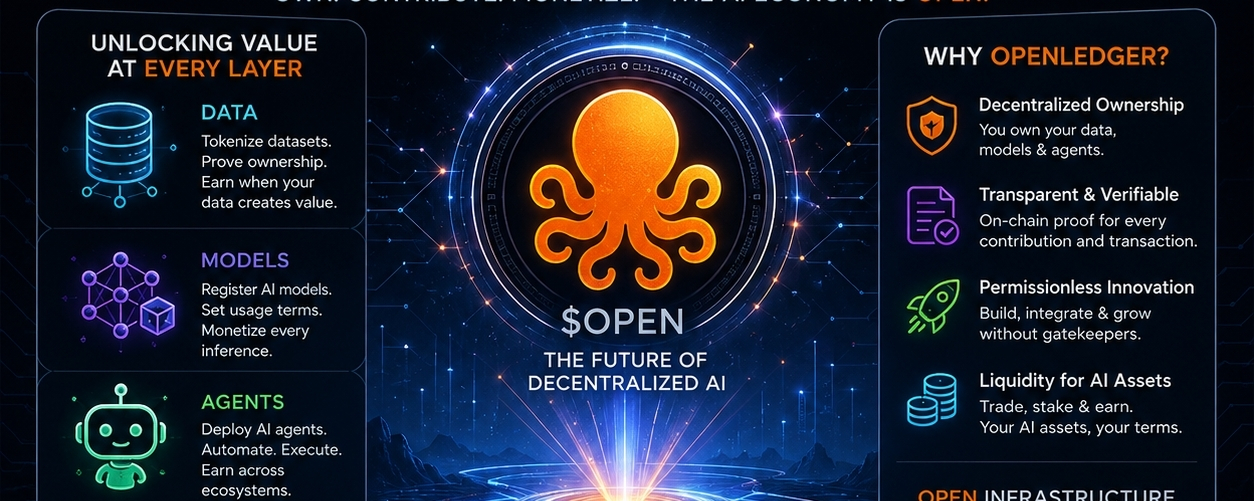
@OpenLedger ($OPEN ) is an idea built for the next stage of the AI economy. Right now, a lot of valuable AI work happens behind closed doors. Data is collected, models are trained, and agents are built to automate tasks, but the people creating those resources often do not see much of the value they helped produce. OpenLedger tries to change that by making AI data, models, and agents easier to own, trade, and monetize on-chain.
That is what makes the project interesting. It is not just another crypto name trying to ride the AI trend. It is aiming at a real problem: how do we give value back to the people and teams that create useful data and intelligent systems? In a world where AI is becoming part of daily work, that question matters more than ever.
Think about it this way. A company may use thousands of data points to train an AI model. A developer may fine-tune that model for a specific task. Another person may build an agent that uses the model to answer questions, manage workflows, or execute transactions. Each step adds value. But in most systems, that value stays locked inside a private platform. OpenLedger is trying to make those contributions visible, traceable, and financially rewarding.
This is where the blockchain side becomes important. Blockchain can help track ownership, record contributions, and create transparent reward systems. OpenLedger appears to be building around that strength. If the platform works as intended, creators could earn from the usage of their data or AI assets instead of watching large platforms capture everything. That is a strong idea, and it fits a growing demand for fairer digital economies.
When I look at OpenLedger, I immediately think about projects like Bittensor, Fetch.ai, and Render. Bittensor focuses on incentives for decentralized machine learning. Fetch.ai is known for autonomous agents and automation. Render is centered on distributed GPU power for rendering and AI-related workloads. OpenLedger feels different because it is trying to connect the value chain itself, not just one part of it. It is less about one tool and more about the economic layer underneath AI.
That broader approach could give it a real place in the market. Businesses are already looking for ways to use AI more efficiently, and many developers want better ways to earn from their work. If OpenLedger can build trusted systems for data licensing, model ownership, and agent monetization, it may find a strong role in future AI marketplaces, decentralized cloud platforms, and enterprise automation tools.
The big question is execution. Many projects sound promising in the beginning, but only a few turn into something people actually use. OpenLedger will need developers, partnerships, and real-world demand to prove that its model works beyond theory.
Still, the timing feels right. AI is growing fast, and people are starting to ask harder questions about ownership, fairness, and value sharing. OpenLedger enters that conversation at exactly the right moment. The real story here is simple: as AI becomes more powerful, who gets to benefit from it? That is the kind of question that can shape the next big wave in crypto and technology.