I’ll be honest I didn’t expect to spend much time thinking about OpenLedger.
At first glance, it looked like another attempt to combine two industries that already suffer from too much language and too little clarity. “AI blockchain” has become one of those phrases that sounds important until you hear it repeated enough times that it begins collapsing under its own weight. Every project claims it will decentralize intelligence, reinvent ownership, or build a fairer digital economy. Eventually the words stop meaning anything. They start sounding like placeholders for ambition.
That was my initial reaction to OpenLedger.
But the more I sat with the idea behind it, the harder it became to dismiss completely. Not because the project suddenly appeared flawless, or because I became convinced decentralized AI is inevitable, but because OpenLedger seems to be orbiting a real tension that quietly sits underneath the modern AI economy — a tension most people still don’t fully notice.
We are entering a world where intelligence is becoming infrastructure, yet the people contributing to that intelligence rarely own any meaningful part of the systems being built from it.
That imbalance feels strangely invisible right now because AI still appears magical from the outside. Most users interact with models through polished interfaces, quick outputs, and abstract conversations. But underneath those systems exists an enormous hidden economy of human contribution. Data labeling, behavioral feedback, specialized datasets, model refinement, ranking systems, annotations, contextual corrections, reinforcement loops — millions of invisible inputs shaping machine capability over time.
The unsettling part is that almost none of this labor resembles traditional labor anymore.
People contribute intelligence passively now. Every interaction becomes material. Every correction improves systems. Every pattern becomes training infrastructure. Human knowledge slowly dissolves into machine optimization pipelines, and somewhere along the way ownership becomes difficult to trace.
That seems to be the space OpenLedger is trying to explore.
Not AI as a product, but AI as an economic coordination problem.
The protocol appears less interested in building a single dominant model and more interested in constructing rails around how intelligence itself is created, attributed, and monetized. The deeper idea feels almost philosophical: if machine intelligence is increasingly built from distributed human contribution, should the economic structure around it also become distributed?
That question sounds idealistic until you realize how centralized the current landscape already is.
Most AI systems today operate through asymmetrical extraction. Data flows inward from the public. Models become exponentially more valuable. Platforms consolidate power. Contributors disappear into the background. The people shaping the intelligence rarely participate in the upside generated from it.
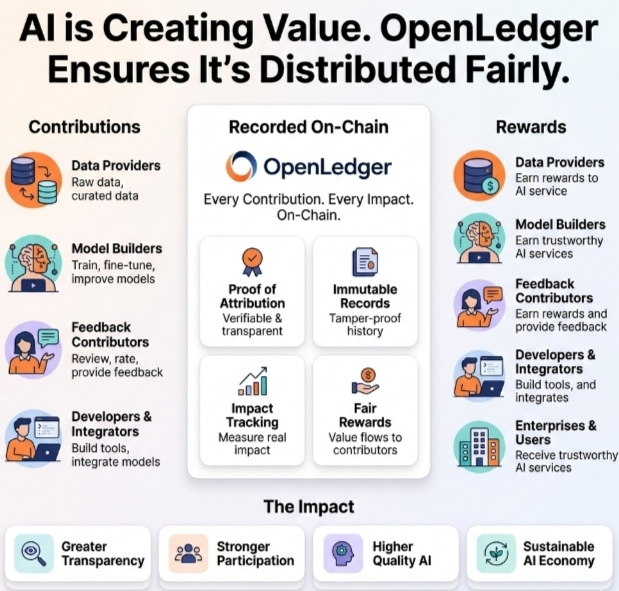
OpenLedger seems to challenge that structure by treating datasets, models, and AI agents as economic participants rather than static digital products. The architecture implies that intelligence production should be measurable enough for value to move back toward contributors instead of accumulating entirely at the platform layer.
At first I thought this sounded conceptually elegant but practically impossible.
Because intelligence is messy.
Unlike financial transactions, knowledge creation does not happen in clean linear sequences. A model’s behavior emerges from countless overlapping interactions. One dataset influences another. One contributor improves a system indirectly through subtle refinements that may only matter months later. Human expertise often becomes valuable precisely because it cannot be reduced neatly into metrics.
This is where the complexity of OpenLedger becomes genuinely interesting.
The protocol appears to be attempting something closer to attribution infrastructure than traditional blockchain coordination. The ledger itself matters less than what the ledger is trying to observe. Instead of simply tracking tokens or transactions, the system seems designed to track participation inside intelligence creation.

Who contributed what. Which models evolved through which data. How value moved through training pipelines. How AI agents generate economic activity. How contribution becomes economically visible.
In theory, this creates a world where intelligence becomes auditable.
But there’s something slightly uncomfortable about that idea too.
Because once intelligence becomes measurable, human cognition starts drifting closer to financial infrastructure. Participation stops being passive. Knowledge becomes capital. Attention becomes labor. Interaction becomes yield-generating activity inside larger machine economies.
That is the strange psychological shift sitting underneath decentralized AI systems.
They promise liberation from centralized extraction while simultaneously accelerating the financialization of human contribution itself.
OpenLedger exists directly inside that contradiction.
And honestly, that contradiction is probably why the project stayed in my head longer than I expected.
The protocol doesn’t feel naïve exactly, but it does feel aware that AI infrastructure is no longer just a technical problem. It’s becoming a social problem, an economic problem, even a political problem. Once intelligence becomes programmable and monetizable at scale, ownership structures suddenly matter in ways the internet never fully prepared for.
Who owns machine-generated productivity? Who receives value when models are trained on collective behavior? Who decides what knowledge deserves compensation? Who validates quality inside decentralized systems where incentives inevitably distort behavior?
These questions become difficult very quickly.
Because decentralized coordination sounds beautiful until real incentives appear. The moment rewards enter a system, people begin optimizing around extraction. Low-quality contributions flood networks. Governance mechanisms become political. Wealth concentrates through staking power. Reputation systems slowly harden into hierarchy. Economic efficiency begins competing against intellectual integrity.
And AI systems are especially vulnerable to this because intelligence quality is incredibly difficult to measure objectively.
A blockchain can verify whether a transaction happened. It cannot easily verify whether knowledge was meaningful.
That distinction matters more than most people realize.
The success or failure of projects like OpenLedger may ultimately depend less on technical scalability and more on whether decentralized systems can coordinate human contribution without flattening intelligence into simplistic economic signals.
That feels like the real experiment here.
Not whether AI can run on-chain. Not whether tokens can incentivize participation. But whether decentralized systems can preserve nuance inside economies increasingly obsessed with optimization.
The more I thought about it, the more OpenLedger started feeling less like a crypto project and more like an early response to a future that is arriving faster than society seems emotionally prepared for.
A future where intelligence itself becomes an asset class.
And maybe that sounds dramatic, but look carefully at the direction things are moving. Models are already replacing forms of labor. Data is already treated like infrastructure. AI agents are beginning to act autonomously across digital systems. Entire industries are reorganizing themselves around machine-generated cognition.
The deeper question is no longer whether AI becomes economically dominant.
It’s who owns the systems beneath that dominance.
Right now, the answer is mostly large centralized organizations with enough compute, capital, and distribution to absorb the network effects. Protocols like OpenLedger appear to be experimenting with alternative structures before those ownership patterns become irreversible.
Will decentralized AI systems outperform centralized ones? Maybe not.
Centralized systems still move faster. They coordinate more efficiently. They possess enormous advantages in infrastructure, talent concentration, and capital deployment. Decentralized systems often struggle with fragmentation, governance paralysis, and speculative behavior that distracts from productive utility.
OpenLedger will likely face those same pressures.
But even if the system remains imperfect, I think the project matters for a different reason.
It forces a conversation that the broader AI industry still tends to avoid.
A conversation about invisible labor. About attribution. About participation without ownership. About whether intelligence should become privately enclosed infrastructure or collectively coordinated infrastructure. About whether the future digital economy simply extracts from people more efficiently or finally creates mechanisms where contributors become visible participants inside the systems they help shape.
I still carry skepticism toward the entire sector. Maybe that skepticism is healthy. Too many projects mistake philosophical ambition for practical execution. Too many protocols confuse tokenization with genuine decentralization.
But I also think dismissing these experiments entirely would miss something important.
Because beneath all the hype, beneath the speculative noise, beneath the branding and narratives, projects like OpenLedger are reacting to a real structural shift happening quietly beneath the internet itself.
The economy is slowly moving from ownership of information toward ownership of intelligence.
And humanity still hasn’t decided what that transition is supposed to look like.