@OpenLedger The more I observe the evolution of artificial intelligence, the more I feel that the market is still focusing almost entirely on the visible layer of innovation while underestimating the infrastructure quietly becoming necessary underneath it. Most discussions surrounding AI remain centered around model capability, reasoning breakthroughs, autonomous agents, inference efficiency, and the race toward increasingly powerful systems capable of replacing human workflows across entire industries. Those developments are obviously important, but history repeatedly shows that technological revolutions rarely create their greatest long-term value through the most visible products alone. The largest and most durable economic layers are often the invisible systems that allow complexity to scale without collapsing under its own weight.
This is one reason OpenLedger has started standing out to me in a much deeper way than many other AI-related projects entering the market today. At first glance, most people naturally frame OpenLedger as a project focused on attribution, contributor rewards, and decentralized participation within AI ecosystems. That explanation is technically accurate, but I increasingly think it misses the far more important structural implication behind what this kind of infrastructure may eventually become. The deeper opportunity may not simply involve helping contributors receive fairer economic recognition. The larger opportunity may involve building the coordination infrastructure necessary for increasingly autonomous AI economies to remain economically understandable once complexity becomes too large for humans to manage informally.
That distinction matters far more than many people currently realize.
Modern AI systems are no longer isolated products built entirely inside a single company with clear ownership boundaries and transparent dependency structures. They are becoming layered economic environments composed of countless interconnected components operating simultaneously beneath the surface. A single AI product today may indirectly depend on licensed datasets, open-source research, synthetic generation pipelines, fine-tuned architectures, retrieval systems, external API cloud infrastructure providers, annotation labor, agent frameworks, and inherited model layers all interacting together inside one operational environment. To users, the final product appears singular and cohesive. Structurally, however, it is often fragmented across invisible relationships and commercial dependencies spread throughout multiple ecosystems.
Right now, most of those relationships are managed through partial documentation, centralized trust assumptions, internal coordination, fragmented contracts, or social memory between organizations. That model may appear functional while the industry remains relatively early and incentives stay aligned during expansion cycles, but history consistently demonstrates that informal coordination becomes fragile once industries mature and economic pressure begins exposing structural weaknesses hidden beneath growth. Every major technological and financial system eventually reaches a stage where scale itself creates coordination problems too large for trust alone to manage efficiently.
The crypto industry already learned this lesson repeatedly over the past several years. During bull markets, ecosystems appear naturally coordinated because rising liquidity masks operational fragility beneath optimism. Governance concerns seem abstract. Dependency risks feel manageable. Ownership assumptions remain mostly unquestioned because expansion keeps incentives temporarily aligned. But once stress enters the system, invisible complexity rapidly becomes visible conflict. Suddenly everyone wants verifiable records, transparent accountability, contribution history, enforceable agreements, and durable infrastructure capable of surviving disagreement. Systems that once relied comfortably on informal coordination begin requiring institutional-grade structure because financial pressure transforms ambiguity into liability.
I do not believe AI ecosystems will behave differently.
If anything, I think the coordination challenges surrounding AI may eventually become significantly larger because intelligence systems themselves continuously evolve through inherited dependencies, external integrations, and dynamic interactions between increasingly autonomous environments. AI systems are not becoming simpler as they scale. They are becoming structurally harder to audit, harder to interpret, and harder to economically map across fragmented ecosystems where countless contributors influence outcomes simultaneously.
That is precisely where OpenLedger starts looking much more important to me than many current market narratives suggest.
If attribution infrastructure evolves into machine-readable economic provenance capable of preserving transparent contribution history across AI environments, then OpenLedger may ultimately become part of the trust architecture future institutions require before deploying autonomous systems confidently at scale. Enterprises integrating AI into finance, healthcare, cybersecurity, logistics, legal operations, research environments, and enterprise automation do not simply evaluate whether models are intelligent enough to perform tasks effectively. They evaluate whether the surrounding infrastructure is operationally reliable enough to survive audits, compliance reviews, disputes, legal scrutiny, governance failures, and long-term institutional pressure.
That distinction is critical because institutional adoption has never depended solely on capability. Institutions adopt systems once they become economically survivable under stress.
This is one reason I think the market still dramatically underestimates how important provenance and attribution infrastructure may eventually become inside AI economies. Most current conversations remain trapped inside speculative narratives surrounding acceleration. Faster models. Smarter agents. More autonomy. Bigger reasoning capacity. But as ecosystems scale, coordination itself often becomes more valuable than raw capability expansion. Intelligence without accountability eventually creates hesitation. Intelligence without traceability creates operational uncertainty. Intelligence without durable economic memory becomes difficult for institutions to trust once meaningful financial exposure enters the system.
OpenLedger appears positioned directly inside that emerging problem space.
What makes this especially interesting is that AI systems are increasingly moving toward environments where outputs are generated through layered interactions rather than isolated computation. Future autonomous ecosystems may involve agents calling external tools, inheriting third-party reasoning layers, integrating dynamically updated datasets, interacting with decentralized services, and continuously evolving through external feedback loops. In those environments, understanding where outputs originated and which dependencies shaped decisions may become economically essential rather than philosophically optional.
And that changes the role attribution infrastructure plays entirely.
Attribution stops being a simple creator-economy narrative about rewarding contributors more fairly. It becomes infrastructure for coordination, accountability, and institutional trust inside systems too complex for social assumptions alone to manage safely. Markets historically place enormous value on infrastructure capable of reducing uncertainty once industries mature. Financial markets evolved clearing systems because transaction complexity required structured coordination. Global supply chains evolved verification infrastructure because trust alone stopped scaling efficiently. Cloud computing evolved security and identity standards because institutional participation required survivable operational structure underneath rapidly expanding digital ecosystems.
AI may now be approaching a very similar transition.
Of course, none of this means attribution itself suddenly becomes easy or politically simple. One of the biggest mistakes people make in crypto is assuming transparency automatically creates resolution. It does not. Recording contribution history is fundamentally different from determining economic materiality or resolving governance disputes fairly. Not every participant within an AI ecosystem deserves permanent recurring value forever, and no scalable economy can realistically operate if microscopic contributions generate infinite financial obligations across entire dependency chains. Any serious attribution framework inevitably faces difficult questions involving relevance thresholds, governance authority, dispute resolution, commercial enforceability, and jurisdictional complexity.
Those problems are real.
But I increasingly think many critics misunderstand the actual objective.
The goal is not perfection.
The goal is reducing institutional uncertainty enough for increasingly autonomous AI ecosystems to remain economically manageable at scale. History consistently shows that infrastructure becomes valuable not because it eliminates complexity entirely, but because it allows complex systems to continue functioning reliably even after incentives become adversarial.
That may ultimately become the most important part of the OpenLedger thesis.
The opportunity may not simply involve helping contributors monetize datasets more effectively than existing centralized AI platforms. The larger opportunity may involve helping future AI economies preserve durable economic memory capable of surviving fragmentation, institutional pressure, commercial disputes, and autonomous coordination across increasingly layered environments.
That sounds significantly less exciting than AGI hype or speculative narratives surrounding autonomous agents replacing humanity overnight. Still, boring coordination infrastructure has historically captured some of the most durable value during every major technological transformation in modern history.
The internet itself did not become globally dominant simply because websites improved visually or applications became more entertaining. It scaled because invisible infrastructure layers matured quietly underneath the surface until institutions trusted the system enough to build economies on top of it. Payment rails, verification protocols, cloud architecture, security standards, and coordination frameworks ultimately mattered just as much as the visible applications consumers interacted with daily.
I think AI may now be entering a similar stage.
And if increasingly autonomous intelligence systems eventually become deeply embedded into global economic infrastructure, then platforms capable of preserving transparent provenance, accountability, and coordination clarity may become far more important than most people currently expect.
That is why OpenLedger continues standing out to me.
Not because it guarantees perfect fairness. Not because attribution magically solves governance. Not because every coordination challenge disappears once records exist on-chain. But because I increasingly believe future AI economies may become too structurally complex to function efficiently without durable infrastructure capable of preserving economic memory beneath the surface.
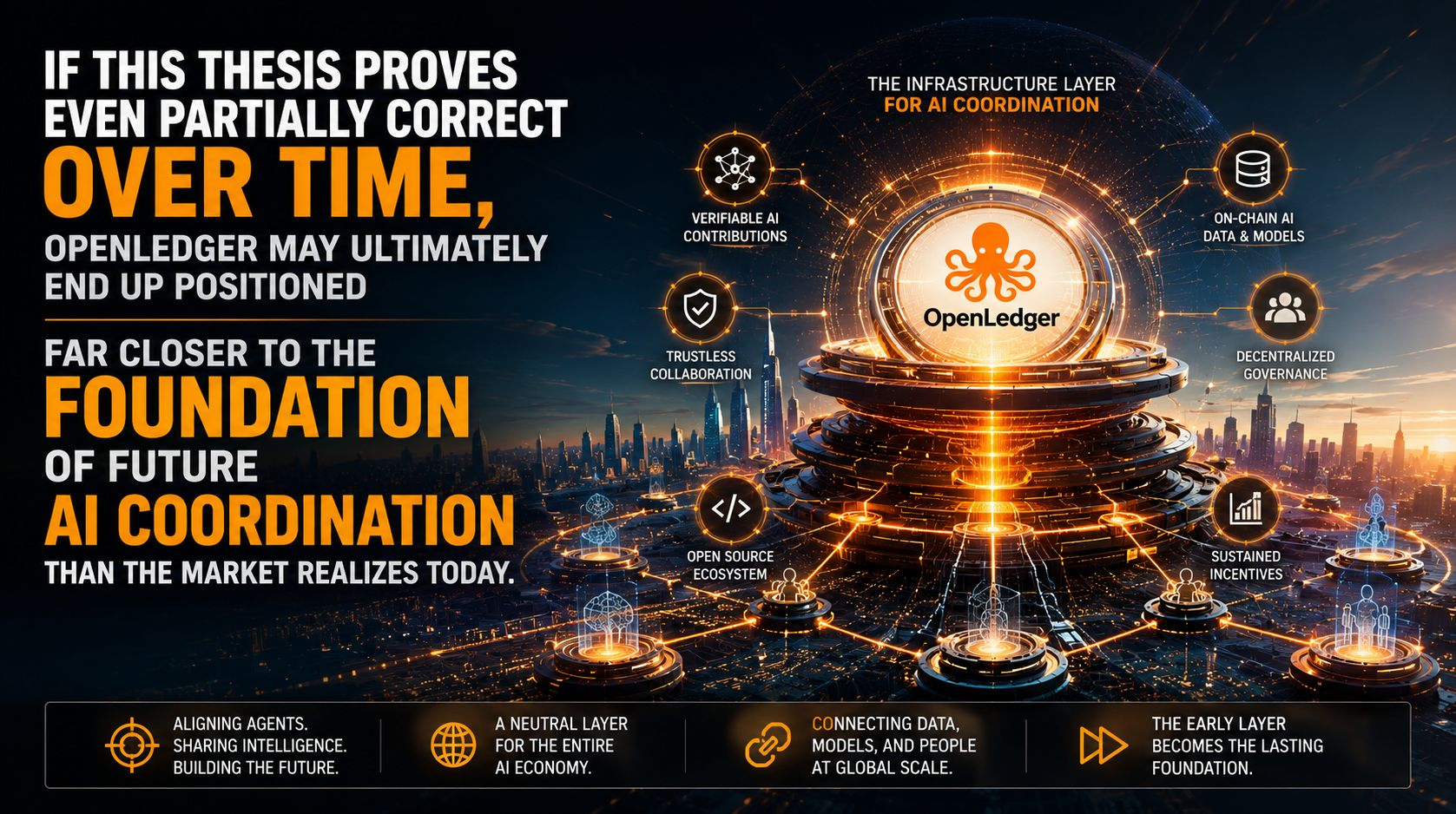
And if that thesis proves even partially correct over time, OpenLedger may ultimately end up positioned far closer to the foundation of future AI coordination than the market currently realizes today.