

The Question Nobody Thought to Ask
When someone has never traded crypto before and wants to get started, where do they go first?
Increasingly, the answer isn't Google. It isn't Reddit. It's ChatGPT, Claude, Gemini, or another large language model — typed into a chat window with a question like: "Which crypto exchange should I use?"
For hundreds of millions of users, AI assistants have become the first point of contact for financial decision-making. And yet, until now, almost no systematic research has examined what those AI assistants actually say when asked about crypto exchanges — and whether their answers reflect the real landscape of the market.
DeFiLlama Research set out to answer exactly that question.
How the Study Was Conducted
The research team ran 120 outputs across four leading large language models: Claude Opus 4.7, GPT-5.4, Gemini 3 Flash, and Qwen 3.6 Plus.
Rather than asking leading or branded questions, researchers used 30 neutral, unbranded prompts — the kind of genuinely organic queries a first-time user might type. The prompts were run in both English and Mandarin, capturing a cross-linguistic picture of how AI represents the exchange landscape.
The methodology was designed to surface natural AI behaviour: what exchanges does a model recommend when it has no particular reason to favour any one platform?
The Tri-Pillar Hierarchy
The headline finding is striking in its consistency: three exchanges — Binance, OKX, and Bybit — appear in 100% of outputs across all models and all prompts tested.
This finding alone deserves unpacking. Across four different AI systems, built by four different companies, trained on different data, responding in two different languages — three platforms surface every single time. The researchers call this the "Tri-Pillar Hierarchy": a structural concentration in AI's mental model of the crypto exchange market that persists regardless of the model or language used.
Binance stands apart even within this group, capturing approximately 90% of all Top-1 slots — meaning that when an AI is asked to name a single best exchange, Binance appears at the top of that list the overwhelming majority of the time.
Intent Frames: How AI Carves Up the Market
One of the more nuanced findings of the study is that different exchanges don't just appear more or less frequently — they own specific intent frames. When a prompt is framed around a particular user need, certain exchanges consistently surface as the go-to recommendation:
Kraken → Safety and regulatory compliance framing
Bybit → Derivatives and advanced trading framing
Coinbase → Institutional access and U.S. regulatory clarity framing
Binance → General-purpose, highest-volume, broadest asset selection
This means AI isn't simply listing the same exchanges every time — it's pattern-matching user intent to a specific exchange identity. The exchange that gets recommended depends substantially on how the question is framed, even when the underlying request is functionally similar.
The Gap Between AI's Picture and Reality
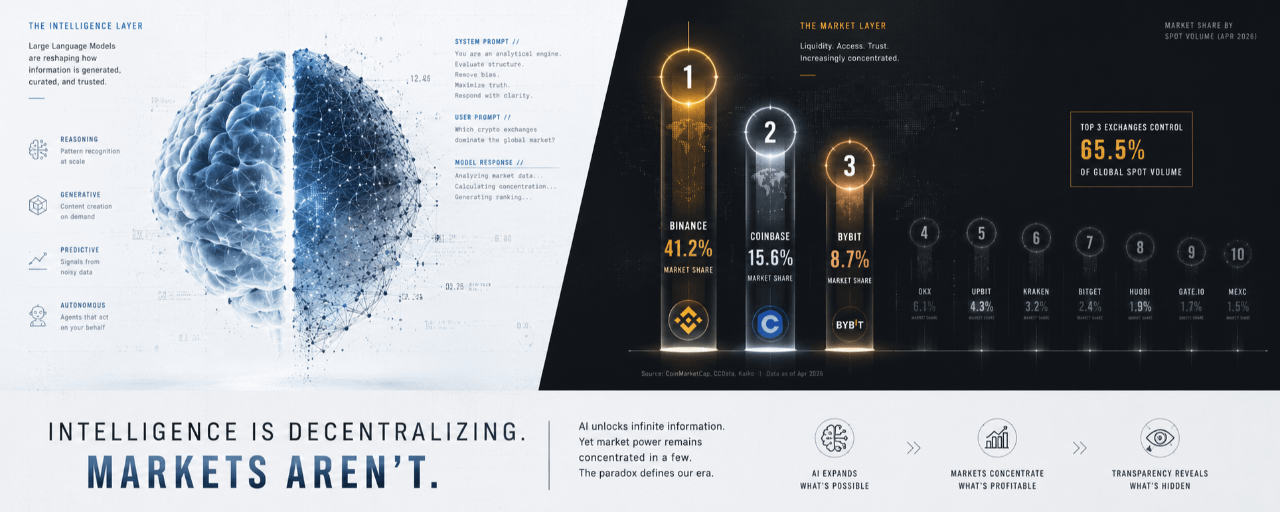
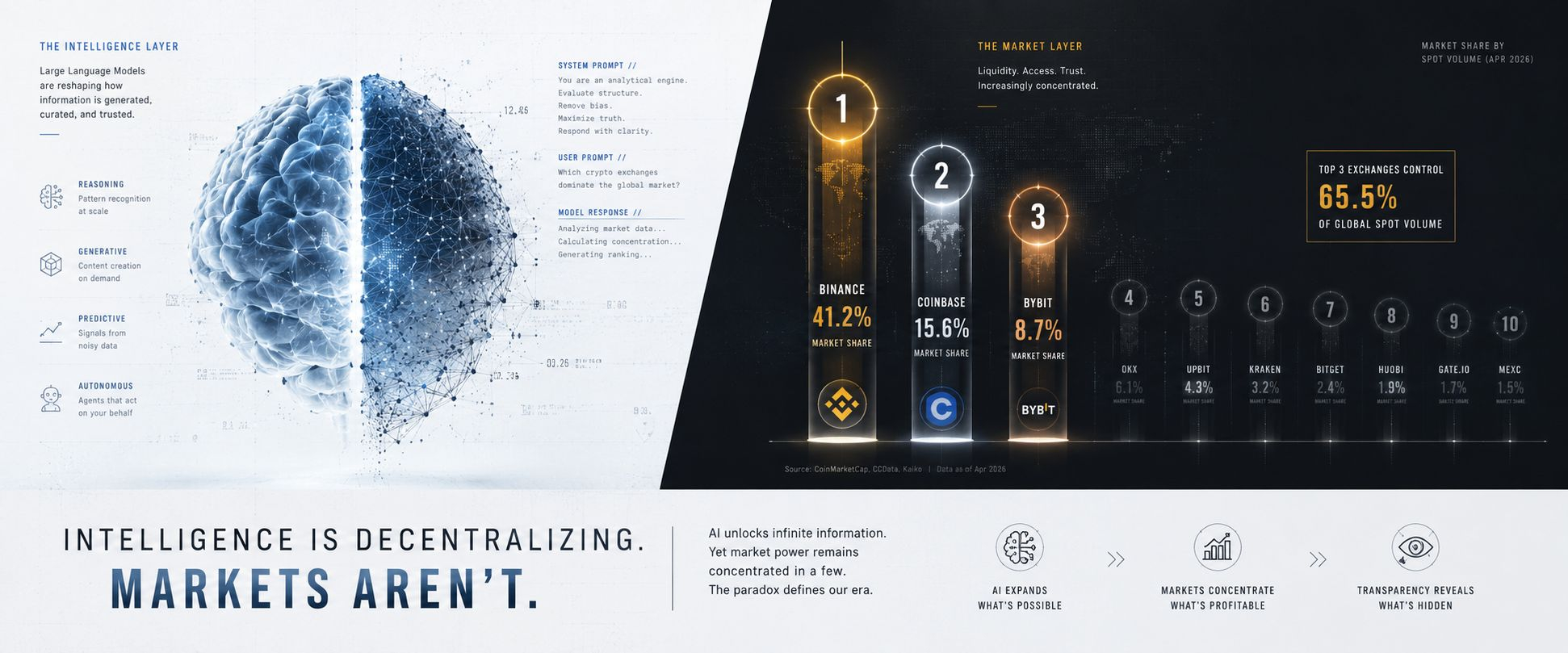
Perhaps the most important finding is structural: AI's picture of the crypto exchange market is significantly more concentrated than the actual trading volume landscape.
Real trading volumes are distributed across a wider range of platforms than AI outputs suggest. Exchanges with substantial market presence, active user bases, and strong regional dominance appear far less frequently in AI recommendations — or don't appear at all — despite representing a meaningful share of actual trading activity.
This gap has real consequences. For users relying on AI to navigate a first decision about where to trade, the map they receive may be materially incomplete. The exchanges they never hear about aren't necessarily worse — they're simply not part of AI's training-derived consensus.
What This Means for the Next Era of Crypto Discovery
The DeFiLlama study arrives at an important moment. As AI assistants become the primary interface through which millions of people discover financial products and services, the biases embedded in those systems — whether intentional or emergent — become structurally significant.
A few implications worth considering:
For users: Understanding that AI recommendations reflect training data consensus — not independent analysis — is essential. The exchange an LLM recommends most frequently isn't necessarily the best fit for your use case, geography, or risk tolerance. Treat AI as a starting point, not a verdict.
For exchanges: AI visibility is becoming a new axis of competition. Organic presence in AI training data — driven by media coverage, documentation quality, community discussion, and third-party analysis — increasingly determines whether a platform gets surfaced at all in the AI-mediated discovery funnel.
For the industry: The concentration finding raises questions about how AI-driven discovery will shape market structure over time. If three exchanges capture 100% of AI mentions, and AI becomes the primary discovery mechanism for new users, the implications for competitive dynamics are significant.
The Bigger Picture
The DeFiLlama study is, at its core, a map of how AI sees the crypto world — and a reminder that AI's picture is a product of the data it was trained on, not a neutral assessment of the current landscape.
In a space that changes as rapidly as crypto, the gap between what AI "knows" and what is currently true can open up quickly. The exchanges that dominate AI's mental model today are largely those that dominated headlines and community discussion during the period that training data was collected. New entrants, regional leaders, and platforms that have grown quickly in recent cycles may be structurally underrepresented regardless of their current market position.
For anyone making decisions about where to trade — whether they're a first-time user asking an AI chatbot or an institutional team evaluating platforms — the DeFiLlama study is a useful reminder: the most prominent answer isn't always the most complete one.
Read the full DeFiLlama Research report at defillama.com/reports.