
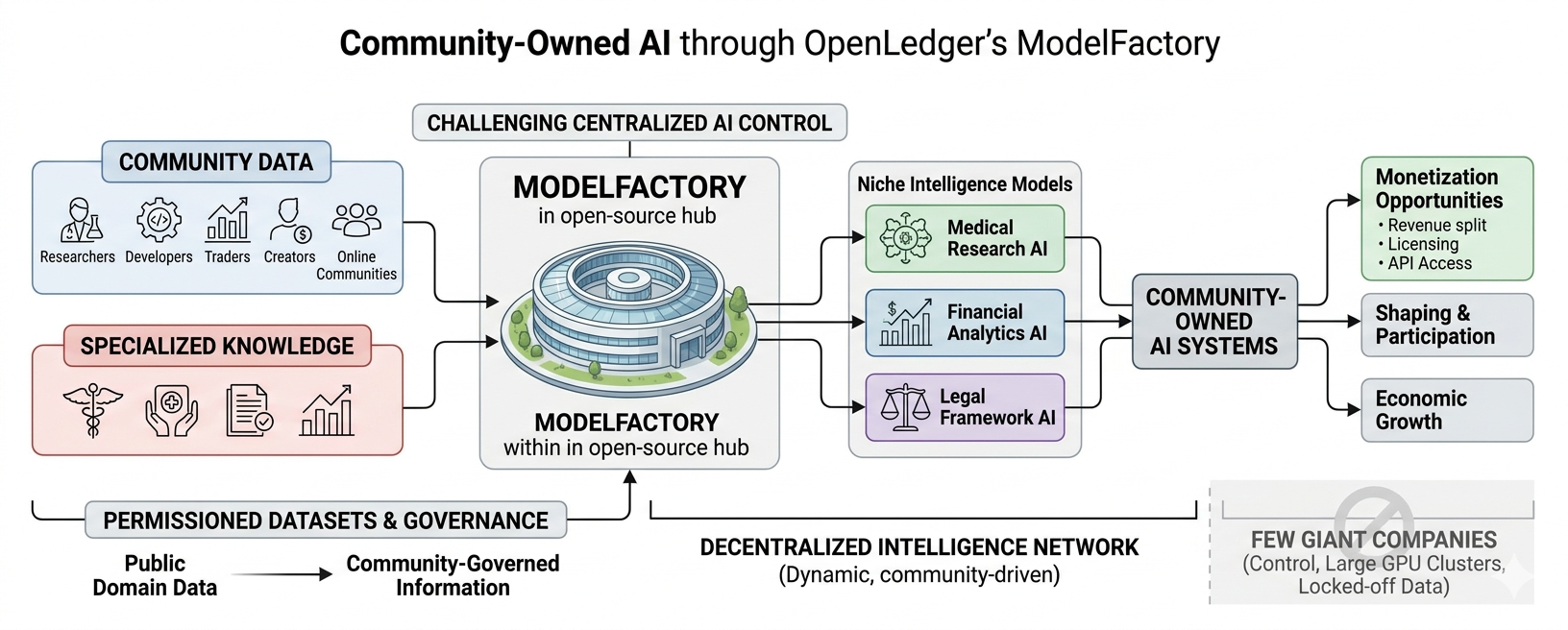
For years, artificial intelligence felt like a space controlled by a very small group of companies with enormous amounts of money, infrastructure, and technical talent. Building or fine-tuning AI models wasn’t something ordinary developers, smaller startups, researchers, or online communities could realistically participate in. The costs were simply too high. Training infrastructure required massive GPU clusters, highly specialized engineers, and access to large datasets that most people didn’t have. Over time, the AI industry naturally became concentrated around a handful of major players, and people slowly started accepting that as normal. If you wanted to build advanced AI systems, you needed the resources of a giant lab. That became the standard assumption.
But the more AI evolves, the more that structure starts to feel incomplete. What’s interesting is that most of the raw material powering modern AI doesn’t actually come from those large companies alone. It comes from people and communities across the internet. Researchers publish papers. Developers contribute code. Traders share analysis. Creators upload content. Entire online ecosystems continuously generate valuable information every single day. All of that eventually becomes data, and data is the foundation of AI systems. Yet the communities producing that value are usually not the ones benefiting from the intelligence built on top of it. That imbalance is becoming harder to ignore, especially now that AI is turning into real infrastructure for the digital economy.
This is the angle where OpenLedger’s ModelFactory becomes genuinely interesting. Instead of treating AI creation as something reserved only for billion-dollar companies, ModelFactory pushes a different idea. If a community owns valuable datasets or contributes specialized knowledge, maybe that same community should also have the ability to build AI systems from it. Not just use AI, but actually participate in creating it, shaping it, and potentially monetizing it. The idea sounds simple on the surface, but it carries major implications once you think about it carefully. It changes the relationship between communities and AI itself.
One of the most important things about ModelFactory is that it focuses heavily on specialized intelligence rather than trying to compete directly with giant universal AI systems. For a while, the AI industry became obsessed with building increasingly massive general-purpose models trained on enormous amounts of internet data. Bigger models became the goal. But in real-world situations, companies and communities often care far more about specialization than broad general knowledge. A medical research group doesn’t necessarily need an AI trained on random internet conversations. It needs systems deeply familiar with medical datasets, clinical language, and verified research. A financial analytics community may need models optimized for on-chain data and market behavior. Legal organizations may require systems trained around regional regulations and specific legal frameworks.
That’s where specialized AI becomes extremely valuable. Smaller focused models trained on high-quality datasets can often outperform larger systems in niche environments because the information is cleaner, more contextual, and far more relevant. More data doesn’t always create better intelligence. Sometimes it simply creates more noise. Anyone who has worked closely with data understands this quickly. A carefully curated dataset with strong contextual value can become far more powerful than massive amounts of loosely organized information. ModelFactory leans into this idea by creating infrastructure where communities can organize permissioned datasets and potentially transform them into useful AI systems.
The concept of permissioned datasets is especially important here. For years, internet platforms collected information under systems where users had little control over how their data was eventually used. AI accelerated that model even further because information suddenly became one of the world’s most valuable digital resources. Now people are beginning to ask much harder questions about ownership, attribution, licensing, and participation. If communities create valuable knowledge collectively, should they have some say in how that knowledge becomes AI infrastructure? ModelFactory moves toward a framework where datasets can exist under agreed governance structures rather than being treated as open resources with no ownership layer attached to them.
That shift changes the economics of AI in a very meaningful way. Right now, most AI value flows toward centralized companies because they own the infrastructure stack. Communities contribute data indirectly through activity, engagement, content creation, research, and discussions, while corporations monetize the resulting intelligence systems. ModelFactory introduces another possibility where communities themselves could participate in licensing, API access, AI-powered products, enterprise integrations, and other economic opportunities tied to specialized models built from their own datasets. Once financial incentives become connected to data ownership, the entire structure around AI participation starts changing.
This is also one of the reasons decentralized AI discussions increasingly overlap with blockchain infrastructure. Blockchain technology is fundamentally about coordination, ownership, transparency, and contribution tracking. AI, meanwhile, is becoming one of the most valuable infrastructure layers in the digital economy. Eventually those two worlds were naturally going to intersect. Communities are beginning to realize that the information they collectively generate may carry significant economic value when transformed into intelligence systems. That realization alone could reshape how online ecosystems operate over the next decade.
At the same time, none of this removes the difficult realities involved in AI development. Building reliable AI systems remains extremely hard. Compute infrastructure is still expensive. Fine-tuning models still requires technical expertise. Governance systems can become complicated very quickly. Poor-quality datasets create unreliable outputs, and privacy concerns remain one of the largest unresolved issues in AI development today. Permissioned data systems sound promising, but they also introduce difficult questions around compliance, intellectual property, and security. These are not small challenges, and projects operating in this space will need to solve them carefully if they want long-term trust and adoption.
There is also the reality that major AI companies continue moving extremely fast. Organizations with enormous capital and infrastructure advantages are unlikely to lose their dominance overnight. That’s why the future of AI probably won’t become a simple battle between centralized and decentralized systems. More realistically, the ecosystem may become layered. Large general-purpose foundation models may continue handling broad intelligence tasks while smaller community-driven systems specialize in narrow expertise and highly contextual applications. That outcome feels far more realistic than a total replacement of existing AI giants.
One of the most fascinating parts of this entire shift is how communities themselves are evolving. For years, internet communities mainly produced content and engagement. AI changes the equation because information itself can now become trainable intelligence. That transforms communities into potential intelligence networks. A biotech research collective with years of curated scientific data may eventually create highly valuable AI systems within its niche. Trading communities with structured market analysis may train specialized financial agents. Educational groups could build regional tutoring systems optimized for local languages and curriculums. Even smaller gaming ecosystems are beginning to understand the value of their behavioral datasets.
The internet rewarded scale for a very long time, but AI may start rewarding context and specialization just as much. Niche expertise could become one of the most valuable resources in the next generation of digital infrastructure. That possibility changes how people think about ownership online. Communities may no longer remain passive contributors feeding centralized platforms. They could become direct participants in the intelligence economy itself.
Real success for ModelFactory probably won’t look flashy in the beginning. It likely won’t come from hype cycles or temporary excitement. The strongest signs of success would actually look much quieter. Communities building useful niche models. Researchers monetizing specialized intelligence responsibly. Smaller organizations accessing AI infrastructure previously out of reach. Permissioned datasets functioning without completely giving away ownership. Those are the kinds of developments that signal real infrastructure growth rather than speculation.
AI is slowly becoming embedded into nearly every digital system around us, from education and healthcare to finance, software, automation, and research. Once intelligence becomes infrastructure, ownership becomes far more important than people initially realize. The first phase of modern AI belonged mostly to giant centralized labs with overwhelming resource advantages. That phase is still continuing, and probably will for years. But underneath it, another layer is starting to emerge — slower, more experimental, and far more community-driven.
That’s ultimately where OpenLedger’s ModelFactory fits into the larger picture. Not as a magical replacement for major AI labs, but as an attempt to widen participation before the intelligence economy becomes completely concentrated in the hands of a few powerful companies. And honestly, if communities eventually gain the ability to transform their own datasets into meaningful AI systems, products, and economic opportunities, that shift could become much bigger than most people currently expect.